


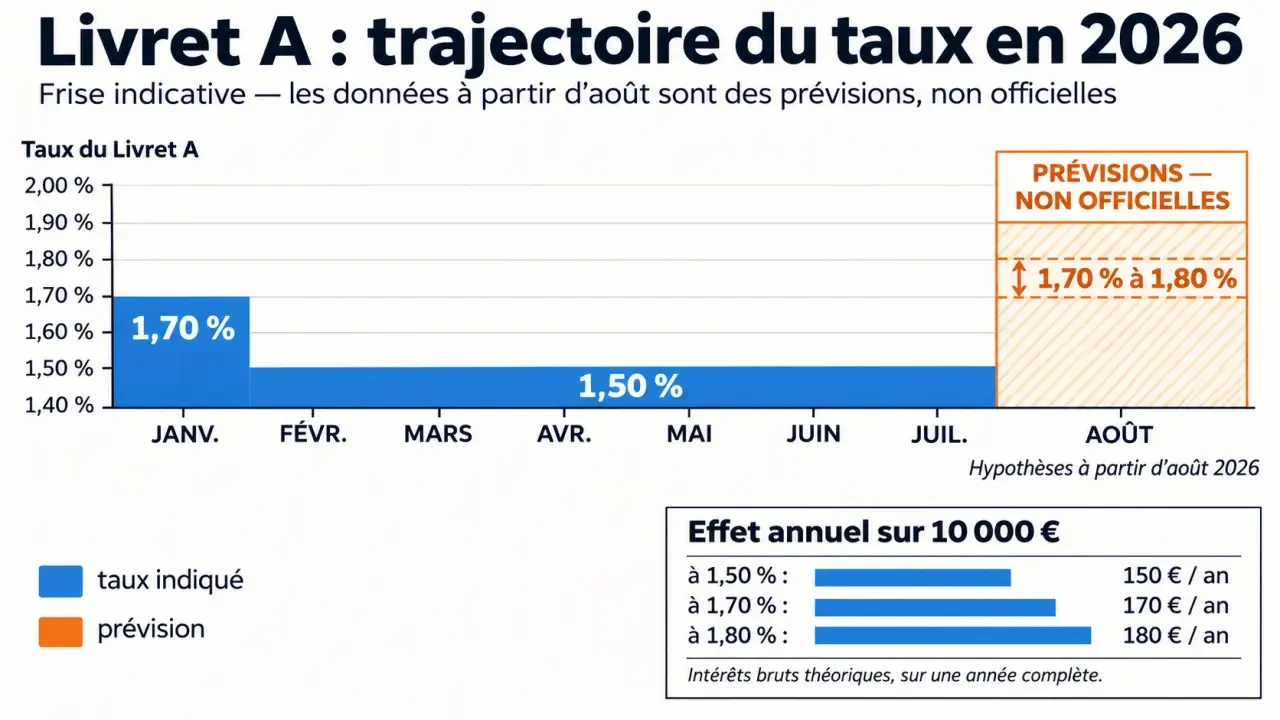
The Book A rate is 1.5% per year since 1 February 2026, compared with 1.7% before. For August 1, 2026, estimates suggest an increase of 1.70 per cent or 1.80 per cent. However, these projections are not a formal decision: the announcement is expected around 15 July. Here are the dates to distinguish and the concrete consequences for your savings.
Applicable rates and assumptions for August 2026
According to Service-public.fr and the Ministry of Economy, the remuneration of Book A was lowered to 1.5% on 1 February 2026. The rate of 1.7% remained applicable until 31 January. The decrease therefore represents 0.2 percentage point, not a 0.2% decrease in interest.
The usual schedule includes two annual revisions, on 1 February and 1 August. A distinction must therefore be made between the actual rate and the anticipated rate published before the next deadline.
| Period | Annual rate of Book A | Status |
|---|---|---|
| 1-31 January 2026 | 1,7 % | Applicable rate |
| 1 February to 31 July 2026 | 1,5 % | Officially fixed rate |
| From 1 August 2026 | 1.70 % to 1.80 % envisaged | Forecasts to be confirmed |
Better rates Placement evokes a range of 1.70 to 1.80 %, while Le Monde also mentions the 1.80 % hypothesis. An announcement around 15 July would allow to know the rate chosen for August. A possible increase would not retroactively affect the remuneration of previous months.
To verify the final figure, prefer the publications of the Ministry of Economy and Public Service.fr. The effective date counts as much as the advertised rate: a forward-looking item may present an estimate without it being still applicable.
Inflation and €ster: the two drivers of remuneration
The rate of Book A does not depend solely on the rise in prices. Its regulatory formula combines inflation and a short-term interest rate in the euro area, the€Ste. It is based on semi-annual averages, which avoids the direct impact of each monthly change.
An average that explains the lag with prices
The calculation is based on the average between non-smoking inflation and the rate of €This is the case for the reference semester, with rounding and floor rules. L€Ster reflects the cost of borrowing in euro on a daily basis on the money market. In particular, it operates under the influence of the monetary policy of the European Central Bank.
For the August revision, MeilleurRates Placement refers to an expected average inflation of 1.6% over the first six months of 2026, compared with 0.89% in the previous six months. The Journal du Net quotes a €This figure is set at 2.1%, according to the ECB. These indications shed light on expectations of an increase, but a rate observed on an ad hoc basis does not replace a definitive semi-annual average.
The Bank of France proposes, the Ministry decides
The Bank of France calculates and recommends regulated savings rates. The Ministry of Economy then fixes them. In exceptional circumstances, a derogation from the formula can be retained: the mathematical result is therefore not, on its own, an official announcement.
SARA illustrates this policy space. By February 2026, the Ministry of Economy reported that the formula would have led to 1.9%. The rate was finally set at 2.5%, i.e. additional support for 0.6 percentage point to popular savings.
Interest in euro: measuring the real effect of an increase
A rate of 1.5% is an annual remuneration, not a 1.5% return between February and July. To simply measure the effect of different rates, here are simulations over an entire year, with constant capital. They do not constitute the exact calculation of interest for the year 2026.
| Placed sum | 1.5% year-on-year | 1.7% year-on-year | 1.8% year-on-year |
|---|---|---|---|
| 1 000 € | 15 € | 17 € | 18 € |
| 5 000 € | 75 € | 85 € | 90 € |
| 10 000 € | 150 € | 170 € | 180 € |
For EUR 10 000, the increase from 1.5% to 1.8% represents an additional EUR 30 over 12 months. If this change only occurs in August, the supplement only concerns the end of the year. The amount actually collected also depends on the dates of payment and withdrawal, the interest being calculated by fifteen.
In Le Monde, Philippe Crevel estimates the gain at 23 euros over one year for an outstanding amount of 7,800 euros, and nearly 10 euros over the year 2026. This example shows why an increase of a few tenths of a point remains modest in euros. As a benchmark, the average outstanding amount quoted by the Caisse des dépôts is 7,500 euros.
To estimate your annual remuneration, separate the rate periods: January at 1.7%, February to July at 1.5%, and August to December at the rate officially withheld. Applying the August rate only to any year would overestimate or underestimate your interest.
Real return is also seen as a shadow of inflation
The nominal rate is the interest credited to the booklet. The real return measures the evolution of the purchasing power of this savings. When prices increase faster than remuneration, capital increases in euros but allows less goods and services to be purchased.
With a remuneration of 1.5 per cent and an inflation of 1.8 per cent over the same annual period, the real return would be about -0.3 per cent. However, it is necessary to compare consistent periods: monthly inflation expressed over one year is not enough to establish the final balance sheet of savings throughout the year.
There is also an inflation that remains in the shadow of your next purchase. If your Booklet A finances a car, work or move, the price of this project may change other than the general index. For short-term planned spending, check the budget or estimate regularly. Your real goal is not only to raise the balance of the booklet, but to keep the necessary amount at the time of payment.
This distinction does not remove from Book A its precautionary saving role. Availability of funds, State guarantee and tax exemption remain useful even when the actual yield is low.
Booklet A, LDDS or SARA: What priority for your savings?
The LDDS is paid at the same rate as Book A: moving money from one to another does not therefore improve the yield. SARA, on the other hand, deserves a verification of eligibility, since it offers higher remuneration under conditions of income and tax domicile.
- Book A: 1.5 % since February 2026, with possible revision in August.
- LDDS: 1.5 % since February 2026, aligned with Booklet A.
- SARA: 2.5 % since February 2026, compared with 2.7 % until 31 January.
Better rates Placement is considering a 2.80 per cent SARA in August, but this assumption remains to be officially confirmed. Interest on these regulated booklets is exempt from income tax and social levies.
In practice, first check your access to SARA, and then scale your available reserve according to your expenses and projects. A change in rates alone does not justify placing necessary short-term savings on a risky or immobilized medium.