


The rental return returns annual rents to the amount invested in a dwelling. But an attractive gross rate does not say what remains after expenses and taxes, nor how much you will have to pay each month to repay the credit. To judge an investment, calculate the gross, net and net results successively, then compare these results with financing and rental risk.
From the total cost, not only from the price of the advertisement
The rental yield measures rental income relative to the cost of the property. The Overall profitability goes further: it also takes into account the evolution of its value, the resale costs and the duration of its holding. A dwelling can therefore produce satisfactory rents while causing a loss of value on exit.
To compare two ads, always use the same denominator: the total cost of acquiring and leasing. Add the purchase price, notary fees, agency fees at your expense, initial work and possible furnishing. Avoid counting twice the fees already included in the price displayed.
An apartment purchased 200,000 € and leased 900 € per month displays so 5.4% gross on price alone (900 × 12 ÷ 200 000) × 100. If costs and works bring the investment to 225 000 €, gross return on total cost falls to 4.8%. Housing has not changed, but the measure has become more realistic.
Keep funding costs separately. This distinction makes it possible to assess first the performance of the property, then that of your banking installation, without mixing real estate return and return on equity.
Moving from gross return to net net with consistent formulae
The names sometimes vary according to the calculators. To avoid misleading comparisons, specify whether your result is calculated before or after financing, and on theoretical rents or actually cashed.
| Indicator | Annual formula | Utility |
|---|---|---|
| Theoretical rough | (Monthly rent excluding charges × 12 ÷ total cost) × 100 | First sort of ads |
| Net before financing | [(rents received - owner's charges) ÷ total cost] × 100 | Operational performance |
| Net-net before financing | [(rents received - ownership charges - rental taxes) ÷ total cost] × 100 | Income after tax |
Reduce actual expenses to the owner
Retain non-recoverable co-ownership charges, off-site property tax collected from the tenant, proprietary insurance, management fees and any unpaid rent insurance. Add a realistic envelope for equipment maintenance and replacement. The tenant's allowances for expenses do not constitute additional income.
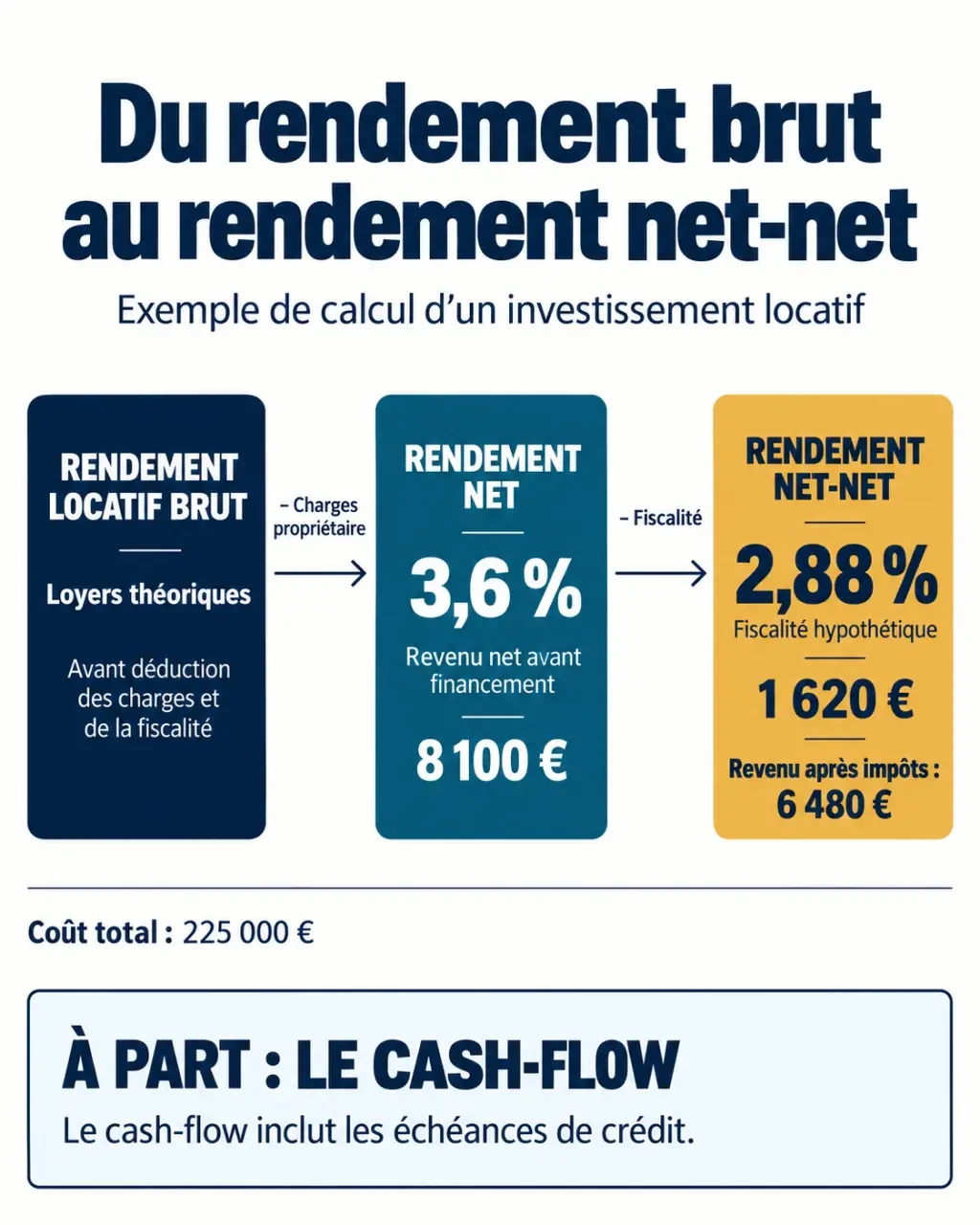
In our example, suppose a fully rented year and 2,700 € annual expenses incurred by the lessor. Net income before financing reaches 8,100 €either 3.6% of 225 000 €. These amounts are simulation assumptions, not market averages.
Calculate the tax according to your situation
The net-net depends on the tax system and your personal situation. The bare lease is a property income, including the micro-subsidy or the real regime under conditions. Furnished rental is an industrial and commercial benefit; LMNP status does not mean automatic exemption. Allowances, deductible expenses and any depreciation are governed by separate rules.
If the tax attributable to the lease is assumed to be 1,620 € in our example without credit, after-tax income becomes 6,480 €2.88 per cent. With a loan, interest can change the tax result according to the plan. Do not deduct the repaid capital as a tax burdenand check the applicable rules before any decision is taken.
Credit changes cash flow, not just return
The cash flow measures the money that actually enters or exits your account. Its annual formula is: rents received - operating expenses - credit maturities, insurance included - rental taxes. Unlike the net return before financing, it therefore includes the repayment of capital.
A negative cash flow means that you finance part of the operation each month. This does not automatically imply bad profitability: a fraction of the monthly payments repay your debt. However, this savings effort must remain compatible with your budget, including for a period without a tenant.
The banking leverage effect allows you to acquire an asset with a limited contribution. It can improve capital performance when economic returns exceed the cost of financing, but it also increases losses. Low intake is therefore not a sign of efficiency alone.
The weather here acts as a two-compartment hourglass: rents arrive gradually, while a work or boiler may require immediate payment. An annual average masks this gap. Build a monthly cash/disbursement schedule to identify the lowest cash point: it is more than a percentage that helps to scale your security reserve.
Compare cities without confusing high yield with secure placement
Generally announced yields range from 4% to 8%, with large variations. However, there is no « good rate » universal: rental demand, building condition, necessary management and ease of resale change the reading of the result.
The benchmarks published by Horiz.io illustrate these differences. In the absence of a measurement date specified here, they should not be considered as discounted quotes or guaranteed returns for a particular dwelling.
| Town | Average gross yield indicated | Price per m2 |
|---|---|---|
| Paris | 3,9 % | 9 850 € |
| Lyon | 4,3 % | 4 580 € |
| Bordeaux | 4,5 % | 4 280 € |
| Marseille | 6,2 % | 3 140 € |
| Perpignan | 9,7 % | 1 510 € |
| Saint-Étienne | 9,8 % | 1 210 € |
Then compare neighborhoods and really similar housing. Check rents, rental times, transport, employment areas and local rules. Also consider the DPE, energy decency obligations, and approved or predictable condominium work.
Rented property nine months instead of twelve loses 25% of its theoretical annual rents. Its gross yield is declining in the same proportion, while certain expenses continue to run: the deterioration of net income may be more marked.
Test the project until resale before making an offer
A spreadsheet or simulator is useful if its assumptions remain visible and editable. Prepare three scenarios: central, favorable and degraded. Variate the vacancy, maintenance costs, exceptional work and resale price, rather than assuming an automatic increase in rents and prices.
- Control revenue: rent excluding realistic charges, applicable ceilings and periods without rental.
- Document the costs: property tax, condominium accounts, estimates, management, insurance and financing.
- Test your resistance: maximum monthly effort and reserve available after acquisition.
- Prepare the exit: selling time, fees, possible taxes and capital remaining due.
To compare different horizons, the TRI, or internal rate of return, takes into account the dates of your contributions, net flows and resale proceeds. The VAN, or net present value, updates these flows at the rate of return you require; a positive value indicates that the scenario exceeds this requirement.
These indicators remain dependent on assumptions. Before purchasing, have the uncertain tax or technical points checked by a competent professional. A solid project must remain bearable without hypothetical surplus value and without permanent occupation of housing.