


The PEA Trade Republic is particularly interested in savers who wish to invest regularly in shares or ETFs, with scheduled plans announced without brokerage fees. However, its interest depends on the securities sought, the amount invested and the conditions of execution. Before opening or transferring, you must distinguish the displayed price from the actual cost and check that the automation corresponds to your budget.
A tax envelope for long-term investment
The EAP allows the holding of eligible shares and funds within a specific tax framework. At Trade Republic, it is integrated into an application that also offers other accounts. The EAP remains legally and fiscally separate from the ordinary securities account A title available in the application is therefore not necessarily accessible in this envelope.
The terms of subscription quoted by Le Parisien are the majority and the French tax residence. A taxpayer may hold only one conventional APE. If you already have one, the approach to consider is a transfer, not a second opening.
Ceiling and taxation: key benchmarks
The ceiling for payments from the conventional EAP is 150 000 €, excluding gains realized in the plan. After five years, earnings benefit from an income tax exemption, but remain subject to social contributions. The Parisian mentions a rate of 17,2 %, to be checked according to applicable regulations and your situation. The consequences of a withdrawal depend in particular on the age of the plan; after five years, withdrawal usually results in closure, with exceptions.
This favourable taxation does not protect against stock market declines. The EAP is suitable for savings that you can immobilize over a long period of time, without placing your reserve for unforeseen expenses.
Check titles instead of counting the catalogue
Capital earns about 2 000 eligible actions and ETFs on the platform. The Parisian evokes about 140 ETF, without specifying a directly comparable perimeter. These figures are not enough to confirm the presence of a specific fund: look for its ISIN code and its eligibility in the application. Some synthetic ETFs allow exposure to S&P 500 or NASDAQ while respecting the conditions of the AEP.
The fees displayed do not represent the full cost
The rates reported by Capital and Le Parisien provide benchmarks, but the contractual grid presented before subscription must take precedence. In particular, check opening fees, one-off orders, transfers and any specific transactions.
| Operation | Tariff reported | Attention |
|---|---|---|
| Opening | 1 € according to Le Parisien | To be confirmed under current conditions |
| Classic order from 200 € | 1 € | Excluding indirect costs |
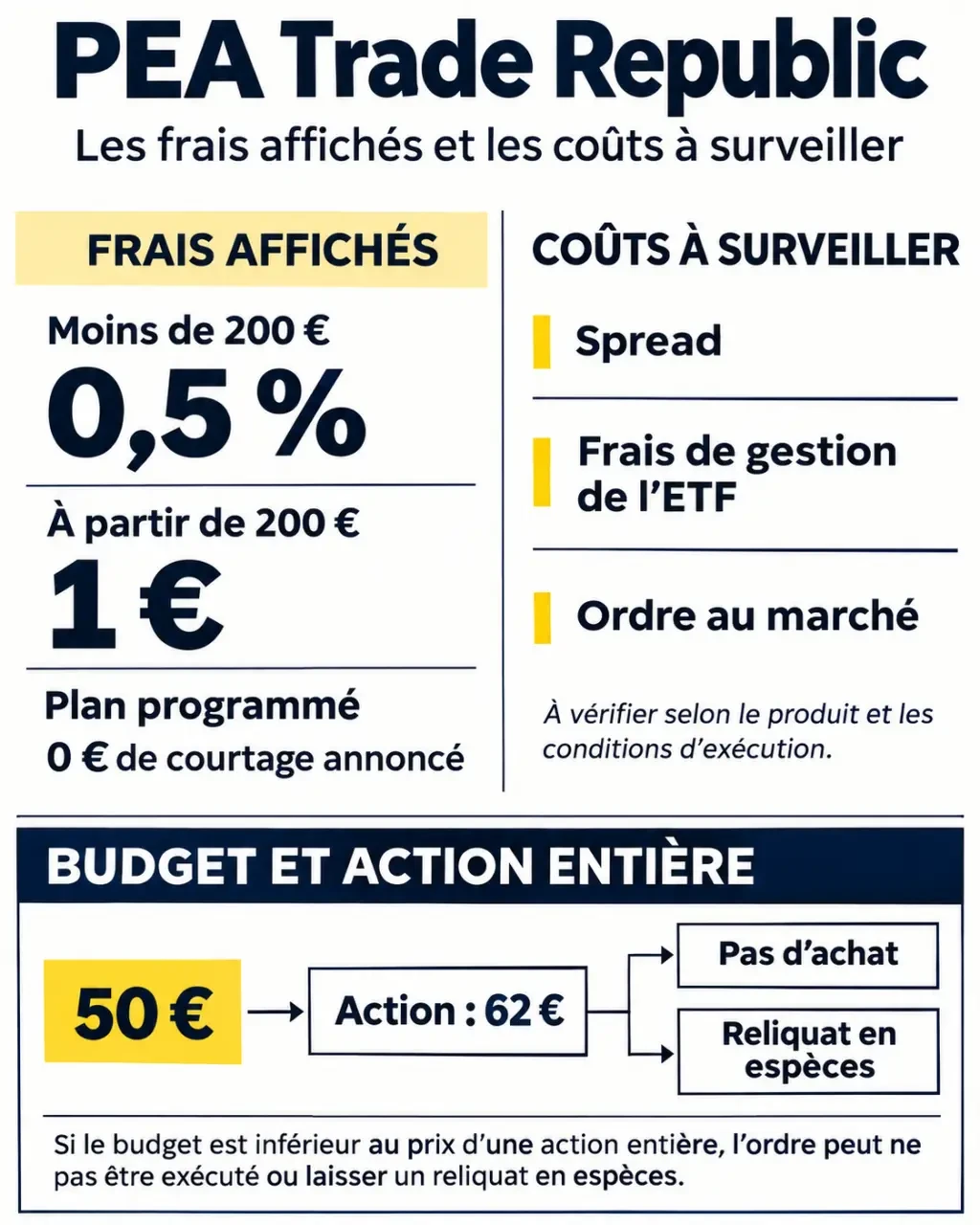
| Order less than 200 € | 0.5% according to Capital | An order of 12 € represents 0.06 € brokering |
| Programmed plan | 0 € announced brokerage | Fund costs and spread remain |
The Parisian also indicates that accountancy, inactivity and payments are free of charge. Capital mentions the absence of a minimum order. This does not mean that any money can buy any title: the purchase of an entire unit remains an important constraint of the EAP.
Spread and execution place deserve your attention
The spread is the difference between the best buyer price and the best seller price. This is not a separate commission, but it influences the economic cost of buying. Another item is the management costs of an ETF, which are included in its value.
Capital reports an execution via LS Exchange, rather than directly on Euronext. Its analysis highlights generally more favourable conditions on liquid ETFs during the Euronext timetables, cited above. 9 a.m.-5.30 p.m.. The spread may be less favourable on or off a little traded title. A limited order allows a maximum purchase price to be fixed, without guaranteeing its execution.
Scheduled plans: a useful discipline, with entire purchases
The principle is to select an eligible action or ETF and then define an amount and frequency. Capital described four frequencies : weekly, twice a month, monthly or quarterly. Check the proposed feeding arrangements: The article indicates that a drawdown from the current account can be used when the AEP species are insufficient.
This method, often called DCA, allocates purchases over time and reduces the temptation to constantly wait for « good time ». It does not guarantee a better return than immediate investment or loss protection.
A planned budget does not guarantee a purchase
According to Capital, plans purchase as many whole securities as possible within the budget. There is no purchase of shares in the described PEA. If your amount does not cover a unit, the purchase cannot be made. If more than one unit is purchased, part of the budget may remain uninvested.
Think of the amount programmed as the needle of a gauge: it must stay above the price of one part, not just the day of setting. An increase in the price may make a previously adjusted budget inadequate. To limit deadlines without purchase, periodically check the relationship between your payment and the unit price, or study a comparable ETF that is more accessible, without sacrificing its quality.
Finally, the plans described by Capital are implemented at market prices, not at limited prices. You automate a calendar and budget, not a specific purchase price.
Open or Transfer: two steps not to be confused
The route reported by Le Parisien begins with the creation of a Trade Republic account, with a cash account and an ordinary securities account, and then activation of the PEA. The interface can evolve: follow the steps displayed in the application and check the selected envelope before any payment or order.
- Prepare your ID and tax residence information.
- Create your access and perform the required checks.
- Consult the terms and conditions of the EAP and the rate schedule.
- Choose the opening or transfer depending on your situation.
- Control the activation of the plan before your first investment.
Capital refers to an opening announced in five minutes. This entry time does not guarantee immediate validation of the file.
For an existing PEA, Parisien reports an indicative deadline of one to three months. A transfer retains the fiscal anteriority of the plan, unlike a closure followed by a new opening. Check previously the acceptance of each line, the departure fees, their possible reimbursement and the availability of transactions during the transfer. Do not close your old PEA to simplify the process.
Facing BoursoBank or Fortuneo, compare your actual use
Trade Republic deserves to be studied if you prefer regular automated purchases on securities actually available. For manual orders, less liquid securities or a need for accompaniment, brokerage alone does not separate offers.
Compare with BoursoBank, Fortuneo or another broker on the same basis:
- your usual amounts and the number of monthly orders;
- the specific ETFs sought and their availability for planned investment;
- Order types, execution places and schedules;
- transfer fees and possibilities to reach customer service.
Capital referred to eight BoursoInvest funds in his comparison with BoursoBank: this figure concerns this particular offer, not all the titles available in his PEA. As catalogues and tariffs evolve, a relevant comparison should cover the current conditions. The right choice is one that allows you to execute your strategy simply, at a controlled cost, without imposing embarrassing compromises on titles or orders.