
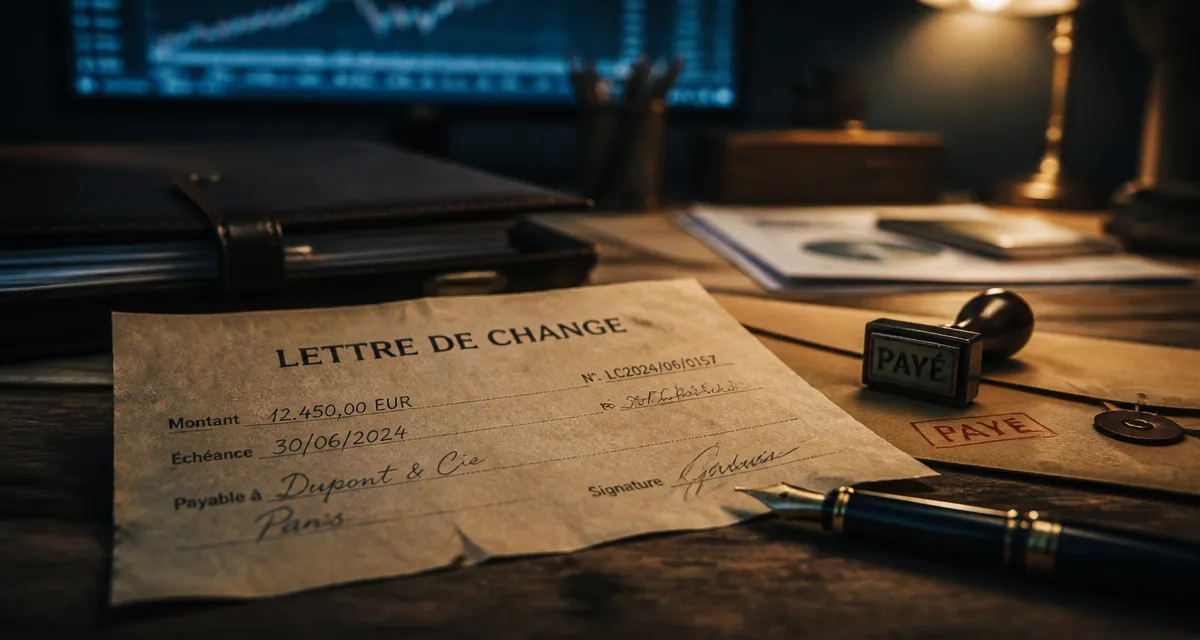

Payment by draft, although less common than bank transfer in day-to-day transactions, remains a structuring tool for inter-firm financial management. This trade effect legally binds a supplier and its customer, formalizing a settlement commitment at a specified time. Mastering this mechanism allows companies to secure their cash flows and to frame their business relationships rigorously.
What is a milking and how does it work?
In professional language, the term « trafficking » means the Letter of exchange. This is a written document by which the shooter (the creditor or supplier) orders the drawer (the debtor or customer) to pay a specified amount on a fixed date, either to himself or to a third party.
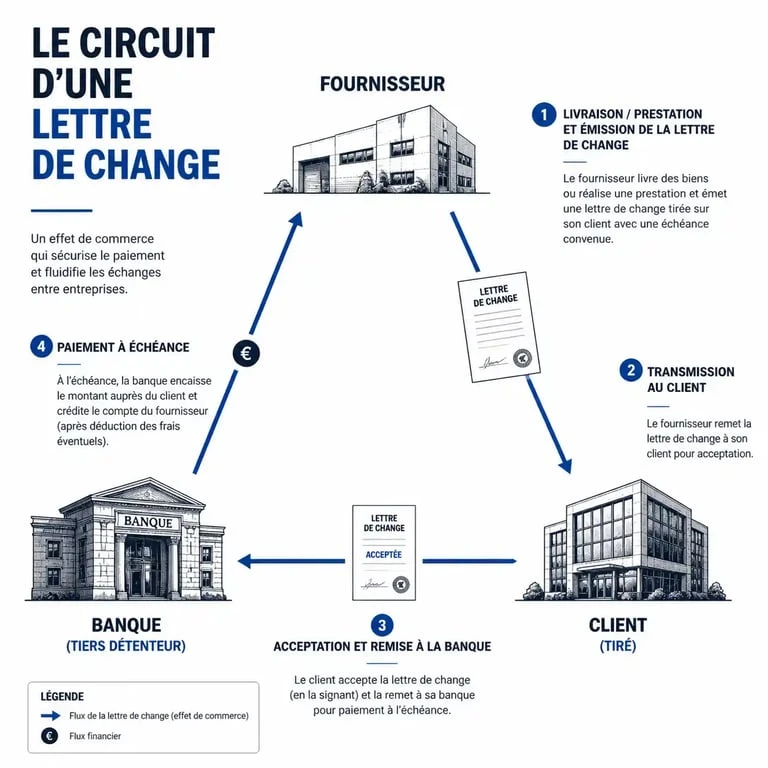
The three actors involved in the operation
The milking circuit consists of three distinct parts:
- Shooter: The company that sold a property or a performance. It issues the trade to materialize its claim.
- The shot: The debtor client. By signing the trade, he recognizes his debt and undertakes to settle it at maturity.
- The beneficiary shall: Often the shooter himself. The supplier may, however, designate its bank as a beneficiary to facilitate cash flow or to obtain an advance of funds.
A bill of exchange or a promissory note?
Although the term « trafficking » is used generically, there is a difference with the promissory note. The note of exchange is issued by the creditor, while the promissory note is issued by the debtor himself. In both cases, this trade effect ensures maturity planning.
Mandatory information for legal validity
Payment by draft is regulated by the Commercial Code. In order for a bill of exchange to be valid and enforceable, it must contain precise information. The absence of any of these statements results in the nullity of the trade effect.
| Mandatory | Description |
|---|---|
| Name « Letter of exchange » | Must be included in the text of the title. |
| Mandate to pay | Accurate amount written in numbers and letters. |
| Name of the shot | Full identity of the debtor. |
| Deadline | Specific date of payment. |
| Place of payment | Bank details (BRI) of the shot. |
| Date and place of issue | Essential for calculating legal deadlines. |
| Shooter signature | Validation of the payment order. |
The acceptance by the drawing, translated by its signature on the document, is not a condition of validity of the title, but it is necessary for the client to be engaged « change ». Without this signature, the supplier holds a claim, but does not benefit from specific guarantees of the law of trade effects.
Time management and cash flow: the strategic aspect
Payment by process regulates financial flows. By setting a precise deadline, it allows for the exact date of availability of funds. Unlike the cheque, cashable upon receipt, the draft offers visibility on future receipts. It allows the treasurer to anticipate his financing needs, transforming payment uncertainty into a date-specific certainty. This time alignment between delivery and settlement ensures the stability of the operating cycle.
Discount: turning a transaction into cash
The supplier may usebank discount to obtain funds before maturity. He « sells » the trade effect to its bank, which pays the amount after deduction of commissions and dagios. It is an effective short-term financing tool to address a lack of liquidity.
Endowment and traffic
The bill of exchange is a negotiable document. By the mechanism ofendorsementa supplier may use a draft he holds to pay his own creditor by signing on the back of the document. This power of circulation makes trafficking a quasi-currency between professionals.
Risks and procedures for non-payment
The risk of being paid at maturity exists despite the signature of a treaty. Commercial law provides for strict procedures to protect the bearer.
The protest
If the transaction is unpaid, the recipient must have a protection. This authentic act, drawn up by a commissioner of justice or notary, officially finds the refusal of payment. This document makes it possible to initiate simplified proceedings against the previous document and its endorsers.
Consequences for the debtor
Failure to pay for an accepted trade results in penalties for the debtor:
- Bank of France registration: Payment incidents degrade the company's credit rating.
- Loss of confidence: An unpaid payment is seen as a warning signal on the company's solvency.
- Forced execution: The protest facilitates recovery procedures, including precautionary seizures of accounts or property.
The digital age
Despite the growth of the SEPA transfer, the trade remains used in the BTP, wholesale and import-export trade. The LCR (Letter of Change) modernized this practice. A dematerialised version, it keeps the legal advantages of the bill of exchange without paper manipulation, thanks to a computer exchange between banks.
Trafficking also remains a complement to solutions to trafficking.factoring. Factoring companies often favour issuing commercial effects as they facilitate subrogation and recovery in the event of litigation. Far from being obsolete, trafficking remains a debt management tool adapted to complex business relationships.