
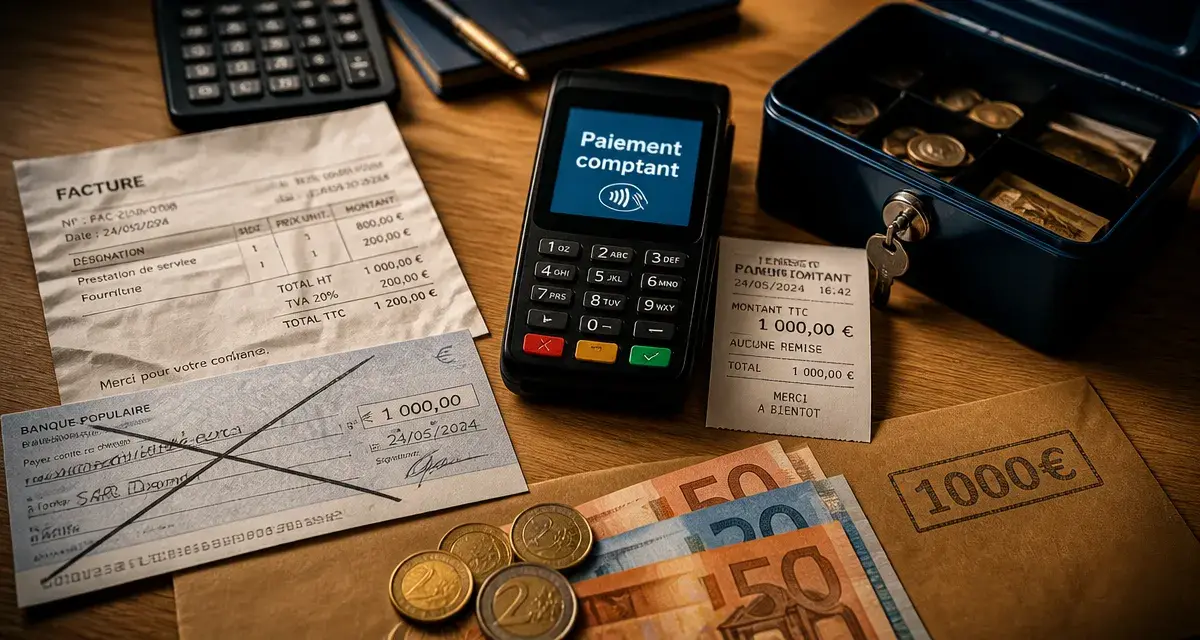

Cash payment is the most direct and secure form of settlement in trade. Unlike the credit mechanisms or negotiated payment deadlines, it is based on immediateness that simplifies the relationship between buyer and seller. Whether you are an individual or a business, mastering the nuances of cash payment is an asset to optimize your finances and contractual relationships.
What is cash payment? Definition and legal framework
Cash payment refers to a transaction where the whole price of a good or service is paid at the time of sale or service. Legally, this means that no time limit is granted to the buyer. Once ownership is transferred or service is rendered, the funds must be paid.
A strict temporality
Although the term refers to instantness, commercial practice allows for a slight flexibility. A settlement is generally considered to be a cash payment. at the latest within the week following delivery or receipt of the invoice. In the retail trade, this concept is confused with cash flow. In the B2B sector, cash payment is often required on the order to secure the supplier, which distinguishes it from the 30-, 45- or 60-day end-of-month periods that are commonly used.
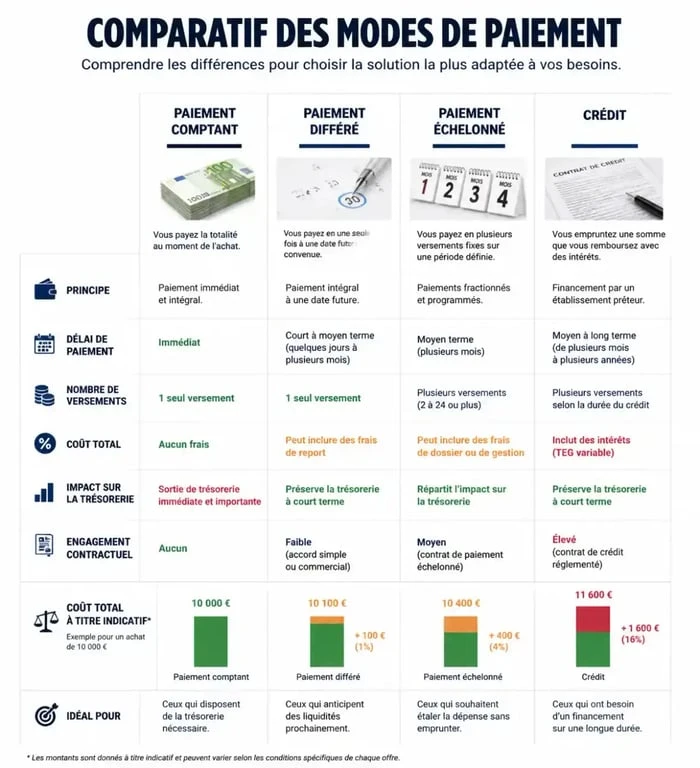
Distinction with other methods of settlement
In order to understand the scope of cash payment, one must oppose its alternatives: the deferred payment, where the Regulation takes place at a later date fixed in advance ; on instalment payment, which divides the total amount into several monthly instalments ; and credit, where the purchase is financed by a third party with interest.
The benefits of the immediate settlement for both parties
Choosing or demanding a cash payment is a financial strategy that offers tangible benefits to both cash and cash-disbursing people.
Security and liquidity for the seller
For a supplier, cash payment is the bulwark against the risk of being paid. By receiving the funds immediately, the company avoids carrying an uncertain customer debt. This improves the liquidity the structure, allowing to reinvest these funds without delay. In addition, this reduces the administrative costs associated with customer recovery and tracking pending invoices.
Budget management and rebates for the buyer
On the buyer side, paying cash allows a clear view of its financial situation. There is no dormant debt. The main lever remainscommercial discount. Many suppliers grant a discount, often between 1% and 3%, if the customer agrees to pay immediately instead of using the usual payment period. It is a cost-effective way to reduce its purchasing costs if cash permits.
The cash payment clears the accounting balance sheet of uncertainties. Where payment deadlines create an accumulation of claims and debts, immediate settlement brings total clarity. It allows companies to navigate with increased agility, as each transaction is closed as soon as it is initiated. This tense flow dynamic strengthens the strength of business partnerships by creating a climate of mutual trust.
Practical arrangements and accounting records
Cash payments can take several technical forms, each having its own specific characteristics in terms of traceability and legal ceilings.
Means of payment authorized
The choice of support depends on the amount of the transaction and the context. The Species capped at 1,000 € for French tax residents. The credit card ensures immediate debit, except in the case of a deferred debit card. The instant transfer is privileged in B2B and real estate for an availability of funds in seconds. Finally, the cheque is considered cash, despite the delay in bank cashing.
Impact on company accounting
Accounting, cash payment simplifies the entries. For a sale, we use the account 512 (Bank) or 53 (Caisse) as a direct consideration for the product account (Class 7) and the VAT collected. Unlike credit sales, it is not necessary to go through account 411 (Clients) if the payment is simultaneous with the invoice, although many accounting software do by default to maintain one history per third.
Cash payment in specific contexts
The concept of « Cash » adapts according to the sectors of activity, with precise rules.
The case of real estate
Paying for real estate means buying without resorting to a bank loan. The purchaser disposes of all the funds. In this case, the deed of sale does not contain a suspensive condition for obtaining a loan, which makes the record attractive to the seller. The transfer of funds shall be effected through the notary's accounting at the time of signature of the authentic instrument.
Factoring: turning the delay into counting
For companies suffering from payment delays imposed by their customers,factoring is a hybrid solution. The « factor » buys the invoice and pays the company within 24 to 48 hours. For the seller, this amounts to getting a cash payment, even if his final customer will only pay in 60 days. It is a working capital management tool.
Compulsory cash payment
In some cases, the law or practice prohibits credit. This is the case for perishable products or in regulated sectors where payment deadlines are framed to avoid chain bankruptcies. A supplier may also require a cash payment from a new customer whose creditworthiness is not yet established or from a customer who has had payment incidents.
Summary: When should cash payment be preferred?
The use of cash payment must be arbitrated according to your cash position. If you have a cash surplus, paying your suppliers in cash to get a discount is often more profitable than leaving money in a professional low-rate savings account. Conversely, if your cash is strained, cash payment may jeopardize your ability to deal with other urgent expenses.
For the seller, the cash requirement is a trading lever. It can be offered in return for a price fall or delivery priority. It is a financial steering tool that, well used, fluidizes business relationships and improves the financial structure of businesses.