


The best real estate investment is one that meets your goal without weakening your cash flow. Furnished accommodation allows to pilot its assets, a SCPI delegates management, parking reduces the purchase budget and crowdfunding finances operations over a shorter period. But no support brings together high yield, guaranteed capital and immediate availability of money. To choose, you have to compare what really remains in your pocket, constraints and exit conditions.
Start with your main constraint, not performance
Before looking for a property or investment, specify your priority: collect income, build a creditable asset, limit management or invest a modest amount. This response often eliminates more bad leads than a ranking of cities or products.
Your budget is not limited to the contribution. It also includes your borrowing capacity, the acceptable monthly effort and the saved savings for unforeseen events. A profitable operation on paper may be inappropriate if you cannot finance a repair or a period without rent.
- You want to keep your hand: Study naked or furnished rental, accepting management decisions and work.
- You lack time: Compare the SCPI and delegated rental management, including their costs.
- Your capital is limited: Review the shares of SCPI or a parking lot, without confusing accessibility and absence of risk.
- You prepare future revenues: bare ownership can be studied, but it does not meet a need for immediate rents.
The horizon counts as much as the budget. Maslow recommends that Minimum 8-10 years for SCPIs and 15 to 20 years for nude property. These are benchmarks, not a resale guarantee at maturity.
The main media: what you really buy
Acquiring an apartment, company shares or an obligation is not the same. You have neither the same control over the asset, nor the same responsibilities, nor the same possibilities to recover your money.
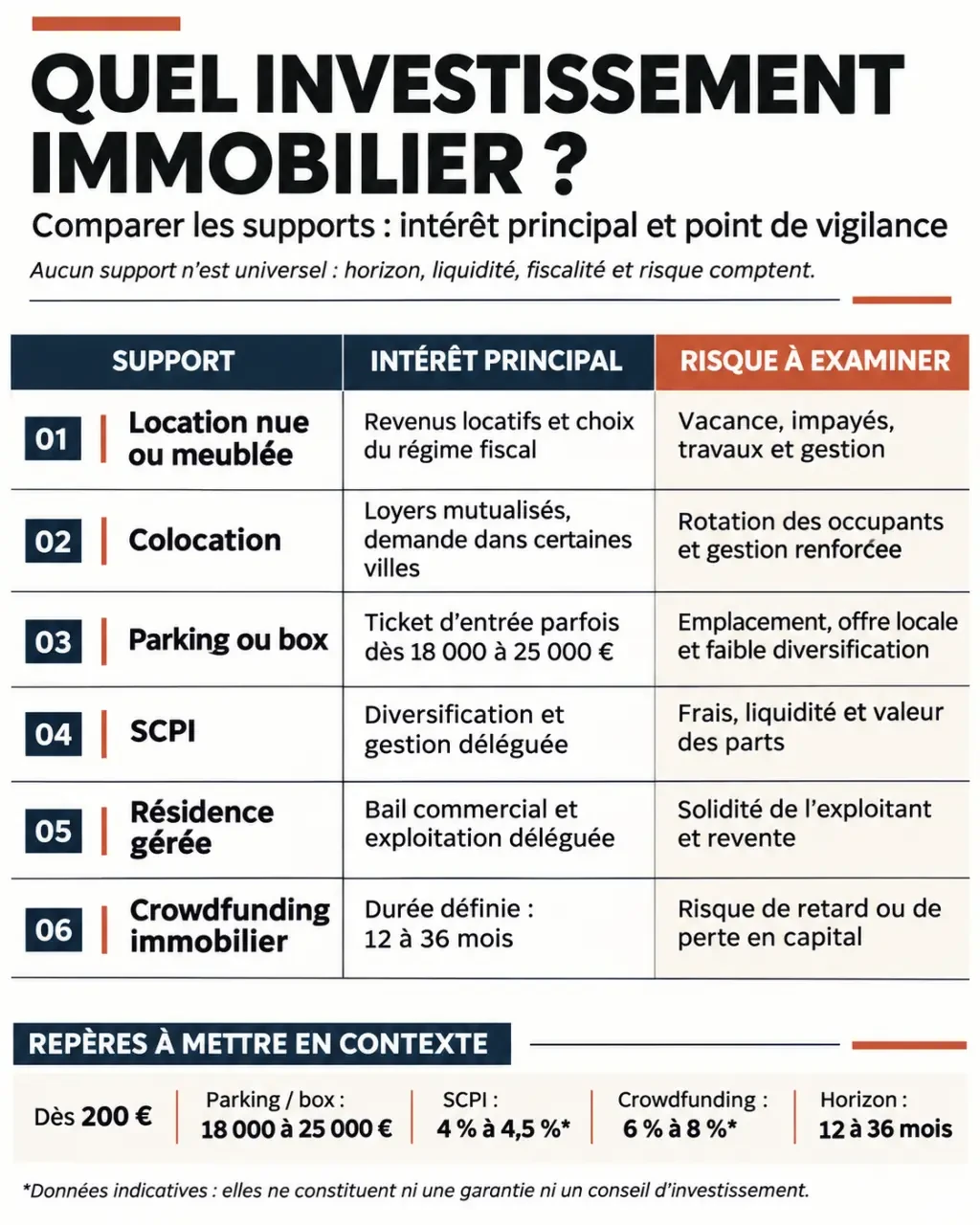
| Support | Primary interest | Point of vigilance |
|---|---|---|
| Rental naked or furnished | Asset control and credit financing | Vacancy, work, unpaid work and management |
| Colocation | Multiple rents for the same dwelling | Occupant rotation and adaptation |
| Parking or box | Lower budget than housing | Very local demand and charges |
| SCPI | Delegated real estate management | Fees, variable revenues and uncertain resale |
| Residence managed | Holding entrusted to a professional | Operator's strength and commercial lease |
| Crowdfunding real estate | Financing an identified operation | Delay in repayment and capital loss |
Small budget: distinguish entry ticket and full cost
My Immo Circle mentions accessible SCPIs from 200 €, with entry fees often between 8% and 12%. Check the conditions of each vehicle: investing a small sum does not make the investment liquid. For parking in the province, Crédit Agricole Immobilier indicates about 18,000 to 25,000 €, with an indicative gross yield of 6% to 8% in the region. These benchmarks do not replace price, fee and demand analysis in the street concerned.
Delegated management: contract does not remove risk
Crédit Agricole Immobilier places the initial bet in student residence between 90 000 € and 100,000 €, depending on location, for an indicative gross yield of 4 to 4,5 %. The commercial lease must be reviewed: allocation of work, rent revision, renewal and operator obligations. In crowdfunding, Maslow evokes durations of 12 to 36 months, but a delay can prolong immobilization. Average gross yield of 9,11 % quoted by My Immo Circle for real estate bonds is neither a promise nor a secure income.
Compare net income, cash flow and exit
Gross yield is used to make a first sorting, not to decide. To properly compare two acquisitions, use a total cost including price, acquisition costs, work and, if applicable, furniture.
- Gross yield: annual rents excluding expenses divided by the total cost retained, multiplied by 100.
- Net return: deduct non-recoverable expenses, the property tax remaining at your expense, insurance, management and maintenance expenses.
- Cash available: Also cut credit maturities, borrower insurance and taxation, according to a realistic schedule.
Reason by stratum: rent is the visible layer, current expenses the next, and then comes the spaced expenses — roofing, furniture replacement, renovation — And finally, the exit costs. A good can look comfortable each month while consuming its margin at a large construction site. Bringing these future expenses back to a monthly provision makes it possible to compare old housing, renovated property and delegated investment on a more honest basis.
Positive cash flow is not synonymous with higher total performance. Repayment of capital also builds your wealth, while a drop in the resale price can degrade the final result. So test a scenario with vacancy, unexpected work and less favourable exit prices. Also compare the credit rate, insurance and file fees.
Location and taxation must withstand examination
An attractive city does not guarantee a good purchase
Study the neighborhood, then the building, then the housing. Transport, employment areas and campuses are of interest only if they correspond to the intended occupants. A co-location requires a suitable distribution; A student studio must remain practical every day. Compare competing ads and really possible rents, without systematically holding the top of the range.
Also check the condominium minutes, planned work and energy performance diagnosis. A dwelling classified as F or G requires a review of the applicable obligations, the feasibility of the renovation and its cost. A discount on purchase can be absorbed by the yard.
Tax saving comes after economic quality
In real-life furnished rental, expenses and depreciation can reduce taxable income, subject to conditions. In bare leases, some works can contribute to a land deficit. These mechanisms are not interchangeable: have their application to your situation checked and the consequences during resale.
Maslow mentions an imputation of the land deficit on total income up to 10 700 € per year, subject to conditions, with an obligation to maintain a lease linked to imputation. Ceilings, exceptions and commitments must be confirmed prior to work. A tax reduction does not compensate a good that is too expensive or difficult to rent.
Before signing, require a project that remains bearable
Retain a strategy only if you can explain its operation, costs and exit. For a direct purchase, request technical and condominium documents. For a SCPI, review the fees and withdrawal conditions. For a managed residence, analyze the operator; for crowdfunding, the project, its possible guarantees and the risk of default.
- Set your maximum saving effort and preserve an available reserve.
- Compare several solutions with the same assumptions about spending and taxation.
- Assess the consequences of lack of income or delayed exit.
- Have the legal and fiscal aspects validated before any commitment.
The right choice is not necessarily the one with the highest percentage. This is the one whose risks you understand and which you can keep without selling in an emergency.