


A new real estate investment may constitute a wealth and prepare additional income, but its success depends mainly on the price paid, the rental demand and the remaining budget. Reduced acquisition costs, energy performance and guarantees are real assets. They do not exempt from calculating profitability after charges and taxes or preparing for resale.
Choosing the new for its real benefits, not for its promises
Investing in the new is about buying a newly built or planned dwelling to rent it, unlike buying a main residence. The objective may be to collect rents, prepare retirement or pass on an asset. These priorities determine the acceptable length of detention and funding.
Calculation of profitability and saving effort
Estimate the main indicators of your real estate investment from your own data.
Acquisition cost
Rent and vacancy
Estimated annual expenditure
Indicate the annual amounts. They will be converted into a monthly equivalent for the savings effort.
Real estate credit
Estimated results
Calculate a loan monthly (optional)
Indicative calculation for a fixed rate depreciable loan, excluding insurance and charges.
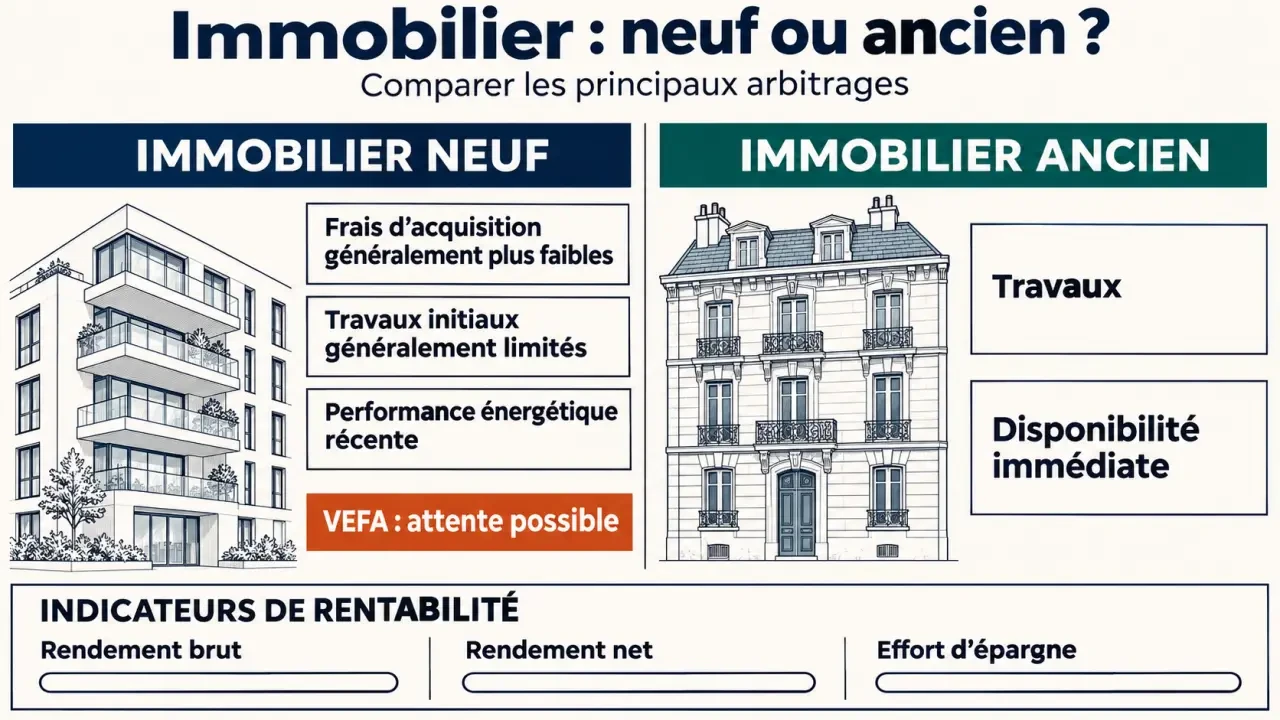
The Notary fees generally represent 2 to 3% in the new, compared to 7 to 8% in the old. This difference reduces the cost of entry, without necessarily compensating for a higher purchase price. Compare the total cost of equivalent housing, not their only prices.
| Criteria | New real estate | Old real estate |
|---|---|---|
| Work | Initial renovation generally limited | Status of housing and condominiums to be considered |
| Energy | Recent standards, including RE2020 by licence | Variable performance, improved by renovation |
| Availability | Possible Expectation on Plan Purchase | Existing and visiting housing |
| Prices | Any additional costs to be met by local rents | Work to be included in the comparison |
A recent home can offer better thermal and acoustic comfort, with less predictable work at the start. This favours its attractiveness, without guaranteeing an increase in value. Public facilities, elevators or landscaped spaces can also generate large loads.
Leave the neighborhood and tenant before selecting a program
The rental application must be verified at the district level. Study really accessible transport, employment areas, shops and educational institutions. An announced transport project does not provide the same safety as a line already in service.
Then define your target tenant: student, single person, couple or family. The surface, number of rooms, parking and storage must match its needs. Compare several similar ads, their rents and duration of publication, and then request a written estimate from a local manager independent of the seller.
The commercial perspective of a program sometimes acts as a mask: it shows light and green spaces, but leaves out daily trips, morning deliveries or future ones. To find the real accommodation, browse the neighborhood at several times, find the orientation on the plan and check out nearby projects. This check reveals constraints that no witness housing decoration can correct.
Finally, review the proponent's deliverables, financial status, and the accuracy of the description. Awareness does not replace contract verification. Compare the services included, the supplements and the forecast charges before booking.
Calculate yield and saving effort separately
The gross return is calculated by dividing the annual non-expense rents by the total cost of acquisition and multiplying by 100. This cost includes the price, acquisition costs and rental expenses, including furnished furniture.
To obtain a net return before tax, subtract from the rents the remaining property tax, non-recoverable expenses, insurance, management, maintenance and a rental vacancy allowance. Personal taxation and financing must then be analysed separately.
The saving effort is the cash you have to bring where receipts do not cover disbursements. Its monthly calculation follows this logic: rents received less monthly loan, borrower insurance, expenses incurred and taxes provided. A repayment of capital built from the wealth, but remains an immediate exit of money.
The credit allows the acquisition of an asset higher than the savings mobilized: this is the leverage effect. It also exacerbates the consequences of a fall in value or prolonged vacancy. Compare the total cost of the loan, not just its rate, by integrating guarantee, record and insurance.
- Test a rent-free period and less than the commercial estimate.
- Provide for any intermediate interests during construction.
- Keep a reserve available after the meal and expenses.
- Check that the savings effort remains bearable without tax advantage.
Adapting taxation to your heritage goal
Pinel is no longer open to new acquisitions. Other solutions are not interchangeable: some seek immediate income, others seek a tax deduction or hold without management. Confirm the rules applicable to the date of signature, particularly for recent arrangements.
Rental naked, Jeanbrun or LMNP: compare also the output
In the classic bare lease, rents are a property income. The Jeanbrun scheme is based on a depreciation logic, with a minimum rental commitment announced by 9 years. The parameters presented include an off-land basis of 80 %, annual rates of 3.5 to 5.5 per cent by rent level and a maximum amount of 12 000 € per year. These ceilings are not automatic: require confirmation of eligibility, tenant resources and calculation procedures.
In non-professional furnished rental, the revenues are industrial and commercial profits. The micro-BIC provides for a discount of 50 %. In real terms, expenses and depreciation can reduce the taxable profit according to the applicable rules. Compare accounting fees, furniture and tax treatment of resale before choosing.
LLI and bare ownership: accept lasting constraints
The intermediate rental housing can benefit from a VAT rate of 10 % in eligible installations, in particular in return for rent and resources ceilings. The commitments announced cover: 15 to 20 years. A furnished LLI offer requires a precise verification of the legal structure and compatibility of the advertised benefits, without assuming their cumulation.
The nude property is intended for the investor who does not need immediate rent. With often planned dismemberment on 15 to 20 years, the haircut announced is generally 30 to 40 %. Lusufruiter uses or leases the property during this period. Verify contractually the distribution of work and the conditions of restitution.
Secure construction, rental and resale
In VEFA, the sale in the future state of completion, the route passes through reservation, financing, notarial act and calls for funds related to promotion. Before signing, review the delivery time, suspensive conditions, descriptive notice and financial guarantee of completion. A delay can delay rents while generating expenses.
Technical protections have separate perimeters: perfect completion for one year after receipt, biennial guarantee of 2 years for certain equipment and 10-year guarantee 10 years for the most serious disorders. They did not exempt from careful delivery inspection and written follow-up of reservations.
For the rental, compare the management fees and exclusions from the unpaid rent guarantee. For exit, anticipate sales costs, taxes on surplus value and commitments still in progress. Finally, ask for a complete simulation integrating a resale without price increases: a solid project must be based on its real economy, not on an expected valuation.