
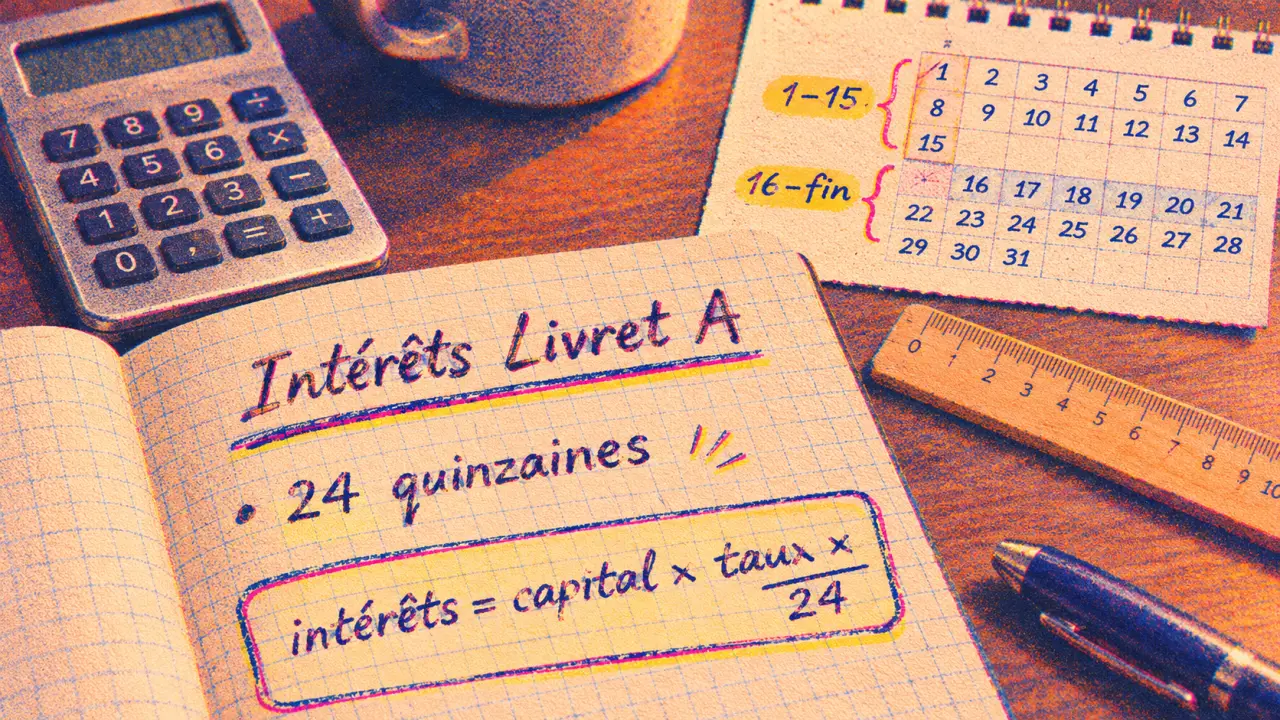

To calculate the interest on Book A, multiply the amount paid by the annual rate, then by the number of fifteen acquired divided by 24. The decisive point is therefore not only the sum deposited: remittance and withdrawal dates also determine your gain. The following is the method for obtaining an estimate and understanding variances with a simplified annual calculation.
The formula to be used according to the duration of placement
Booklet A works with 2 15 per month or 24 15 per year. The first court from 1st to 15th; the second, from 16th to last day of the month. Only the paid fortnights are included in the calculation, regardless of their actual duration in days.
Interest = paid capital × annual rate × number of fortnights / 24.
The rate shall be expressed in decimal form: a rate of 2 per cent shall be written 0.02. For an entire year, without movement and at a constant rate, the formula simply becomes: capital × annual rate.
An example to put the calculation
With 5,000 € paid for 6 fortnights and 1 hypothetical 2 %, you get: 5,000 × 0.02 × 6 / 24 = 25 €. This rate is used only to illustrate the method; it does not constitute an indication of the current rate applicable.
The rate of Book A is regulated and can change. For an exact estimate, take the one that applies to each period concerned with your bank. If a review occurs during your investment, calculate the interest for each period separately and add the results.
Value dates make the difference
The date on which the money appears in your account does not always correspond to the beginning of his remuneration. It's the value date that counts. A payment begins to produce interest at the beginning of the next 15 years; a withdrawal ceases to be produced at the beginning of the 15th of the withdrawal.
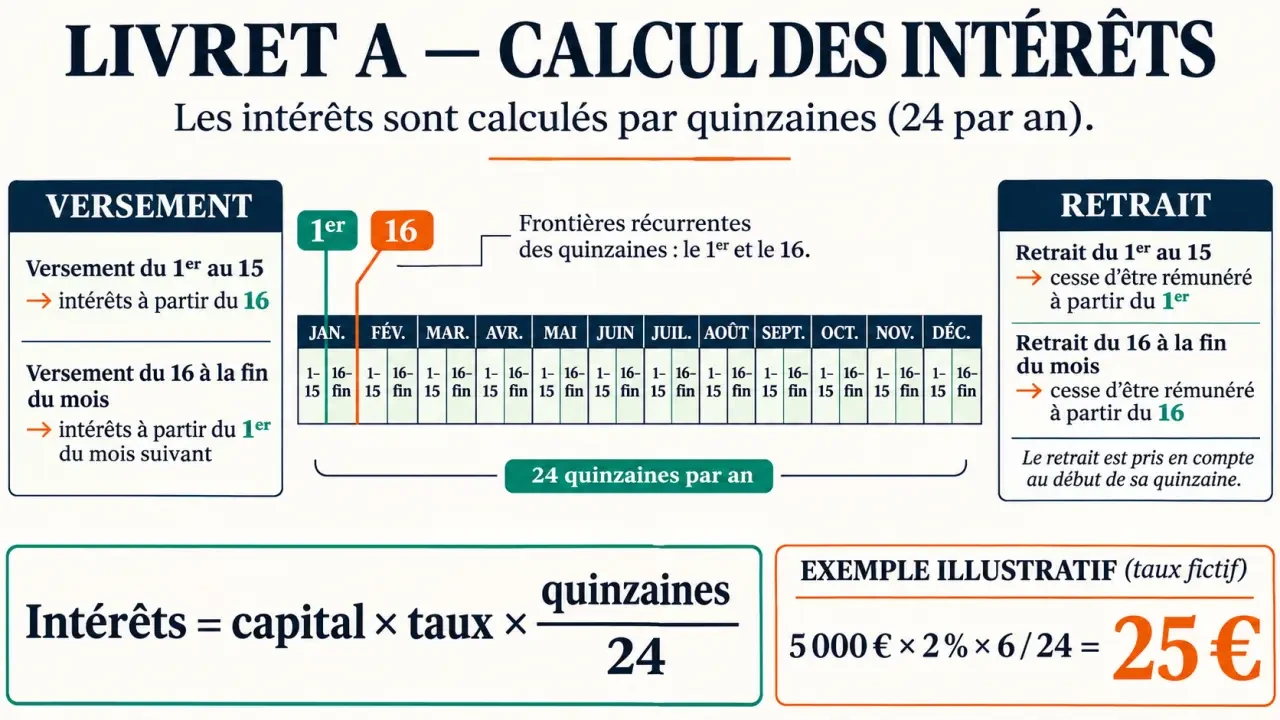
| Date of transaction | Start of payment | End of remuneration of the amount withdrawn |
|---|---|---|
| 1 to 15 of the month | 16 of the same month | Last day of the previous month |
| From 16 to the last day of the month | 1st of the following month | 15 of the same month |
Place before a border, remove after
A deposit registered on 15 March returns from 16 March. Registered on 16 March, it only returns from 1 April. For a withdrawal, the reverse logic: withdrawing on March 15 causes the remuneration of the first fortnight on the sum withdrawn; waiting for the 16 allows to keep it.
The useful benchmarks are therefore 15 and end of month for payments, 1 and 16 for withdrawals. Anticipate the processing times: launching a transfer on the last night of the month does not guarantee its registration on the same day.
Imagine a scissor-cut calendar on the 1st and 16th: each piece represents an indivisible compensation block. Place on both sides of the same cut, and only one day can change the result; Move your repository inside the same block, and its value date remains the same. This image helps focus your efforts on the right deadlines, rather than monitoring each day.
Simulations to estimate your gain
The following table is based on constant hypothetical annual rate of 2 %without withdrawal or further payment. The durations correspond to 15 actually paid, and not to a simple duration between two dates.
| Paid capital | 1 month: 2 15 | 6 months: 12 fortnights | 1 year: 24 fortnights |
|---|---|---|---|
| 1 000 € | 1,67 € | 10 € | 20 € |
| 5 000 € | 8,33 € | 50 € | 100 € |
| 10 000 € | 16,67 € | 100 € | 200 € |
| 22 950 € | 38,25 € | 229,50 € | 459 € |
The amounts are rounded to the cent for reading. A monthly estimate is therefore calculated over 2 fortnights, but a deposit made during a month does not automatically benefit from these two periods.
Add a payment without repeating the calculation
Suppose 5,000 € be paid all year round and you add 1 000 € 15 July. The supplement is due from 16 July, for 11 fortnights until 31 December. Still with the 2 % assumption, the initial capital produces 100 € and supplement approximately 9,17 €either 109.17 € total.
For regular payments, apply this logic to each deposit. In the presence of numerous withdrawals, a table per fortnight becomes more convenient: indicate the paid balance, the applicable rate and the corresponding interest, then sum.
Ceiling and capitalization: what amount does it actually pay?
The payment ceiling of Book A is 22 950 € for an individual. For associations, the common law ceiling is 76 500 €, with special schemes according to their category. This ceiling covers deposits: it does not block the addition of interest.
Interest is credited once a year as at 31 December. They then join the capital and themselves generate interest the following year: Annual capitalization. Interest earned during the year is therefore not reinvested monthly.
An individual whose booklet contains 22,950 € can thus exceed this amount thanks to interest. With the previous hypothesis of 459 € over an entire year, his balance was 23,409 €. This new balance may then be paid in full, even if it exceeds the deposit ceiling.
However, no further payment is possible as long as the balance remains at or above the ceiling level. After withdrawal, the deposit capacity corresponds to the difference between the remaining balance and 22,950 €, and not necessarily the amount withdrawn.
Check its estimate without overestimating performance
The interests of Book A are exempt from income tax and social contributions. The calculated gain is therefore a net gain: no tax deduction is required.
To compare your estimate with the amount credited by the bank, check these points in order:
- The rate: use the one for each period, not just the one displayed today.
- Dates: start from the recorded transactions and their value dates.
- Capital: separate the visible balance from the actually paid balance.
- Duration: count the fifteen, without applying a daily pro rata.
- Rounding: Keep decimals during calculation and round the final result.
Finally, keep the benefit of a gap in perspective. At a hypothetical rate of 2%, about 15 in 1,000 € represents about 0.83 €. Optimizing a date is useful when it does not create any constraint; delaying an essential expense or risking an overdraft to preserve that amount would be counterproductive. Book A remains above all a precautionary savings available.