
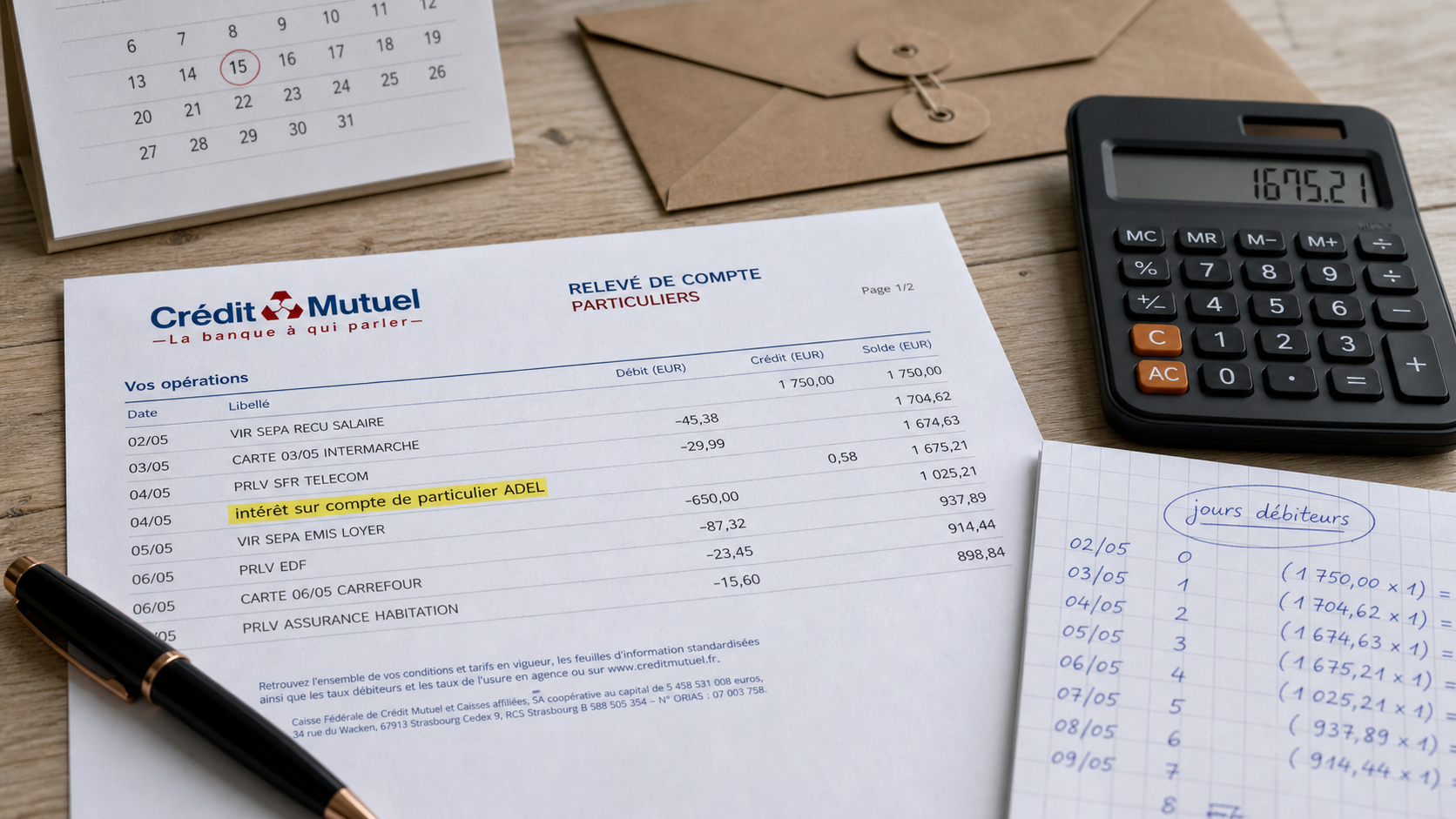

The mention « interest in ADEL account » on a bank statement usually refers to interest receivable, i.e. agios billed because the account was overdraft, even briefly. It often surprises, especially when the amount of the overdraft is small or the wording does not resemble a current banking transaction. Before you see an error, you have to check the period, the number of days due and the rate conditions of your bank.
What does ADEL really mean on a particular account
In this context, ADEL is usually an internal wording used by the bank to identify a line of interest related to the operation of the current account. It is neither a purchase, nor a levy from a trader, nor an external body that you would have authorized. The bank charges here the cost of a temporary advance of money when the balance of the account goes negative.
Estimate of interest receivable
Understanding bank charges:
- Interest receivable: Cost of money borrowed from a negative balance.
- Agios: A term often used to describe the total amount of interest and associated costs.
- Commissions of intervention: Charges levied for processing an operation leading to overdraft.
These interests are called interest receivable. They differ from fixed fees such as intervention fees, rejection fees or credit card contributions. Their calculation depends on the amount of the overdraft, the rate applied and the duration of the account remaining in negative balance. The logic is simple, but the result may seem opaque if the survey does not sufficiently detail the operations.
Interest receivable, agios, minimum lump sum: do not confuse everything
The term « agios » is often used as a generic word. In practice, it can cover several realities: interest calculated on the overdraft, interest on the overdraft, interest on the overdraft. minimum standard provided for in the tariff brochure, or other costs related to an operating incident. An ADEL line can therefore correspond to a very small amount, but also to an amount that seems disproportionate if a minimum collection has been applied.
For example, a customer may see a bank charge debit of -7 € while his discovery was only of 2-3 € For a few days. This delay does not automatically prove an error. It may come from a lump sum minimum, but it justifies asking the bank for details of the calculation to understand the exact amount.
Why this sampling appears on your statement
The most common cause is simple: the account is negative, even over a short period of time. A debit presented before a transfer, a credit card debited earlier than expected, a late cashed cheque or an allowance arrived with a delay may be sufficient to create a few debtor days. In this case, ADEL reflects the cost of this short passage.
Everything about bank overdraft authorization · Discover the rules and conditions governing the authorized bank overdraft to better manage your daily account.
The statement may also appear after a account stoppageoften monthly or quarterly depending on the institution. The bank then collects interest due over a given period. A statement may thus indicate a period of 01/01/2018 to 31/03/2018, with a calculation of several episodes of negative pay. The line is therefore not always linked to a single operation visible on the day record.
The role of the duration of the discovery
The amount deducted depends not only on the maximum overdraft achieved, but also on the number of days the account remained payable. A negative balance of some euros during 2 days does not produce the same result as a longer discovery on 4 daysEven though the sums seem modest. The value dates therefore count as much as the date of the operation.
An account that regularly oscillates around zero can generate more costs than one imagines. The bank calculation shall retain each passage below the threshold and then apply the prescribed rate over the period concerned. This is why the balance must be observed day by day, especially when several small transactions occur before the payment of salary, pension or allowances.
Authorized or unauthorized discovery: impact on cost
If you have Overdraft authorization, the bank may apply a rate provided for in the contract within the limits of the ceiling granted. If you exceed this limit, or if you do not have any authorization, the cost may be higher and other fees may be added. The ADEL levy may therefore reveal a one-time exceedance, even if no payment has been refused.
| Situation observed | Possible interpretation | Point to be checked |
|---|---|---|
| Negative balance for 2 or 4 days | Interest receivable over time | Value dates and rates applied |
| Cost of -7 € for a little discovery | Minimum lump sum or associated costs | Tariff brochure and calculation details |
| Discovery above authorized ceiling | Exceeding expected conditions | Amount of overdraft authorization |
| No memory of discovery | Possible error or date offset | Balance history day by day |
How to check if sampling is justified
The first step is to reconstitute the account over the indicated period. Do not limit yourself to the ADEL line. Check out transactions immediately before and after, value dates, automatic debits, cheque discounts, incoming transfers, and deferred or immediate debit card payments. This is often where the explanation is found.
You can then compare the sample with your contract documents. Debt interest rates, lump-sum minimums and incident charges must be included in the bank's account agreement or tariff brochure. If you do not find these documents, ask your advisor or consult your customer area. The correct document is used to verify whether the amount deducted corresponds to the advertised tariff.
Useful questions for the bank
To avoid a vague response, make a specific request. Ask for the exact period, the number of days due, the balance withheld for calculation, the rate applied and the possible existence of a lump sum minimum. If the sample involves more than one overdraft, ask for details per episode. A clear request can be more easily answered.
- When does the line correspond « interest in ADEL account » ?
- How many debtor days were held?
- What interest rate was applied?
- Has a lump-sum minimum been charged?
- Did the account exceed the overdraft authorization?
- Can the bank provide the detailed calculation in writing?
This is particularly important if your income is low, irregular or close to a level similar to the AHR. In this case, a few euros of costs may affect the balance of the budget. The bank must be able to explain the bill clearly, especially when a small overdraft results in an amount that seems high compared to the amount actually used.
Contesting or negotiating a refund: the right method
If you think the levy is unjustified, start by contacting your bank advisor. A telephone exchange may be sufficient to obtain an explanation, but it is best to confirm in writing, especially if you request a refund. Stay factual: state the date of the levy, its amount, the exact wording and the reason why you are challenging it. The more precise the demand, the easier it is to process.
When the challenge is legitimate
The dispute is relevant if the account has never been debtor over the specified period, if the value dates appear inconsistent, if a transfer announced on time has not been properly accounted for, or if the amount invoiced does not correspond to the rates reported. It can also be justified if the bank has applied fees without sufficient prior information.
LArticle L. 312-1-5 of the Monetary and Financial Code This includes information on certain bank charges related to irregularities and incidents. A statutory deadline of Minimum 14 working days is often mentioned to allow the customer to be informed before the debit of certain fees. If you feel you have not been properly informed, mention this point in your complaint.
Appeals if counsel refuses
If the advisor's response does not satisfy you, send a complaint to the bank's customer service. Attach the relevant statements, account history catches, your account agreement if you leave, and details of your exchanges. Request a written and reasoned response. This allows us to keep a clear record of the request and the response obtained.
In case of persistent blocking, you can enter the competent bank mediator, whose contact details must be available on your bank's website or in your contract documents. If your financial situation is permanently weakened, it may also be useful to ask your bank for the arrangements for customers in financial fragility. In the case of more global debt, the Overindebtedness Commission It is not just a cost dispute.
Avoid the return of an ADEL line on future surveys
Prevention is based on a simple principle: reduce the days when the account goes under zero. Even a small overdraft can generate interest if it repeats itself. The most effective is to identify transactions that create the lag: rents, insurance, subscriptions, monthly credit payments, card expenses or energy levies. Once these points are identified, it becomes easier to anticipate sensitive times.
- Activate a balance alert before switching to 0 € or before the authorized overdraft threshold.
- Consolidate large levies immediately after the arrival of wages, pensions or allowances.
- Request a small formalized overdraft authorization if the offsets are regular.
- Check value dates, especially for cheques and certain deferred transactions.
- Keep a margin of security on the current account, even modest.
It may also be useful to create your own minicomputer in a spreadsheet, with a column for the date, one for the balance, one for the number of days in negative and one for the rate indicated by the bank. Even without getting a result to the nearest cent, this tool helps to identify risk periods and to discuss more specifically with your advisor. It also gives a clearer view of the small discoveries that come back regularly.
Finally, do not hesitate to negotiate. If the ADEL line is exceptional, related to a delay in income or an isolated incident, a commercial discount is sometimes possible. The request is more likely to succeed if you show that you have understood the origin of the fees and that you are putting in place measures to avoid their repetition.