
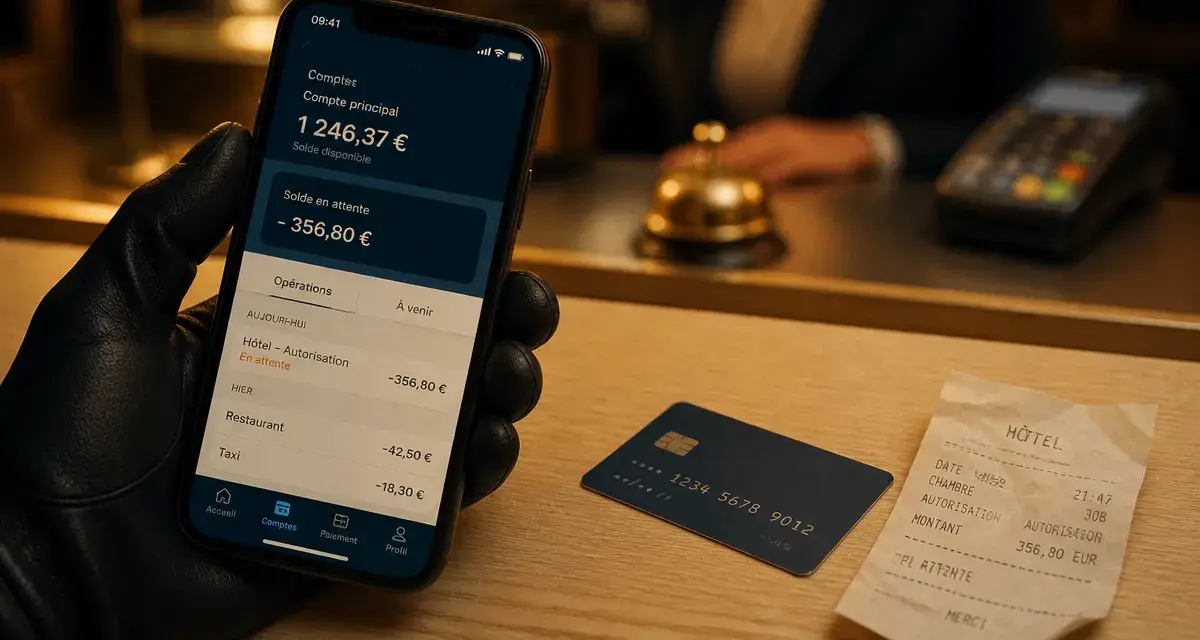

You check your banking application and notice a sum « on hold » or a balance available below your actual balance, without a corresponding purchase being debited. This phenomenon, which is often a source of concern, is the result of a bank card footprint. This security mechanism, common in the tourism and services sector, allows traders to check your creditworthiness before finalizing a transaction. Understanding its operation is necessary to avoid seeing your payment ceilings saturated at the inappropriate time.
What is a bank footprint and how is it distinguished from a payment?
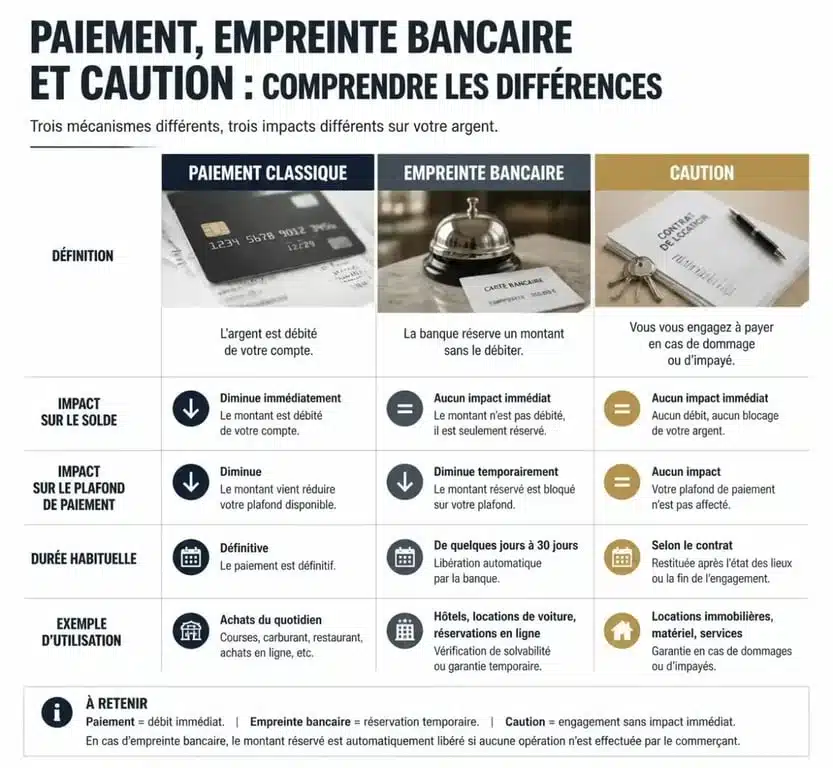
Bank footprint, technically called pre-authorisation, is a transaction whereby a bank reserves a certain amount in your account on behalf of a trader. Unlike a conventional payment, money is not transferred. He stays on your account, but he is « frozen » : you can no longer use it for other expenses.
The difference between debit, deposit and print
It is common to confuse these terms, yet their consequences on your portfolio differ. Classic debit is a firm transaction that reduces your actual balance. The bond is often a larger amount of money, used as a guarantee against possible damage, as in car rental. The footprint is a provision check that can be converted into final payment or cancelled.
Here is a comparison to better understand these operations:
| Type of operation | Impact on real balance | Impact on ceiling | Purpose |
|---|---|---|---|
| Standard payment | Immediate or deferred flow | Final reduction | Purchase of goods or services |
| Print / Pre-authorisation | No immediate flow | Temporary blockage | Solvency check |
| Bank guarantee | No flow (except degradation) | Blocking often important | Security guarantee |
The technical mechanism: why your money seems to disappear
When a trader requests a print, his payment terminal or reservation platform questions your bank. The bank checks whether your balance and limits allow the transaction. If so, she will issue an authorization number and set aside the amount requested. For the banking system, this amount is committed, which explains why it is deducted from your balance availableeven if it is still in your accounting balance.
This system protects the merchant. A restaurant owner who accepts a group reservation or a hotelier who blocks a room ensures that in case of late withdrawal (no-show) or additional consumption, the funds will be recoverable. For the customer, it is an invisible regulation that allows access to services without advancing the actual cash flow immediately, while protecting the provider against payment uncertainties.
Impact on your payment ceilings
This is where the problem arises for many users. Even if the money is not debited, the amount of the print is recorded in your payment ceiling weekly or monthly. If you rent a car with a print of 1,000 € and your ceiling is 2,000 €, you only have 1,000 left € for the rest of your vacation, even if your account is supplied. It is therefore useful to anticipate these blockages before a trip.
Common situations where you will be asked for a print
Bank footprints are the norm in certain sectors where the final amount of the benefit is not known in advance or requires a guarantee.
Hotels and reservation platforms
Upon arrival at the hotel, it is customary to request a credit card for extras such as minibar or room service. The hotel takes a footprint that usually covers the price of the stay plus a daily security package. On sites such as Booking or Airbnb, a pre-authorisation can be made at the time of booking to validate the validity of the card.
Rental of vehicles
This is the most binding case. Renters almost always require a stamp corresponding to the insurance deductible. This amount can reach several thousand euros. Attention: Many renters refuse "debit" cards (the majority of French classic cards) for these prints and require a "credit" card to be able to block funds more easily.
Automatic service stations
When you insert your card into a 24-hour automaton before serving gasoline, a print is taken. It often amounts to 120 € or 150 €whatever amount of fuel you plan to take. Once full, the actual amount is sent to the bank, but the initial print can take a few hours or even days to clear.
How long does the block last and how do you lift a print?
The life of a bank footprint varies depending on the nature of the transaction and the banks' internal policies. As a general rule, pre-authorisation takes place between 7 and 30 days.
Automatic release of funds
In most cases, the footprint disappears on its own as soon as the final payment is processed by the trader. For example, after returning your rental car without damage, the landlord releases the print. However, the interbank system is not instantaneous. It is not uncommon for the print to persist on your bank application for 48 to 72 hours after the end of the service.
Can we force a fingerprint to be lifted?
If a print persists too long and blocks your ceiling, you have two levers of action:
- Contact the merchant: He initiated the application. He can send a release message to his bank to speed up the process, although not all terminals allow it easily.
- Contact your bank: With proof that the final transaction has been paid or cancelled (invoice, cash ticket), your advisor may sometimes force the cancellation of the pre-authorization.
Practical tips for managing your bank footprints
To avoid finding yourself with a card refused at the restaurant while your account is full, a few simple reflexes are useful. Check the nature of your card: "DEBIT" or "CREDIT" is now mandatory on French cards. For car rentals abroad, a "CREDIT" card is recommended to facilitate fingerprinting.
Ask the merchant the exact amount of the print he intends to take. In hotels, you can sometimes offer to leave a deposit in cash or pay the entire stay in advance to reduce the amount of pre-authorisation. Before a big start, ask your bank for a temporary increase of your ceilings. This usually costs nothing and offers you a comfortable space to absorb the different footprints associated with your trip without affecting your daily expenses.
The bank card footprint is a useful guarantee tool for trade. If it remains invisible most of the time, its management becomes important when travelling or spending large amounts. By staying vigilant on your ceilings and understanding the release times, you turn what could be a source of stress into a simple technical formality.