
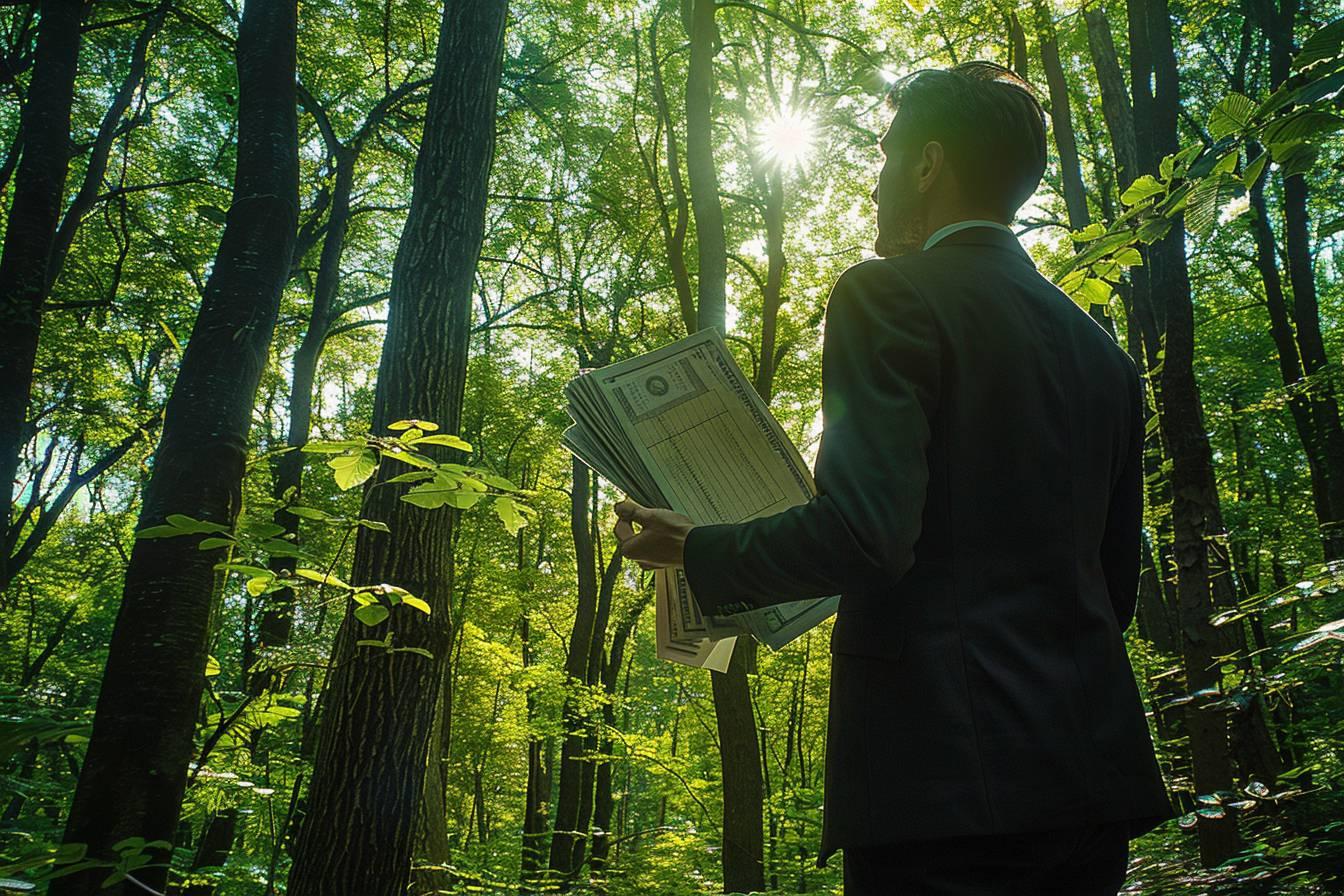

Investing in forests is an opportunity that is gaining in popularity, especially for its tax benefits. As an enthusiast of financial markets, I have explored this investment path and I wish to share with you the subtleties of the challenges of purchasing forests. This green investment offers not only a long-term return, but also significant tax reductions. Let us work together to optimize your investments while helping to preserve our natural heritage.
The tax advantages of forest investment
The French State encourages investment in forests through various mechanisms of defi-calisation. These tax incentives aim to promote sustainable management of our forested areas while providing opportunities for tax optimization for investors.
Here are the main tax benefits you can get:
- Income tax reduction : Until 31 December 2022, you could benefit from an 18% reduction in the amount invested, capped at 5 700 € for one person alone and 11,400 € for a couple.
- Improved tax credit : From 1 January 2023, this scheme is moving towards a 25% tax credit, with ceilings raised to 6,250 € for one person alone and 12,500 € for a couple.
- Partial exemption on IFI and inheritance duties : 75% of the value of the forests is exempt for tax on the Fortune Immobilier (IFI) and inheritance or donation duties.
As a wise investor, I particularly appreciate the possibility of diversifying my portfolio while reducing my tax burden. The DEFI (Financial Incentive Facility for Forest Investment) was extended until 31 December 2025, providing medium-term visibility to plan its investments.
How to cut your taxes through forests
The challenge of purchasing forests is not limited to the acquisition itself. It also covers the various operations related to forest management. Here's how you can further optimize your tax situation:
- Forest work tax credit : Between 18% and 25% of forest work expenditure is eligible for a tax credit, capped at 6,250 € (12 500) € for a couple).
- Insurance tax reduction : 76% of the insurance contributions against storms and fires can be deducted, with a ceiling of 6 € per hectare and a maximum of 6,250 € (12 500) € for a couple).
- Exemption from property tax : Young people aged 10 to 50 years may benefit from partial or total exemption from property tax.
It is crucial to note that since 2023, the minimum surface condition of 10 hectares for forest work has been removed, thus opening up these benefits to more investors. In addition, the scheme opened up to first-time applicants for areas between 4 and 25 hectares, further democratising access to this type of investment.
| Type of tax advantage | Rates: | Ceiling (single person) | Ceiling (couple) |
|---|---|---|---|
| Acquisition tax credit | 25% | 6 250 € | 12 500 € |
| Work Tax Credit | 18-25% | 6 250 € | 12 500 € |
| Insurance reduction | 76% | 6 250 € | 12 500 € |

Multi-sector investment: advantages and disadvantages
Although the tax benefits are attractive, it is important to examine this investment from all angles. Being a trader in the process, I know that we must always weigh the pros and cons before we engage.
Benefits:
- Portfolio diversification
- Significant tax reductions
- Contribution to environmental conservation
- Potential for long-term recovery
Disadvantages:
- Overall low yield (approximately 1-2% per year)
- Natural disaster risks
- Low cash investment
- Long-term conservation commitment (minimum 15 years)
It is recommended not to exceed 10% of its overall assets in this type of investment. This precautionary rule allows for tax benefits while maintaining a balanced portfolio.
Investing in forests is an attractive strategy for combining environmental commitment with tax benefits, as explained in this article on Investing in forest procurement for challenges: an ecological and cost-effective investment.
To maximize your tax benefits while diversifying your investments, discover how to optimize its challenges: the best strategies to know.
To diversify your assets while benefiting from tax benefits, find out how investing in forests can combine profitability and environmental preservation.
Silence grows: conditions and management of your forest investment
In order to fully benefit from the tax advantages of buying a forest, certain conditions must be met:
- Conservation commitment : You must commit to keeping the land for at least 15 years.
- Management plan : The application of an approved management plan is mandatory.
- Eligibility of indirect investment : Subscriptions of shares of forest groups or forest savings companies are also eligible for tax benefits.
Forest management requires specific skills. If you are not an expert in forestry, it may be wise to use professionals. Some forest clusters offer turnkey solutions, combining technical expertise and tax optimization.
Let us not forget that forest investment is part of a long-term logic. Trees need time to grow, and your forest heritage will gradually be valued. It is an investment that requires patience, but can be very rewarding, both financially and ecologically.
In the end, the challenges of purchasing forests represents an interesting opportunity for investors seeking to optimize their tax situation while diversifying their assets. However, as with any investment, it is important to properly inform and consider this asset as part of a comprehensive heritage strategy. Don't hesitate to consult a tax advisor or forestry expert to guide you in this green and tax-effective approach.