
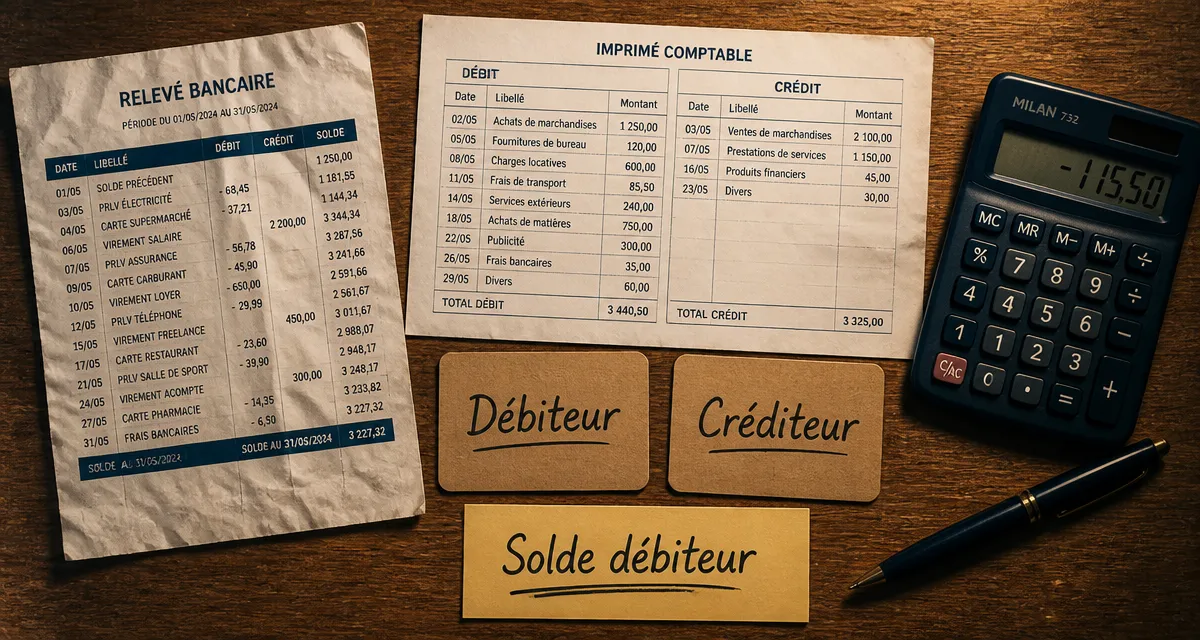

In financial management, the terms debtor and credit often cause confusion. Their interpretation varies depending on whether you view your bank statement or analyse a business account. Mastering this distinction is essential to anticipate cash flows and avoid unnecessary bank charges.
Accounts receivable and credit: definitions and differences
The distinction is based on the meaning of financial flow. One debtor is a person or entity that has a debt to another person or entity. In contrast, the credit is the one to whom the money is due. In a simple transaction, if you buy a product on credit, you become the debtor of the store, which then acts as your creditor.
Test your knowledge: Debtor or Creditor?
The reverse logic of the bank account
The confusion often arises from reading a bank statement. When a banker qualifies your account as credit, your balance is positive. From the point of view of the institution, the money deposited into your account is a debt to you. You're his creditor, and the bank is your debtor.
On the other hand, balance receivable means you spent more money than you had. Then you owe money to the bank, becoming its debtor. This shift in red triggers automatic fee mechanisms.
The accounting perspective
In accounting, debit and credit follow a rigorous structure in the newspaper. The debit is to the left, the credit to the right. A customer account is usually a debtor, as the customer owes the company money. A supplier account is a creditor because the company owes money to the supplier. This method makes it possible to follow precisely the receivables and the debts of the structure.
The consequences of a debit balance
Being a debtor to his bank is never neutral. This means that the financial institution provides you with funds, which is a temporary appropriation. Beyond the immediate cost, this situation leaves a trace in your management history.
Every passage below the zero line influences how the bank perceives your reliability. A profile that multiplies negative balances, even quickly regularized, sends a signal of fragility. This behavioral signature is analyzed by the scoring algorithms, which can complicate obtaining a real estate loan or future professional financing.
The cost of the overdraft: agios and commissions
The first impact of a debtor balance is financial. The Bank applies agiosinterest calculated on the amount and duration of the overdraft. There are two situations:
In the context of authorizedYou have a prior agreement with your bank. The interest rate is framed, although often high. In case of Unauthorised discovered, i.e. above the agreed ceiling, interest rates increase and are accompanied by intervention commissions. These fixed costs per operation quickly increase the bill.
Risk of payment incident
If the debtor balance persists, the bank may reject your payments. A cheque without provision or a withdrawal refused entails significant rejection costs and may lead to a deposit in the Central Cheques File (FCC) of the Banque de France, causing a bank ban.
Comparison of financial flows
This table summarizes the terms according to the context of use to facilitate your reading.
| Term | Banking context | Context Accountant | Action |
|---|---|---|---|
| Debtor | Negative account | Whoever owes money | Refund |
| Accounts payable | Positive account | The one to whom the money is due | Cash |
| Flow | Money output | Increase in an asset | Spend |
| Crédit | Money entry | Increase in liabilities | Receive |
3 reflexes to avoid debtor balance
Maintaining a credit balance requires discipline and a tracking method adapted to modern flows such as deferred payments and subscriptions.
Anticipate cash lags
The debit balance often occurs because of a mismatch between your expenses, such as rent or taxes, and your income. To limit this risk, try to shift your automatic levies towards the beginning of the month, once your account has been credited with your main income.
Use pay alerts
Most banking applications allow you to configure free notifications. Schedule an alert as soon as your balance falls below a critical threshold, for example 100 €. This gives you time to make a transfer from a savings account or limit your expenses before you switch to a debtor position.
Follow Class 46 accounts
For entrepreneurs, the management of Other accounts receivable and payable, grouped into class 46 of the chart of accounts, is essential. This section deals with non-customers and regular suppliers. A monthly follow-up allows us to detect anomalies, such as an overpayment of social organization or a forgotten fee note, that affect the financial health of the company.
Regularize a debtor balance quickly
If your balance becomes a debtor, the reactivity limits the costs. The first step is to provide the account with an immediate transfer. If the situation results from a major unforeseen event, contact your bank advisor without delay.
A banker is often more likely to negotiate a discount on intervention commissions or temporarily adjust your overdraft authorization if you inform before incidents multiply. Proactive management transforms a liability debtor into a responsible partner.