

You have received the official confirmation: your name is no longer on the National Individual Credits Rebate Incident File (PCIF) or the Central Cheques File (CCF). However, on your last loan application, the bank advisor objected to a non-receipt. This frustrating situation is common. The lifting of a bank ban is a necessary condition for borrowing, but it does not guarantee automatic acceptance.
Why does the end of the file not mean immediate agreement?
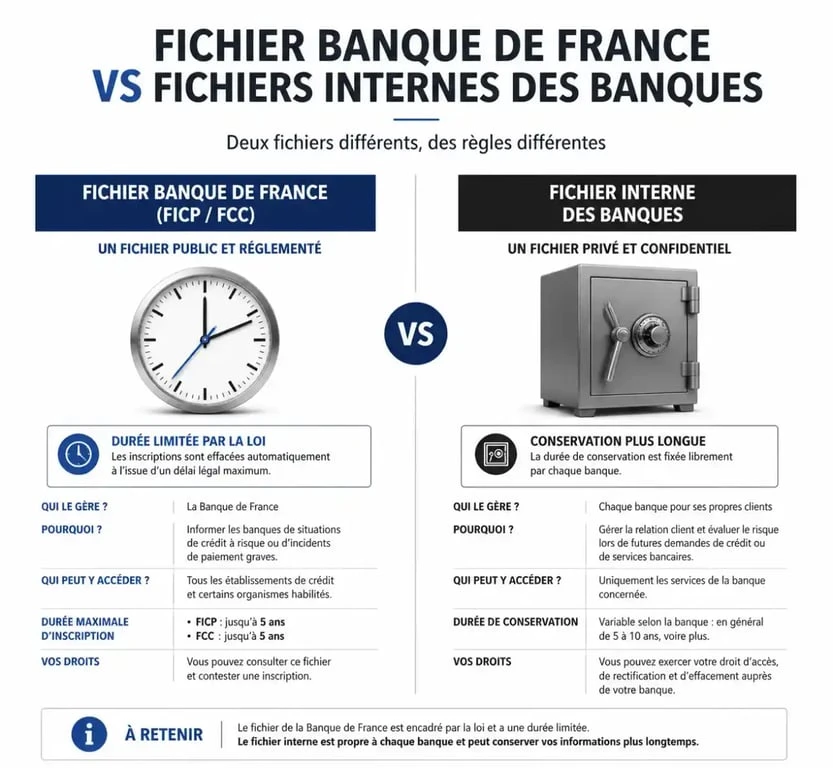
To understand this blockage, a distinction must be made between commercial policy and establishment. The Bank of France manages regulatory files that serve as an alert. Once your debts are settled, these files are updated and your name is cancelled. However, a bank remains a private company free to choose its customers. It has no legal obligation to grant you a loan, even if your financial history has become blank again.
The weight of banks' internal memory
This is where the pack hurts. If you have had payment incidents with the bank you are seeking today, or a subsidiary of the same group, the bank will keep track of these events in its own systems. Unlike FICP, the duration of which is limited by law, internal files may keep information about your former unpaid payments for a much longer period, sometimes ten years or more, depending on the institution's data retention policies.
Even if you are more registered at the Bank of France, the history of your customer relationship weighs heavy. A payment incident that occurred three years ago may cool a risk analyst, as it demonstrates a past fragility that the bank's scoring algorithm negatively interprets.
The analysis of overall solvency
Scattering is one of many filters. When considering your application, the bank evaluates your solvency current under several strict criteria:
The stability of your income is the first point: a CDI or significant seniority as an independent is often required. The rest to live, i.e. the amount available after your expenses and the future monthly payment, must be sufficient. Finally, recent banking behaviour is scrutinized: the bank analyzes your last three statements of account. Agios, intervention commissions, or excessive spending on gambling are often repudiatory, or not.
The role of banking and risk analysis
Each credit application is made through a statistical tool called « score ». This system assigns a rating to your file according to dozens of criteria. The fact of having been recorded in the past indirectly influences this note. If your precautionary savings are non-existent because you have just paid your debts, your score will be lower than that of a profile with regular savings.
For the analyst, the issue is getting a clear picture of your situation. If the bank perceives any blur in your ability to manage your budget in the long term, it will prefer to refuse the file. The purpose of this analysis is to verify that the past incident was not the symptom of structural mismanagement, but a solved route accident. It is therefore necessary to present accounts perfectly clean and incident-free for a period of at least six months after the cancellation.
Transparency on your financial past
Should we hide his old record? If you stay in the same banking group, it's impossible. On the other hand, if you change your establishment, the new bank will only have access to the Bank of France's official files. If you're out there, she won't see anything. However, lying during an interview can turn against you in case of subsequent verification. The best strategy is to assume the past episode by demonstrating, with evidence, that the situation is sound and that you have learned from this experience.
Practical solutions to unlock your situation
If you are experiencing systematic refusal, there are several levers to restore your credibility with lenders.
Change banking institution
It is often the most effective solution. If your current bank penalizes you for past errors entered in its internal files, turn to competition. Another bank will leave on a neutral basis. It will consult with FICP, find that you are no longer there, and base its decision solely on your current income and recent banking behaviour. This is the effect « white page ».
Turning to microcredit or specialized banks
For modest amounts, up to 5,000 or 8,000 euros, accompanying personal microcredit is a serious alternative. These devices are intended for people excluded from the traditional system but showing a real will to get out of it. Some online credit agencies have more flexible acceptance criteria than network banks, although their interest rates may be higher to offset the risk taken.
Go through a specialized broker
A credit broker does not simply submit your file; He defends it with the banks. He knows the most tolerant institutions vis-à-vis the old FICP profiles. It can highlight your strengths, such as salary changes or personal contributions, to compensate for the historical weakness of your file.
Table: Comparison of Timelines and Traces after an Incident
| Type of incident | Bank of France file | Maximum legal duration | Trace to internal file |
|---|---|---|---|
| Unpaid cheque (FCC) | FCC | 5 years (or regularization) | Variable (often 10 years) |
| Credit Delay (FICP) | FICP | 5 years (or regularization) | Variable (often 10 years) |
| Overdebt | FICP | 7 years (or end of plan) | Often definitive in the group |
How do I check that your cracking is effective?
Sometimes an administrative error keeps a record while the debt is settled. Before applying for a new loan, check your actual situation.
You have a right of access the Bank of France files. You can do this for free:
Online, on the Bank of France's official website, with proof of identity. On the spot, making an appointment in the nearest antenna. By mail, attaching a copy of your ID.
If you find that you are still registered while you have regularized the situation for more than two months, contact the institution that reported the incident to require immediate cancellation. In case of blocking, the bank mediator or CNIL may be seized. Once the official « non-inscription » In hand, present it to your future lender as proof of your financial probity.
Obtaining a credit after being registered requires patience and a reconstruction strategy. Don't rush the day after you're out. Take the time to stabilize your accounts for a few months to offer the bank the image of a serene and rigorous borrower.