


Before considering a contract, determine How much does life insurance pay directly influences your allocation decisions and the relevance of each long-term investment. Performance, taxation, distribution between funds in euro and units of account: each parameter shapes actual performance, well beyond official rates. This analysis is intended for those who look closely at profitability and seek to optimize their savings over time without losing sight of the security and tax benefits associated with life insurance.
Do you want to measure what life insurance can actually bring you? Take the key figures 2025, accompanied by concrete examples according to different profiles and amounts invested.
In 2025, the performance of life insurance varies depending on the medium selected:
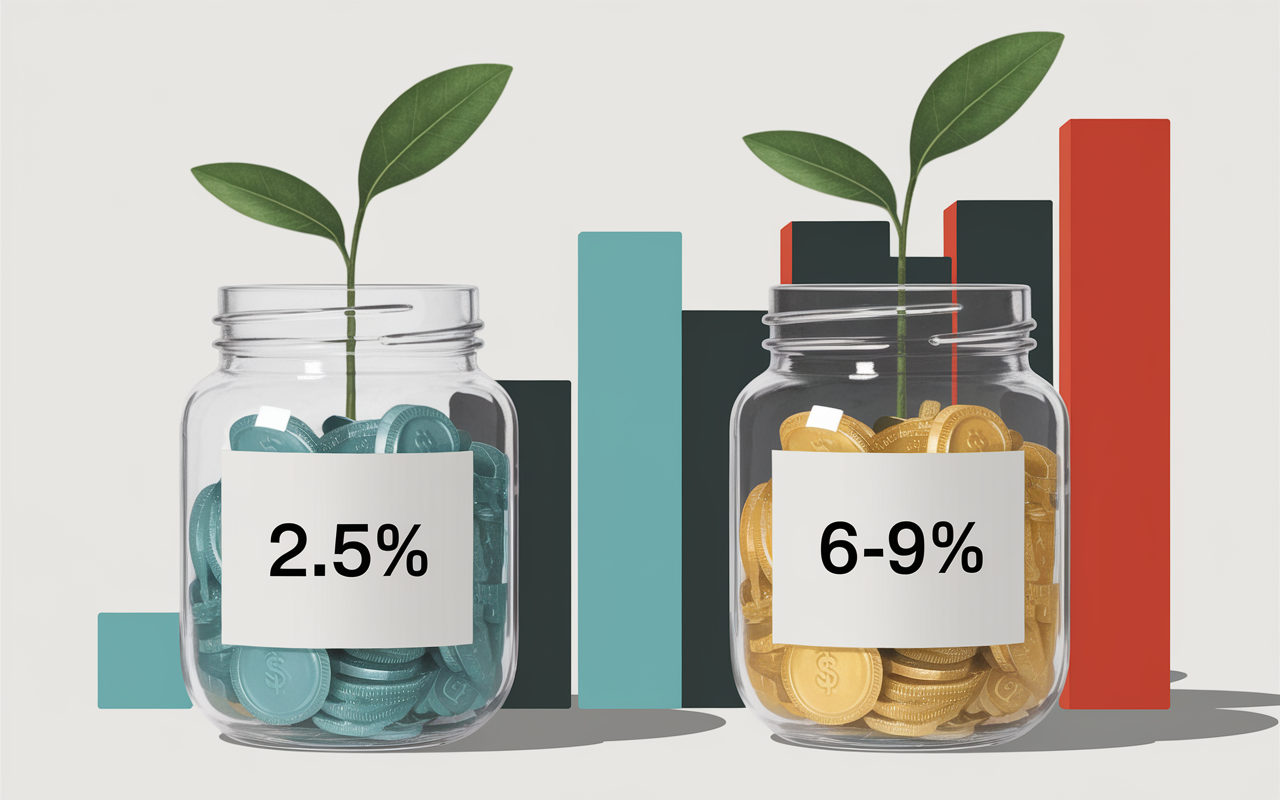
- Funds in euro, offering guaranteed capital : the yield is around 2.5 % per year after fresh (point offers can climb up to 5 %, but they remain rare and limited in duration).
- Units of account (UC), invested in shares, SCPI, ETF... : expected return of 6-9 % per year long-term (exposure to the risk of capital loss, extent of changes depending on the year).
What gains do we hope in practice? For example, place 10 000 € on a fund in euro 2,5 % net supply about 2 100 € earnings in 8 years (excluding taxation), while the same amount on a dynamic allowance may exceed 9 000 € earnings in 8 years, provided that markets remain strong (never acquired in advance). Well-known detail: after 8 years, taxation significantly eases thanks to a reduction up to 4 600 €/year. Compared to Book A, the investment ceiling is much higher, sometimes reaching several hundred thousand euro.
It is best not to limit itself to the performance displayed. Fees and taxes affect the final result considerably. Several professionals in the sector sometimes tell their customers about this surprise, a bit like when travelling by taxi: the amount displayed does not necessarily correspond to the final invoice. It is relatively often observed that the net yield of a well-adjusted life insurance exceeds that of a Book A (fixed at 3 % until January 2025, and 1,5 %) or an ELP, especially over time. It is generally recommended to compare and simulate before entering, as performance gaps between contracts are sometimes clear.
Finally: between 2,5 % net/year from a euro fund and 6-9 % On UC piloted over 10-20 years, the result depends mainly on the distribution of the contract, the negotiation of costs, its seniority and the degree of risk taken.
How much does life insurance pay? Clear answer and key figures
We talk about it regularly, but life insurance hides a more complex mechanics than we think. Let us take a closer look at the essentials to understand its true profitability.
Life insurance refers to a medium- and long-term savings contract set up by banks, insurers or specialized distributors (more than 43 million contracts opened in France). It is used to value capital and/or anticipate transmission with favourable taxation on exits after 8 years. The saver allocates his funds according to various options:
- The funds in euro guarantee the totality of the capital (the default risk of the insurance group remains exceptional), with measured but regular yield.
- The Units of account offer various media: shares, real estate, bonds, ETF... Exposure to market movements. The gain potential is higher, but the possibility of losses also exists.
Finally, the performance of life insurance depends on the "mix": any safety (euro funds) or a significant share in the markets? Some brokers explain to their customers that it looks like the choice of cooking their eggs: each chooses its dose of caution and audacity, according to its objectives.
Definition and operation of life insurance
Is it easy to untangle real performance? There are several key trends.
The reality of the funds in euro
The evolution of funds in euro shows a gradual decline over the last two decades, but a certain resistance in 2023-2025, driven by the rise in rates:
- 2.5% in 2025 net management fees (source Bestrates, main comparators), excluding temporary premiums.
- 5 % on certain offers for new payments, provided that a share is placed on UC (adhesive bonus, duration from 6 to 12 months).
These results are net of annual charges in general, but gross of taxes.
Performance on units of account
UCs do not protect capital, but the higher yield potential attracts long durations. According to various actors (Linxea, Prosper Conseil, Meilleurtaux):
- Prudent allowance (20 % UC): 3 to 5 % annual average of 10 years
- Balanced allocation (50% UC): around 5-6 % Annual
- Dynamic allowance (80 % UC): 6-9 % expected, negative years may occur
Some brokers report a performance of +152% over 10 years with an 80% UC share. However, these results remain uneven: we must accept some volatility and maintain our investment over time (often recommended: at least 8 years).
Observed return on funds in euros and units of account: recent figures
It is really worth dealing with fees and taxes if we want to capture what life insurance brings. They are the "synthesis sheet" that sometimes transforms the promise into reality on your account statement.
What fee to monitor?
The most recent and compared contracts include:
- 0 % payment fees (on most online platforms or specialized brokers)
- Management fees in euro : 0.50 % to 0.77 %/year (already deducted from the official rate)
- Management costs UC 0,60 % to 1,2 %/year
- Arbitration costs 0-0.2% (usually free arbitration each year)
A fee adjustment visibly impacts the result over 10 or 20 years! Some professionals stress the importance of comparing the list of proposed ETFs or "star funds" as a contract may impose additional costs on external media. That is why it is best to make a careful comparison.
Reduction and taxation after 8 years
The tax advantage becomes maximum if the investment is kept longer. After 8 years of detention, life insurance offers:
- Annual tax reduction of 4,600 € (person alone) or 9 200 € (couple) on earnings, excluding social contributions
- Possibility to choose between single flat-rate levy (SPF) at 7.5–12.8% or inclusion in income tax
- Almost zero taxation for progressive withdrawals, subject to the reduction
The net "truth" thus affects according to the withdrawals and age of the contract: beyond 8 years, taxation tends to stop holding back earnings. In practice, many trainers refer to the usefulness of a high-performance tax simulator to project what will really be hit "in the pocket".
Figures by amount and duration
Need a situation to visualize profitability? Three typical cases usually taken in the field:
Scenario 1: Euro funds 2.5% net over 8 years
You place 10 000 €no monthly contribution. Term (8 years):
- Final capital: 12 137 € (loss of 2,137) €, excluding taxation)
Scenario 2: Monthly payments and dynamic allowance 6%
You invest 10 000 € + 200 €/month for 8 years, on a dynamic UC allowance. At the end of the course:
- Final capital after 8 years: 38 213 € (gain: +9,000 to +10,000) € where applicable, excluding taxation)
Scenario 3: 100,000 € 30 years, dynamic profile
In 30 years, with 100,000 € invested in UC:
- Final simulation: between 324 340 € (profile prudent) and 661 437 € (dynamic profile)
| Amount invested | Duration | Profile/funds | Estimated final capital |
|---|---|---|---|
| 10 000 € | 8 years | Euro Fund (2,5 %) |
12 137 € |
| 10 000 € + 200 €/month | 8 years | Dynamic UC (6 %) |
38 213 € |
| 100 000 € | 30 years | Prudent (3.5%) | 324 340 € |
| 100 000 € | 30 years | Dynamic (6.5%) | 661 437 € |
It can be assumed that these projections illustrate the major trends. Some markets sometimes record abrupt corrections or accelerate suddenly, but these figures provide a solid basis for reflection.
Compared to other competing investments
What can you compare life insurance? Booklet A or PEL are often cited as "marks". Here's a picture to better guide you.
| Placement | Annual net return | Ceiling | Security | Taxation |
|---|---|---|---|---|
| Euro AVC Fund | 2.5% (up to 5% with bonus) | ~ Too high to be limited | Guaranteed | Low after 8 years |
| Units of account | 6-9 % (hopeful, unsecured) | – | Unsecured | Low after 8 years |
| Book A | 1,5 % | 22 950 € | Guaranteed | Exemption: |
| PEL opened in 2025 | 2,25 % | 61 200 € | Guaranteed | + tax + PS after 12 years |
| SCPI | 4-6 % (hope) | No | Underlying real estate | Submitted to IR + PS |
Last point to note: for maximum security, Booklet A remains unbeatable (low yield, quickly reached ceiling). If your goal is to increase profitability and fiscal flexibility over the long term, it is best to focus on a well-diversified life insurance – with the possibility of adjusting your risk taking according to your profile.
Frequently Asked Questions (FAQs)
Sometimes some hesitations remain: here are concise answers to resolve common questions.
How much does a life insurance cost a year?
In 2025, count 2.5 % net/year on a classic euro fund, up to 5 % with bonus and 6-9 % on a UC driven for 10–20 years (without formal warranty).
Do units of account earn more?
As it seems, yes, in the long term (10–20 years) when markets are strong. It is noted that some prudent savers prefer to limit their exposure to preserve their tranquility in the face of variations.
Is life insurance more profitable than Book A?
In some respects, a good distribution makes life insurance exceed Book A from 8 years or more. However, the short-term security of Book A remains unmatched.
Can we lose money in life insurance?
No on a euro fund (excluding major default of the insurer). Yes for UCs, especially in times of stock market crisis: diversification and duration remain your allies to cushion turbulence. As one counselor said: "a little emotional elevator" is never excluded.
How long after life insurance becomes attractive?
From 8 years onwards, the maximum tax reduction favours regular withdrawals; before this period, life insurance is already interesting from 3–5 years for savings outside the book.
What fees should be deducted from the posted return?
Count the management costs (0.50 to 1.2%/year), sometimes arbitration costs (0–0.2%) and the "external funds" costs OPC/FCP (see contract information notice, generally not read).
How much to invest to make it pay?
From 1 000 € (and sometimes 500 € in some brokers), but the tax optimisation threshold is regularly found between 10 000–15 000 € or 30 000 €+ to access the diversity of options and real diversification.
Fast simulation: how much does 10,000 pay € 8 years?
To 2.5 % net/year, about 2 137 € gains. To 6 %, near 6 357 € (excluding taxation).
Does taxation significantly reduce the final gain?
Much less after 8 years, thanks to the reduction that makes it possible to extract a large part of the income tax-free earnings. Systematic provision for social levies (17,2 %).
Life insurance really is. « without risk » ?
Yes on Euro funds, no on UC. It is often recommended to mix and adjust according to his profile, and never invest "by automation": test, if possible, a simulator, compare costs, validate your options and then arbitrate.
Want to project your own earnings or compare the most advantageous contracts? Launch a custom simulation or ask for a specialist advisor (ORIAS approved). Simulate my performance