
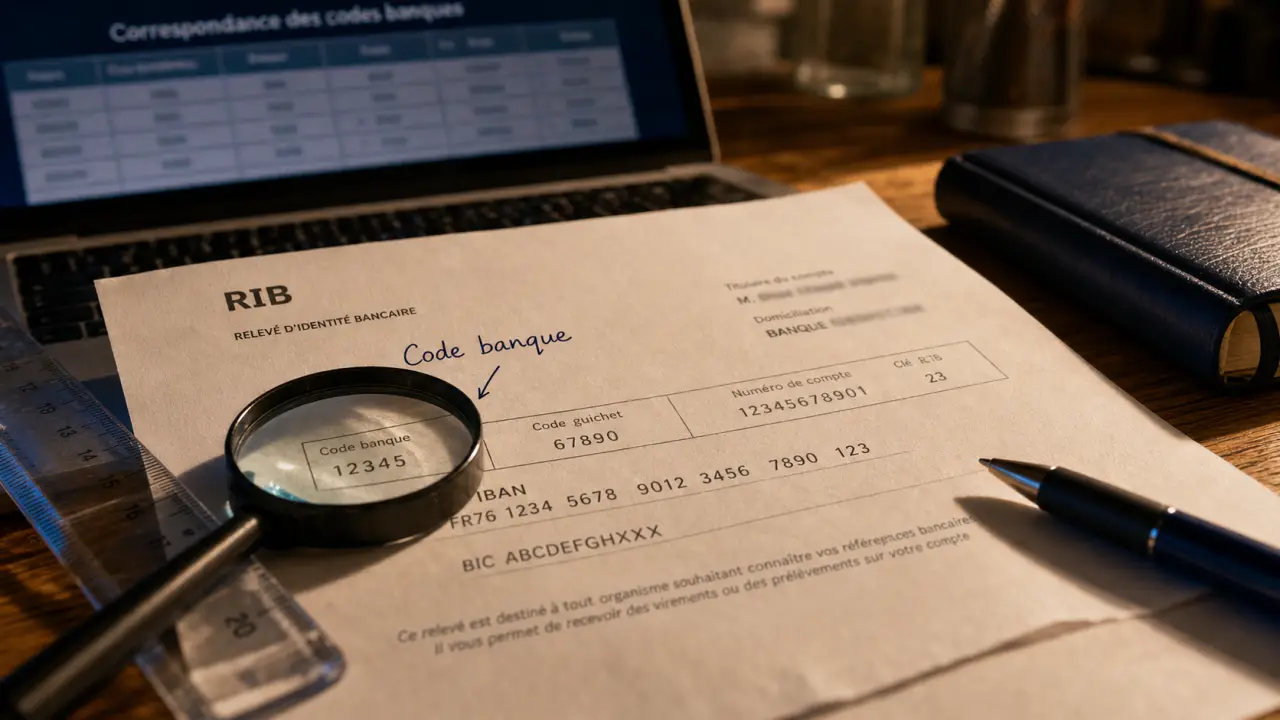

The bank code is used to identify the institution that holds a bank account. It is consulted especially when reading a RIB, that we check a IBAN or prepare a transfer without error. Its shape is simple, 5 digits, allocated to a bank or financial institution according to the interbank nomenclature.
The difficulty rarely comes from the code itself, but from its reading. It should not be confused with the window code, account number, RIB key or BIC/SWIFT. Here is a clear benchmark to understand where it is, what it is for, and how to verify a bank-code match with method.
Bank code: what these 5 numbers really mean
A bank code is a continuation of 5 digits which identifies a banking institution in the coordinates of an account. It is attributed by the Bank of France and makes it possible to recognise the bank concerned in interbank exchanges. In practice, it remains the same for clients attached to the same institution, even if other elements of the BIR vary according to the agency or account.
Understanding the RIB, IBAN and BIC: the official guide · Find out all you need to know about your bank details and their usefulness thanks to this practical card from the Banque de France.
On a bank identity statement, it appears along with several other information blocks. The most common order is: bank code, counter code, account number, RIB key. The bank code is therefore not sufficient to identify a specific account. It only indicates the establishment. To link the information to a holder and to a given account, read all the elements together without isolation.
The difference with the window code
The window code is also composed of numbers, but it does not play the same role. Where the bank code refers to the institution, the window code usually refers to an agency, management centre or internal entity. Two customers from one bank can therefore share the same bank code, while having different bank codes.
This distinction counts when you copy a RIB manually. Inverting the two blocks or deleting a zero at the beginning can make the coordinates unusable. Serious forms rarely require the only bank code. Instead, they demand the complete IBAN, which already incorporates the information necessary for the operation.
The difference with BIC or SWIFT
The BIC, also known as SWIFT code, is used to identify a bank within an international framework. It is used in particular for certain cross-border transfers. The bank code belongs to the French structure of the RIB and intervenes in the national identification of the establishment.
For a current SEPA transfer, IBAN generally remains central information. The BIC can still be requested in some contexts, but it does not replace the bank code. The two identifiers have different uses and complement each other in different situations.
List of bank codes: reading table and useful examples
A list of bank codes should be read with caution as institutions may merge, change business names or use more than one legal entity. A table found online may help to understand a match, but the final check must always be done on a recent BIR, in the banking customer area or with the institution concerned.
| Bank code | Associated institution | To be retained |
|---|---|---|
| 30002 | LCL | Current example of French 5-digit bank code |
| 5 digits | Bank or financial institution | Standard bank code format on a RIB |
| Present in IBAN | French bank account | The code is integrated into the bank details structure |
| Assigned by the Bank of France | Authorized institution | The correspondence is covered by an interbank nomenclature |
To obtain reliable correspondence, the safest is from the official bank document. If you have the RIB in front of you, the bank code is already present. If you only have a business name, check the information in the customer area, on a recently downloaded RIB or via the institutional resources of the Bank of France andACPR.
It should also be borne in mind that a single bank brand can rely on several structures depending on the products, regions, subsidiaries or history of the account. A search by bank name can therefore sometimes give several results. In this case, the official BIR always takes precedence over a general list, especially if you are preparing a sensitive operation or a contact information record.
Where to find the bank code on a RIB or in an IBAN
The most direct way is to look at your Bank Identity Statement. The bank code is usually the first 5-digit block in the detailed portion of the RIB, before the counter code. It can be displayed under explicit wording, such as "Bank Code", or appear in a structured line with other account references.
In a French IBAN, the bank code is also included in the bank details. A French IBAN starts with "FR", followed by two check figures, followed by elements from the RIB. We often meet a presentation of the type FR76XXXXX, where the following characters are involved in bank identification. To avoid errors, it is best not to extract information by eye if you are not sure of the structure. Copy the complete IBAN from an official source.
Good reflexes before copying a code
Before using a bank code, check three simple points: is the document recent, does the name of the holder correspond to the person or company expected, and is the complete IBAN consistent with the RIB? Failure to enter a number may be sufficient to block a transaction or trigger a verification request.
The right reflex is to read the RIB as a set. The bank code, the counter code, the account number, the RIB key and the IBAN are controlled together. An exact code alone does not guarantee that the entire record is good. Errors often come from a partial copy, an old document or a figure forgotten in the middle of a long line.
What the bank code is for in current transactions
The bank code is first used for identify the banking institution. In the context of a transfer, it shall participate in the recognition of the contact details of the account to which the account relates. It also facilitates the reading of a BIR when you want to understand to which bank an account is attached, for example in an administrative, accounting or professional approach.
It may also be useful in internal control. A company that records the contact details of its suppliers may verify that the bank code, IBAN and the name of the establishment are not clearly inconsistent. This is not an absolute guarantee against fraud, but it is a first useful level of vigilance before validation.
Why not use an old list without control
Banks are changing. Some brands merge, agencies close, subsidiaries change perimeter, online establishments appear. An old list can therefore retain a trade name that is no longer used on recent documents. The code must be checked in its actual context.
In practice, if you are preparing a major transfer, do not just have a match found in a table. Ask the beneficiary for a recent RIB, compare the visible information and prefer the full IBAN entry. If there is any doubt, contact the bank or beneficiary via an already known channel, not via the contact details in a suspicious message.
Check a bank code without mistake
To find or control a bank code, always leave the most reliable information available. The most prudent classification is simple: first the RIB downloaded from the customer area, then the bank application, then the documents submitted by the bank, and finally the public lists used as correspondence marks.
- From an RIB : Find the "Bank Code" block or the first 5 digits of the detailed RIB line.
- From an IBAN Use the complete IBAN instead of manually extracting the numbers if you are not used to it.
- From the name of a bank Check that it is not a subsidiary, an online bank or an old name.
- From a single code : confirm correspondence with an official bank document before any sensitive transaction.
The good practice is to treat the bank code as an identification index, not as an autonomous evidence. It helps to read and control the coordinates, but it must always be close to the full BIR, the IBAN and the context of the operation. This combination makes the use of banking information safer and more reliable.