

Understanding the calculation of the interests of Book A In 2025, it is possible not to fall into the traps of the banking calendar while serenely optimising its payments. With a bit of a method, everyone can really benefit from the three successive rates and the famous fifteen, without being taken off guard by the official mechanics.
When we rely on concrete examples and proven tools, it becomes easier to clarify the actual remuneration of our savings. If each movement is adjusted, it is possible to maximize the gains on this regulated booklet You must.
Summary of key points
- ✅ The calculation of the interest of Book A is based on the fifteen, dividing the year into 24 periods.
- ✅ Three successive rates in 2025 apply according to the period of the year.
- ✅ Optimizing the timing of payments and withdrawals improves profitability.
Calculating interest Booklet A 2025: the simple formula and the tricks to know

You are looking to understand in a few minutes how your interest is calculated on Book A in 2025? The method, in reality, remains very accessible when we know the official formula and this famous division into "fortnight term" which governs the earnings. No ambiguity here: it is the concrete points that even count the chain of the three rates of 2025 and the direct impact of your payments and withdrawals.
To be remembered now: your interest for 2025 is determined by applying to your paid balance the current rate and the number of past fifteen, all divided by 24 (since each year there are 24 fifteen). Three rate periods followed in 2025 (3 % in January, 2,4 % February to July, 1,7 % August to December). In order for your payments or withdrawals to generate interest, timing in relation to the 15 calendar remains decisive: some savers learn to spend each year.
Precise examples and optimisation tips await you below, as well as a perspective with other market booklets. Mastering these rules will allow you to regain control over the evolution of your savings, even without extensive banking expertise!
What are the rates of Book A in 2025 and their calendar?
Each year, the rate of Book A changes following a formal decision, usually directly linked to inflation. In 2025, you have to juggle with three rates, this little puzzle does not always make it easy to read the winnings for each.
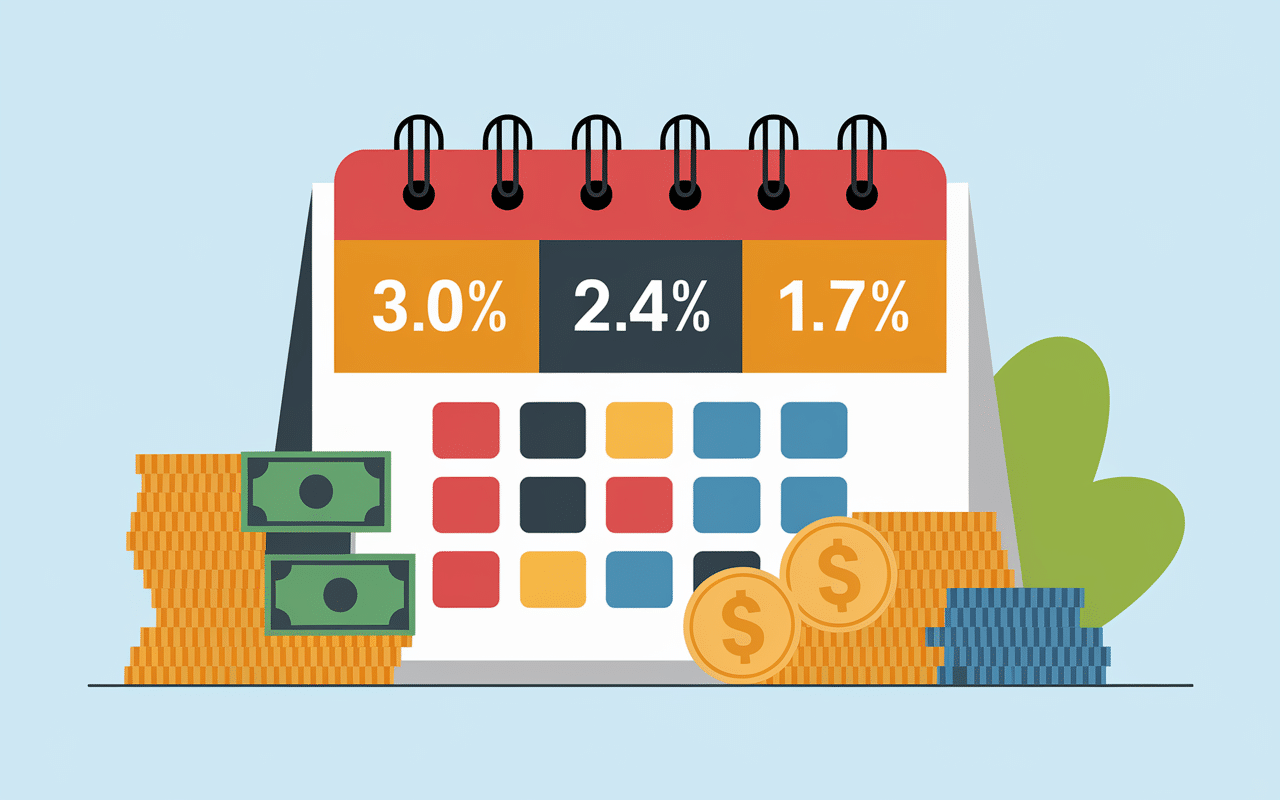
Here is the precise schedule of rates applied to Book A in 2025:
- of 1and as at 31 January 2025: 3,0 %
- of 1and February to July 31, 2025: 2,4 % (down by public authorities)
- of 1and August to December 31, 2025: 1,7 %
Imagine: a 10,000 deposit € on 1and February will not generate the same interest as a similar payment in January. This contrast, far from being a subtlety reserved for experts, makes sense for anyone who wants to invest a substantial sum or plans a transfer at a key point in the year. Some professionals believe that this detail regularly causes many savers to miss several euros, especially among those who pay late.
| Period | Annual rate |
|---|---|
| 1 - 31 January 2025 | 3,0 % |
| 1 February – 31 July 2025 | 2,4 % |
| 1 August – 31 December 2025 | 1,7 % |
Is it still a dark gymnastic in your eyes? It is commonplace: simulators also have a notable success with individuals who want to see more clearly (e.g. more than 4,7/5 user reviews on BestRates). Some customers say, for example, that they have avoided a mistake of several tens of euros thanks to a preliminary simulation.
Why and how do you calculate interest by fortnight?
The Book A has a peculiar characteristic: the calculation of interest is not made on a day or even a month, but on a fortnightly basis. 24 year). This cutting directly affects the actual performance of your investments a bank trainer recently confided to see every year customers surprised by this technical detail.
In practice, it is the "lowest" balance of each fortnight that serves as the basis for calculation:
- Two periods per month: of 1and at 15, then from 16 until the end of the month (24 fortnights per year)
A deposit is used in the calculation only if it is made before 16 or 1and of the month. On the other hand, a withdrawal interrupts earnings from the previous 15 years. It is not uncommon to find that a mere 24-hour delay results in an unexpected loss of "day of interest". This mechanism, often unknown, makes the difference on several hundred EUR deposited.
To illustrate this logic:
Mathis plans to pay 2,000 € on his Booklet A on August 16, 2025. However, his interests will not begin to run until the 1st century.and September, or the next fortnight: any deposit after the 15th will bear fruit only from the beginning of the following month. We understand better why some families choose to schedule their movements at the beginning of the month!
Optimizing payments: practical instructions
For your money to be paid right away, it's better to place the deposits just before 1and or the 16 of each month. On the part of withdrawals, it may be wise to postpone them immediately after these dates, in order to avoid "losing" about fifteen unpaid – a trick often blown by advisors when opening booklets.
Some useful reference points:
- A payment made on the 15th or at the end of the month will start producing interest from the next 15th
- A withdrawal planned just after 1and or 16 makes the most of the paid period
Some users add a reminder to their calendar or smartphone, and find that this simple automation improves their performance effortlessly. Is it really so binding? Many find that the gain, even modest, deserves attention.
Good to know
I recommend that you schedule your payments just before the 1st or the 16th of the month to maximize your interest, and defer withdrawals immediately after these dates so as not to lose about 15 compensation.
The formal formula explained step by step
Let us take a closer look at how the famous formula works, common to all banks authorized to offer Book A.
Formula for calculation:
Interest = Amount placed × (annual rate / 100) × (number of 15 paid / 24)
For each past 15 years, the bank shall retain the recorded minimum balance ; the corresponding rate then applies per period and then the whole is divided by 24 (a full year's pay). This mechanism has nothing to do with esotericism: it is based on an old administrative logic, adapted to the evolution of banking products.
When the exchange rate in the course of the year – as it happened in 2025 – each "band" of fifteen must be calculated separately with the appropriate rate, before adding it up. A professional in the sector recently recalled that the annual statements systematically summarize this detailed calculation, even if the client only sees the final total.
Want to see a real application? Take a look below:
Concrete example
For a deposit of 10,000 € carried out on 1and February and maintained until the end of December:
– Between February and July: (10,000 × 2.4% × 12/24) = 120 €
– August to December: (10,000 × 1.7% × 10/24) = 70,83 €
Total over year: 190,83 € Gross, rounded to a cent at annual closing.
The built-in simulator on MoneyVox or Comparabanks.fr will give you a similar result – it is valuable for those who fear to be wrong with the three separate rates! For example, one bank reports details of each period, which few banks report by default.
Concrete examples of interest calculations Book A
To capture the combined effect of rates and fortnights, nothing like a living example. Sometimes a saver discovers real mechanics at a major event, such as an anniversary or a university year back.
Case 1: Year-round saving
Let's admit that 11-year-old Léna received 1,200 € in January on his Booklet A. All interest will be calculated successively over each period, based on the three rates.
- January: 15 to 3% → (1,200 × 3% × 1/24) 1,50 €
- February to July: 12 fortnights at 2.4% → (1 200 × 2.4% × 12/24) = 14,40 €
- August to December: 10 fortnights to 1.7% → (1 200 × 1.7% × 10/24) 8,50 €
At the end of the year, Lena will benefit from 24,40 € interest, without any tax or social levy to be paid (this is a major asset in the face of many other investments).
Case 2: In-year payment
Imagine a deposit of 5,000 € On 20 March 2025, it will only produce interest from the 15th beginning on 1 March 2025.and April. The calculation therefore begins later.
- April to July: 815 to 2.4%
Remuneration = (5,000 × 2.4% × 8/24) 40 € - August to December: 10 fortnights to 1.7%
Remuneration = (5,000 × 1.7% × 10/24) 35,42 €
About 75,42 € at the end of the year, provided that no withdrawal is made before 31 December. Some savers evoke the surprise of seeing a scar in case of early withdrawal!
Case 3: Partial withdrawal at the end of summer
By withdrawing 4,000 € On 17 August, the remuneration for this sum ceased from the previous 15th, therefore on 15 August. This kind of subtlety is largely underestimated at the time of the decision, recalls one advisor; It is not uncommon for a simulation, even late, to highlight this "lack to win".
How to optimize your winnings on Book A?
Now that the rules are laid, it is worth tying on some optimisation reflexes accessible to all. According to the experience of several banking agents, real gains are sometimes played for a few days!
To better understand the subtleties of calculating the interest of Book A and optimize your investments, discover our comprehensive guide on Booklet A calculation of interest: understand, simulate and optimize your earnings.
To optimize your investments and understand the subtleties of the banking calendar, discover our complete guide on Booklet A calculation of interest: method, rule of fifteen and concrete simulator.
To optimize your finances in 2025, it is essential to anticipate changes such asPension increase 2025: rate, amount, schedule and real impact for your pension.
Knowing that each euro paid benefits from a "half-quinzain" of more or less accentuates the importance of choosing the date. Relatively often, family calendars, purchases or holidays influence the timing of deposits and withdrawals, and it is by anticipating that the advantage is gained.
- Place your payments just before 1and or 16 of the month, to optimize their consideration
- Decal your withdrawals immediately after these dates, in order to benefit from an additional fifteen full
- Consider planning tailored to your projects: events, major purchase, travel, work... anything can be planned to avoid a loss of interest
If an unforeseen event occurs, it may happen that waiting a few days to withdraw or, on the contrary, advance a payment makes it easy to earn a few more euros. On a ceiling of 22 950 €This is not anecdotal over the year. A former agency director testifies to savers who have improved their annual performance by adjusting just one or two operations.
Useful clarification: Interest paid on December 31 may, if your Book A is already on the cap, temporarily exceed it – no risk, the regulations provide for it. Subsequent deposits will simply be put on hold the time to re-enter under the 22 950 €.
Comparison Booklet A vs. other regulated booklets
To maximize each euro, it may be wise to compare Book A with other state books, such as SARA or LDDS. With the expected decrease in 1,7 % At the end of 2025, profitability is not every year the most attractive... Some professionals believe that too few clients arbitrate from one booklet to another as rates fall.
| Product | Rate 2025 | Ceiling | Special features |
|---|---|---|---|
| Book A | 1,7% / 2,4% / 3% | 22 950 € | Exempt, accessible to all |
| SARA | 2.7% to 3.5% | 10 000 € | Resource conditions |
| LDDS | 1,7% / 2,4% / 3% | 12 000 € | Similar to Book A |
The security of capital on Book A reassures unquestionably, but if you can claim SARA (Bookt of Popular Savings), this can significantly improve your remuneration – sometimes until 3,5 %. According to some sources in the sector, a quick simulation often allows the profit to be quantified without (too many) calculations.
Last detail that counts: once inflation is taken into account, the actual profitability of Book A will not exceed 0,69 % December 2025. This criterion weighs in the balance for many well-informed families.
FAQ – Special cases and frequent errors
Although universal, Book A always raises some practical questions and many ideas received. Here is a panel of situations frequently mentioned during appointments or on savings forums, based on the experience gathered by several industry experts.
How do I calculate my interest if I made a payment on February 20?
The calculation of interest starts at the 15th of the 1stand March only. If the sum remains in the account until 31 December, some 20 (March to December) will have to be taken into account and the interest will have to be broken down at each applicable rate. Some bank advisors also recommend always checking this with a simulator, to avoid any projection errors.
Why is the calculation done by fifteen and not by month?
This division goes back to the national banking organisation and continues to impact the real remuneration: a deposit at the beginning or mid-forties can generate up to 15 unpaid days. Some customers only discover this detail after several years of saving!
Can I exceed the ceiling with capitalized interest?
Yes: interest credited at the end of the year can get you over the ceiling of 22 950 € No impact. However, no further payments will be accepted until the balance has been returned under this limit, in accordance with existing regulations.
Are Book A's interest subject to tax?
Interest on Book A is fully exempt from income tax and social contributions. This makes the product particularly attractive to many alternative investments!
Does the rate applied in August 2025 change my annual interest?
This is also the reason why all balances held from 1 January toand August 2025 are paid at 1,7 %. To understand the exact impact according to your dates or amounts, it is often useful to perform a simulation on a specialized platform.
Can I make a quick calculation "amount × average rate"?
In practice, this provides only a relatively rough estimate, since the rule requires a distinction between successive periods of rates. To achieve a reliable result, it is best to use a tool that takes into account the specifics of the past year.
Where can I find a reliable simulator?
Free simulators exist on MoneyVox, Comparabanks or most banking sites. According to a recently published survey, their satisfaction rate exceeds the 4,6/5 on average ensuring a rapid response adapted to all common situations.
Practical tools: simulator, summary diagram and consultant contact
To save time or to check an estimate, most major platforms provide an online interest simulator: just specify the sum, the deposit date, and the tool automatically applies the three 2025 rates to your situation. Users report that in a few clicks they get a relatively detailed calculation avoiding many hesitations.
- Simulator Calculation Bookt A – Comparabanks.fr
- Book Simulator A 2025 – MoneyVox
- Official Information – Service-Public.fr
For specific questions (multiple accounts, savings on behalf of a child, tax context or advanced strategy), a bank advisor is available Monday to Saturday from 8am to 8pm in the majority of institutions. Do not underestimate the impact of a short human exchange: sometimes some personalized advice leads to several tens of euro saved, or even to a judicious arbitration.