
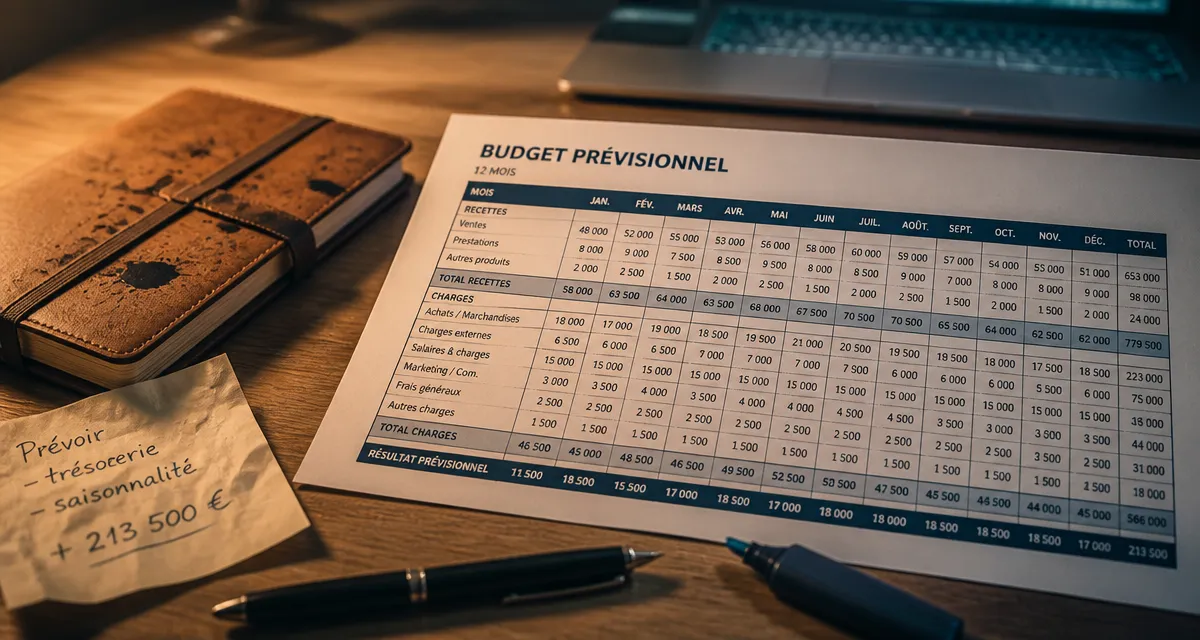

Starting an activity without financial visibility is like navigating without compass. The estimated budget turns intuition into a structured project. More than just a simple table, it is an encrypted simulation of your business and operational strategy over a 12-month period. Whether you are in the creative phase, in associative management or in search of funding, articulating your revenues and expenses is the first step towards sustainability.
What does a concrete forecast budget look like?
The first difficulty often lies in the visualization of the final document. A forecast budget is not a fixed accounting document, but rather a dynamic dashboard. It is presented in the form of a double entry table: the months of the year in columns and the categories of online financial flows.
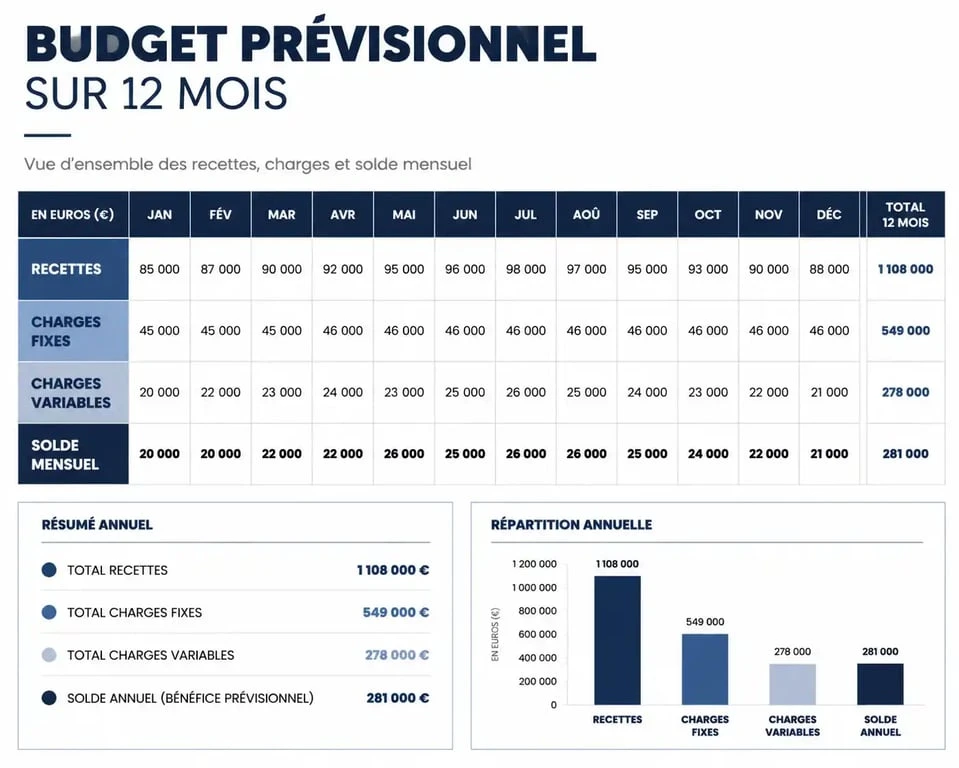
The model structure of a forecast table
The document is divided into two masses: cash receipts (what comes in) and disbursements (what comes out). The objective is to calculate, month after month, the cash balance. The following elements are present in the majority of professional models:
The products These include forecast turnover, subsidies, capital injections and bank loans. The Expenses include purchases of goods, rents, insurance, wages, social contributions, taxes and communication costs. Finally, the monthly balance is the difference between inflows and outflows, while the accumulated balance shows your cash position at the end of each period.
Example Budget for Service Delivery
| Budget items | Month 1 | Month 2 | Month 3 | Total Quarter |
|---|---|---|---|---|
| Income (Sales) | 5 000 € | 7 500 € | 10 000 € | 22 500 € |
| Fixed charges (Lyer, Web) | 1 200 € | 1 200 € | 1 200 € | 3 600 € |
| Variable costs (Subcontracting) | 500 € | 800 € | 1 200 € | 2 500 € |
| Monthly Balance | + 3 300 € | + 5 500 € | + 7 600 € | + 16 400 € |
The 5 steps to build your own forecast
Realizing an estimated budget requires rigour. It is not about guessing the future, but planning it with solid assumptions. Overly optimistic forecasts may lead to a cash breakdown, while excessive pessimism may unnecessarily hinder your development.
1. Realistic estimation of turnover
This step is based on concrete data: market research, order book or average basket observed in competition. It is recommended to create three scenarios: a scenario « Low » prudent, a scenario « Median » likely and scenario « top » optimistic.
2. List all operating expenses
Don't neglect any details. In addition to items such as rent or payroll, include current expenses such as bank charges, software subscriptions, office supplies or accountant fees. Do not forget the social security contributions if you plan to pay yourself.
3. Integrating investment and financing
Purchase of a machine, vehicle or furniture is included in your initial disbursements. At the same time, personal contributions or bank loans strengthen your liquidity in the revenue column. This section checks that you have enough cash to start business before the first sales arrive.
4. Anticipate cash lags
A classic mistake is to confuse billing and cashing. If you charge 10,000 € in January but that your client pays at 60 days, this money only appears in your budget in March. The forecast allows you to anticipate these hollows and to request, if necessary, an authorized overdraft from your bank.
5. Create a secure environment for your numbers
For this document to become a lever of growth, see it as a protective space. By isolating each flow, you create a perimeter that prevents uncertainty from polluting your decision-making. This structured framework absorbs unexpected shocks by allowing you to immediately visualize the impact of a drop in sales on your survival at six months.
Differences between budget, profit and loss account and forecast balance sheet
These three documents are often confused, yet they meet different needs. To drive effectively, identify the one to consult according to your situation.
The forecast budget: cash flow
He answered the question: « Will I have enough money in the bank next month to pay my bills? ». It focuses on the real flows of money and includes VAT, unlike accounting documents that often reason without taxes.
The profit and loss statement: profitability
He answered the question: « Does my business generate profit? ». It compares revenues and expenses over a full year. One can have a positive profit and loss account while having cash in red due to customer payment delays. This is where the threshold of profitability is calculated.
The forecast balance sheet: the wealth
He answered the question: « What does the company own and what does it owe? ». It is a photograph of the company's value at the end of the fiscal year. It lists assets (capital assets, stocks, receivables) and liabilities (social capital, bank debts, supplier debts).
Common Errors and Update Tips
A forecast budget is never final. Its usefulness lies in its confrontation with the real. Here's how to avoid classic traps and maintain a powerful tool.
Fatal oversight in spending
Many entrepreneurs forget jobs such as the CFE (Enterprise Fund Contributions), social security payments in year 2 or the cost of digital marketing. Always plan a line « Unplanned » representing about 5% to 10% of your total loads to absorb hazards without endangering your structure.
Variance analysis: the secret of flying
At the end of each month, compare your forecasts with the reality of your bank account. If you find a significant difference, look for the cause: late payment, exceptional expense or error in estimate. This analysis allows you to adjust your forecasts for the remaining months and take immediate corrective action, such as reducing certain charges or a more active customer recovery.
The importance of appropriate tools
If Excel remains a reference to start with its flexibility, it can become a source of error. For complex or growing projects, the use of financial management software or support by an accountant is preferable. These solutions automate the recovery of bank data and generate more legible tracking charts for your financial partners.