


Making an online bank transfer has become a routine for thousands of consumers attentive to their finances. Whether it's to pay rent, pay a loved one back or schedule a recurring payment, the transaction seduces with its simplicity and autonomy – provided that each parameter is controlled. This dossier sets out the essential steps to be taken, the criteria to be checked, and the precautions to be taken to limit any risk of error or additional costs when transferring online.
What is an online bank transfer
An online bank transfer allows you to transfer money from one account to another without going through an agency or a counter: everything is done from your bank's customer area or mobile app, accessible at any time, computer or smartphone in hand. This tool responds to self-management needs, and is now the standard for paying expenses, transferring funds between accounts, or making remote payments.
The main advantage of online transfer is its speed of execution, its lack of formalities and, often, its free of charge for domestic and SEPA transfers. Both traditional and online banks offer this solution, where agency transactions are sometimes billed.
To make a transfer correctly, you need to know three concepts: IBAN (international account number), RIB (detailed banking identity) and BIC / SWIFT (Bank identification code). These data are essential to secure and route the transaction.
Types of bank transfers online

Online bank transfers are available according to destination and frequency:
- Internal transfer between your own accounts, in the same bank, usually instantaneous and without ceiling.
- External transfer : to a third party, in the same bank or not. SEPA transfers are fast and capped, while non-SEPA transfers impose additional costs and delays.
- One-time transfer : for a single payment. Flexible and suitable for daily management.
- Permanent transfer To be programmed for recurring payments (rent, pension, etc.), limiting forgetfulness.
- SEPA instant transfer : transfer in less than 10 seconds, 24/7, with a cost sometimes charged to the transaction.
International transfers outside the SEPA area, subject to exchange rates and charges, should be prepared carefully, comparing offers and banking conditions according to the country of destination.
Information needed to make an online bank transfer
A transfer requires several information about the beneficiary:
- The complete BIR (with IBAN and, for international transfers, BIC/SWIFT).
- Name of beneficiary, useful for monitoring and identification, even if the IBAN premium for validation.
- Amount and reference transfer (motif or comment, optional but useful to find it).
Attention: each character counts. An error of IBAN or BIC can cause credit to a bad account. The practical advice is to scrupulously compare the information received with that seized, via a secure channel. Some banks offer automatic validation before confirmation, which reduces risks.
Prefer to transmit and receive bank details via secure means, never by unencrypted mail or instant messaging to the general public.
Steps to make an online bank transfer
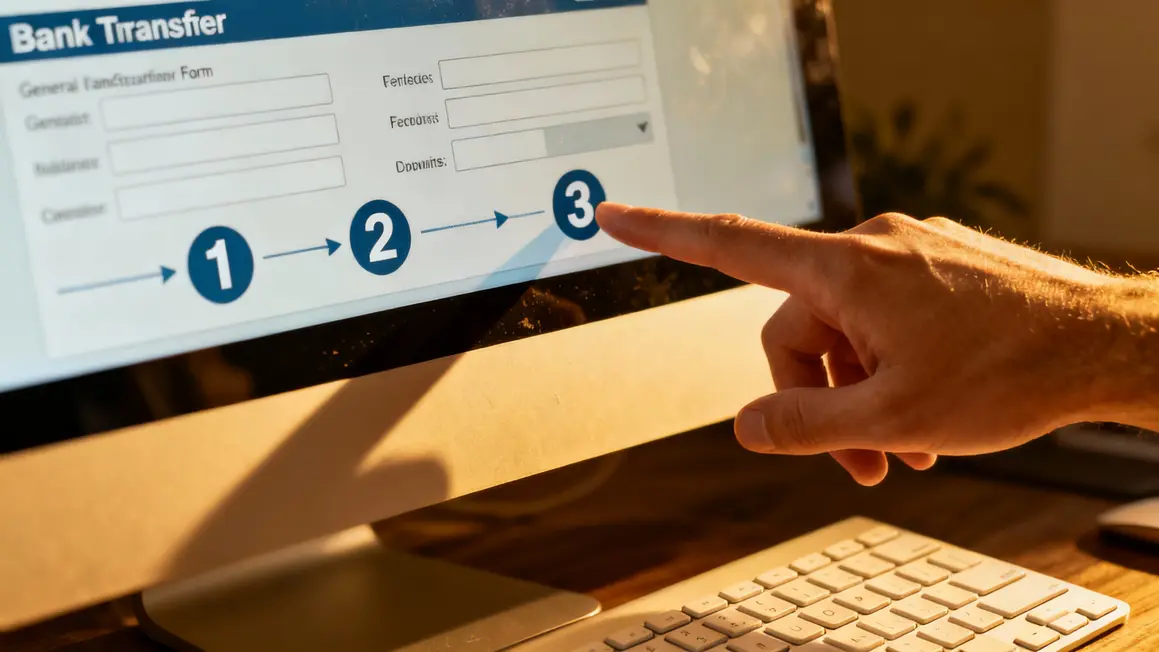
- Connect to the customer space or mobile application with its identifiers.
- Go to the section « Transfers » or « Transfers ».
- Select the account to be debited and the beneficiary (already registered or new).
- For a new beneficiary, enter its information (name, IBAN and BIC if required) and then proceed with validation, sometimes subject to a security delay.
- Indicate the amount, choose the date of execution, possibly schedule the recurrence.
- Validate the operation, often via a security code received by SMS or notification via the application.
- Control the execution tracking in the client area or application.
It is crucial to check the information before each validation: correcting an error of the IBAN or amount is rarely possible after execution.
Timeliness of online bank transfers
The deadlines vary according to the type of transfer and the institutions involved:
| Type of transfer | Estimated time |
|---|---|
| Internal same bank | Immediate action |
| External SEPA | 1 to 3 working days |
| International outside SEPA | 4 to 10 working days or more |
| SEPA Instant | Less than 10 seconds |
Attention: working days impact treatment. Operations launched on weekends or public holidays await the next working day.
Costs associated with online bank transfers
For the majority of SEPA transfers made online, no charge is charged, especially in online banks or neobanks. Some exceptions remain in traditional establishments or for transfers initiated in agencies (between 3 € and 8 € for a domestic transfer and up to 50 € for International Transfer).
International transfers outside SEPA generate higher costs: fixed amount (average 10–30 € + variable fee (between 0.1% and 2%) and, sometimes, bank and exchange intermediary charges.
The SEPA instant transfer can be charged per unit (of 0.50 € At 2.50 € depending on the bank), except for high-end offers where it is included in the package.
To optimize its costs, it may be wise to turn to an online bank or services specialized in international transfers (Wise type, Revolut) that apply more transparent pricing policies and advantageous rates.
The ceilings, limits and security of online bank transfers
The limits are broken down by operation, day or week, and differ according to the type of account. Each can request an increase of these thresholds if necessary, through the customer space or agency. Premium or professional accounts allow higher amounts, while entry into the range is more limited.
Security is based on dual authentication (required DSP2): single-use code, mobile notification or digital certificate. Transfers to new recipients are often blocked for several hours or days for verification.
It is recommended that: verify each beneficiary's data before sending, never validate from a public network, and enable notifications tracking for each transaction.
To make a safe transfer, it is essential to understand the RIB wording: understand each field of your bank identity statement to avoid any errors during the operation.
For transfers to an account abroad, it is essential to know the obligations, exemptions and precautions for an account abroad less than EUR 10 000.
To better understand deadlines and optimize your transactions, discover What time do transfers pass to Bank Postale.
In case of a suspicious attempt or fraud, the bank must react automatically (blocking, control, customer contact) and allow you to contest the transaction for repayment if the error is proven.
Can we cancel a bank transfer online
Cancellation is possible only as long as the transfer is « on hold » or « programmed ». This concerns deferred or permanent transfers, which can be modified directly in the client/app area. As soon as a transfer passes « implemented », it becomes irreversible by the customer: only the bank can request a return from the beneficiary, who remains decision-maker to repay.
To limit any inconvenience, check the accuracy of the information before confirmation, report any errors to the bank as soon as possible and keep the evidence of the transaction can maximize your chances of recourse.
Time limits imposed when adding a beneficiary and double validation play a positive role in preventing errors and fraud before money is finally transferred.
Advantages and disadvantages of online bank transfer
- Simplicity of use and continuous access, on computer or mobile.
- Virtually systematic free for SEPA classic transfers.
- Reactivity of instant and programmable transfers remotely.
- Limits: international fees, deadlines for new beneficiaries, maximum amounts according to the conditions of each bank.
- Risk of error in seizure or in case of negligence of security, which can result in a loss difficult to recover.
Compared to cheques or card payments, on-line transfer facilitates large or regular transfer management. For quick payments, prefer instant transfer or specialized P2P applications, after checking ceilings and fees.
Fabien Durand, an editor specialized in banking products and digital applications, updates this content according to regulatory news and recent user returns.
Making an on-line transfer is now required as an approach accessible to all, provided that special care is taken to enter the coordinates and to monitor ceilings and fees. You can pay rent, pay back friends or transfer your savings in just a few clicks, with the security offered by double authentication and real-time tracking. Have you ever encountered a difficulty with an online transfer? What precautions do you take to limit the risk of error or expense? Share your experiences or practical tips in comments from 01bank.com.
- Share your tips and feedback on online transfers directly under this article.
- If this content has been helpful, make it available on your networks to help other users choose the best banking solution.
- Any tariff issues or ceilings to dig? Consult our other comparative articles available on 01banque.com.
The next step? Why not explore instant transfer offers or multi-currency service comparisons to optimize your transactions abroad and secure your finances, regardless of your project.