

Better understand each RIB wording to navigate without difficulty in its online bank: these precise headings help you to recognize the main elements (IBAN, BIC, bank code...) and to secure your banking procedures. With experience in the sector, I accompany you for a reading and use of the RIB independent, regardless of your experience or the situations you face.
RIB Wording: What does this correspond to?
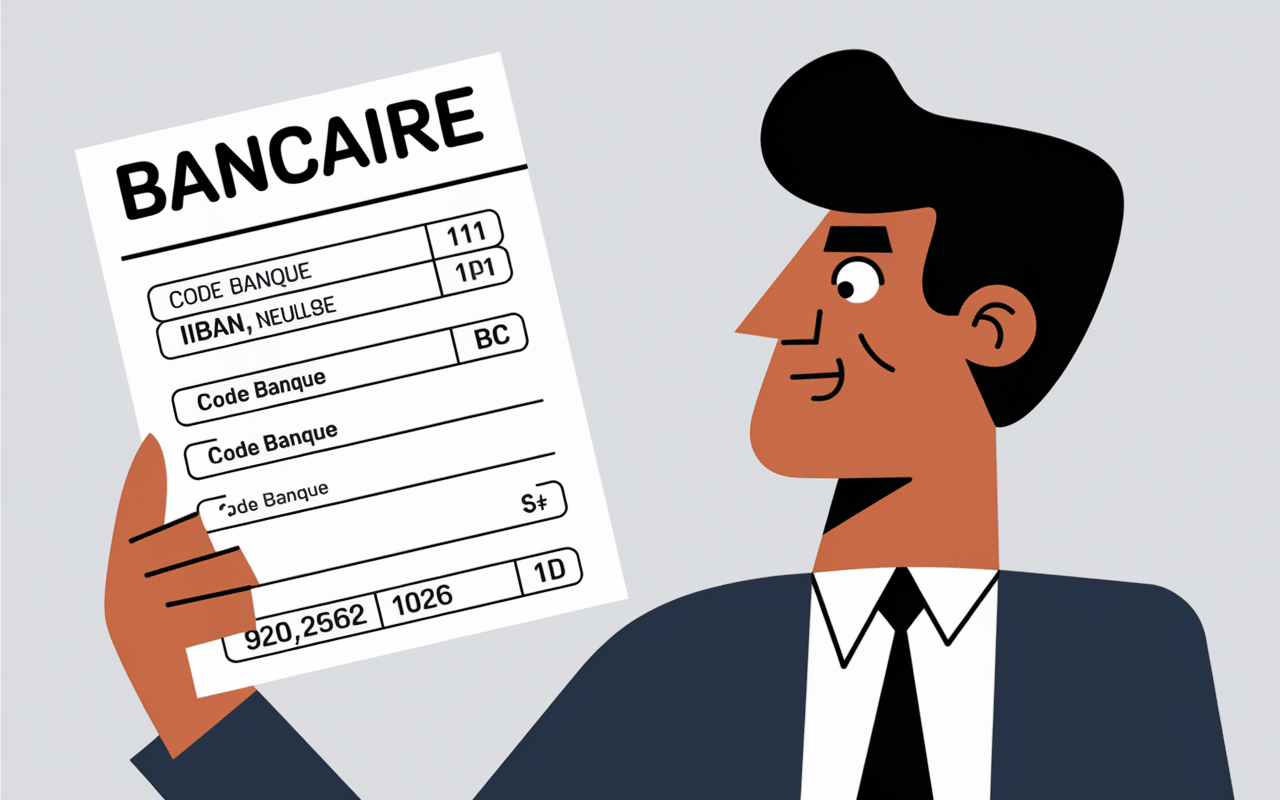
You find "RIB labeled" on a bank form or in your customer area? No stress: this term refers to the title or description of each field in your Bank Identity Statement. On the document, each data (bank name, account number, IBAN, BIC, etc.) precedes its wording to simplify reading and limit errors during transfers or levies.
In concrete terms, the "labelled" on an RIB is not to be filled in or customized. This is the official term given to each bank data « Bank code », « Account holder », « IBAN », for example. Identifying what each wording is used for can be particularly useful for using your French account without anxiety, whether as a newcomer, student or simple curious user.
To illustrate: the wording « BIC » indicates the bank's international code, while « IBAN » represents your international account identification number (in France, 27 characters). These abbreviations reflect every major information required for your daily routine. Sometimes a customer mixes on the acronyms side, hence the interest of careful reading.
Summary of key points
- ✅ The RIB wording corresponds to the official title of each bank information on your statement.
- ✅ It makes it easy to read the data essential for your operations (IBAN, BIC, bank code...).
- ✅ Understanding these wordings is useful to manage your account in France with confidence.
Definition of the RIB and its components
In each French RIB there is clearly identified information, each preceded by a wording. This cutting makes reading clear and accelerates understanding. This clarity is often useful for people who discover the hexagonal banking system.
List of common terms of an RIB in France
The following are some of the wordings that we systematically cross:
- Name of bank: the institution that manages your account.
- Bank code: composed of 5 digits (ex: 30004), it identifies the institution.
- Window code or agency: to 5 digits to locate the branch (example : 00256).
- Account number: unique and personal, usually made of 11 digits or letters.
- RIB key : 2 digits (e.g. 54), it is a French specificity.
- Home: indicates the opening agency.
- IBAN: the international banking number, 27 characters for France (FR... followed by 25 characters).
- BIC or SWIFT: international code for transactions outside the country (example: CMCIFRPP).
- Account holderthe name or business name associated with the account.
- Address: that of the holder or agency, in the format chosen.
This format is framed by French regulations and can be found in both paper and digital versions, sometimes with small differences depending on the bank (a bank trainer recently mentioned some cases of graphic customisation).
Summary table of the fields and wordings of an RIB
| Wording | Meaning | Standard data |
|---|---|---|
| Bank code | Institution identifier | 30004 |
| Window code | Banking agency | 00256 |
| Account number | Account Reference | 01234567890A |
| RIB key | Verification/Control | 54 |
| IBAN | International identification | FR76 30004 00256 01234567890A 54 |
| BIC | International Swift Code | CMCIFRPP |
A French IBAN 27 characters, whereas German IBAN counts 22 and Spanish 24. Some new residents are astonished, yet the logic remains constant regardless of the country.
Access its RIB: digital and agency options

This is also why it is no longer necessary to wait in the agency or search the mails to find his RIB: today, most French banks make it accessible by computer or smartphone.
How to get and download your RIB easily?
Each bank has its small differences, but overall:
- By going through Internet customer spaceAll you have to do is log in, search for "RIB" or "Bank contact", then select "Download" or "Send".
- On mobile banking application: a "Share my RIB" button appears frequently on the home page.
- In agency: it remains possible to ask an impression from an advisor, usually obtained in less than 2 minutes.
Practical detail: Some banks offer automatic sending of the RIB by email in one click. A client recently reported having received his document without even calling.
Another point to note, young offers start around 2€/month and include unlimited access to these digital services. In case of failure, the support remains human (chat or phone call) and some banking experts believe that this facilitates responsiveness.
RIB, IBAN, BIC, SEPA: no longer confused
With all these acronyms and bank codes, difficult at times to find! But the real difference lies in a few words. Let us look more closely together through this comparative table.
The difference in one sentence and key figures
In other words, the RIB is the complete sheet that gathers the information; IBAN is the international account number. The BIC identifies the bank abroad; Finally, SEPA corresponds to the framework facilitating operations in Europe.
| Element | Role | Standard data | Specificity |
|---|---|---|---|
| RIB | Coordinated document | Gather all key fields | French format, historical |
| IBAN | International Number | FR7630004002560123456789054 | 27 characters in France |
| BIC | Bank identifier | CMCIFRPP | 8 to 11 characters |
| SEPA | European area | Transfer/removal facilities | European Regulation |
In practice, providing its RIB is fairly regular in transmitting the IBAN accompanied by the BIC. One advisor reported that a SEPA transfer trial with a Spanish IBAN may sometimes require additional verification, precisely because it only counts that 24 characters.
Secure transmission of its BIR: key recommendations
Sharing your BIN is part of your daily life, whether it's to get pay, help, or pay a benefit. However, it is better to respect certain essentials to avoid problems especially in the digital age where bank fraud is constantly evolving.
Good practices to safely transmit your BIR
Here are the essential reflexes, regularly recalled by several experts in banking cybersecurity:
To better manage your banking transactions, find out why RIB wording plays a key role in your banking operations.
To simplify your efforts, discover how to get your RIB Revolut in a few simple steps and effectively manage your banking information.
To understand how to use your RIB in different contexts, discover our guide dedicated to RIB for a booklet A: steps and details.
- Never pass your BIR on to an unsecured network or public messagingAvoid forums, social networks, etc.
- Prefer customer space or email with attachment for more control.
- Ensure the identity of the person receiving your BIR and its reliabilityespecially in case of doubt.
- Avoid communicating your access codes, passwords or secret answers with the RIB.
The transmission of the RIB alone does not empty your account, but remains a sensitive transaction. Last point to note: who never hesitated before sending his RIB? Caution is always necessary. One counselor said that one of her clients preferred to hand him over out of distrust, proof that the subject remained sensitive.
Good reflex too: any unexpected request from RIB (especially if it comes from an unknown number or a suspicious email) must be confirmed with the bank. A professional routinely recommends checking the origin of the solicitations.
Good to know
I recommend you always confirm the origin of an unusual RIB request with your bank in order to avoid any attempted fraud.
FAQ / Good to know
Questions about the "RIB label" are regular, especially when opening an account in France. Here are precise answers to the usual questions and experience shows that a doubt about the subject remains perfectly normal.
Frequently asked questions about RIB wording and its use
- How to locate the wording or field of a RIB?
On the document, each information (« bank code », « IBAN », etc.) is preceded by its own wording. If you are asked to "your RIB", provide all the elements, not one number. - Is sharing the RIB risky?
No in itself: only bank identifiers or the granting of a debit warrant may expose the risk of fraud. - Is the French RIB accepted internationally?
Yes, thanks to theIBAN and BICIt works for transactions outside France. - In case of loss of the RIB, how can I recover it?
Through your application or customer area, or in an agency, you get less than 5 minutes. - Why do we notice different labels or additions depending on the banks?
Depending on the bank and software used, some RIBs report the complete address or only the main information: the most important is to clearly identify the bank, agency, account, IBAN and BIC codes.
Glossary of banking terms of the RIB
It is often found that it is not obvious to be among the abbreviations. To help you with this express mini-glossary, keep in hand before any steps or questions to your advisor.
- Wording: indication or name worn by each field (e.g. "BIC", "IBAN" ...), clearly visible on the RIB.
- IBANInternational Bank Account Number (27 characters in France, compared to 24 or 22 elsewhere).
- BIC: Bank Identifier Code, also known as SWIFT (e.g. CMCIFRPP).
- SEPA mandate: agreement allowing automatic levies in the euro area, appreciated by students and expatriates.
- RIB key: control code to 2 digits for validation.
- Bank/agency code: identify each for the establishment and branch.
Do not hesitate to consult this lexicon via your customer area or to ask your online advisor (by chat: the "simple" question does not exist when trying to protect your money). A banking expert also slips that the most basic questions are often the most strategic to avoid mistakes.
Need more help or an example?
You can download a RIB template, chat with an advisor, or ask your question live. And for an emergency, some banks have an accessible hotline 7j/7 (this is not always obvious to find, but service still exists).
Updated information according to SEPA standards and GDPR recommendations (2024). Sources: FrenchEntrée, Western Union, Life In Rural France. Offers and figures given for information purposes, subject to change by institution.