


In France, the home insurance of an owner is not usually compulsory outside of condominiums. In condominiums, insurance covering at least his civil liability is required, whether he occupies the dwelling or not. But this minimum does not necessarily compensate for damage suffered by one's own property. To choose suitable protection, it is therefore necessary to distinguish between the legal obligation, the use of housing and the expenses which one wishes to cover after a disaster.
Housing status determines your insurance obligation
Ownership is not sufficient to determine whether insurance is mandatory. The first question is whether the property falls under the co-ownership regime. A house can also belong to a condominium: the appearance of the building makes it impossible to cut.
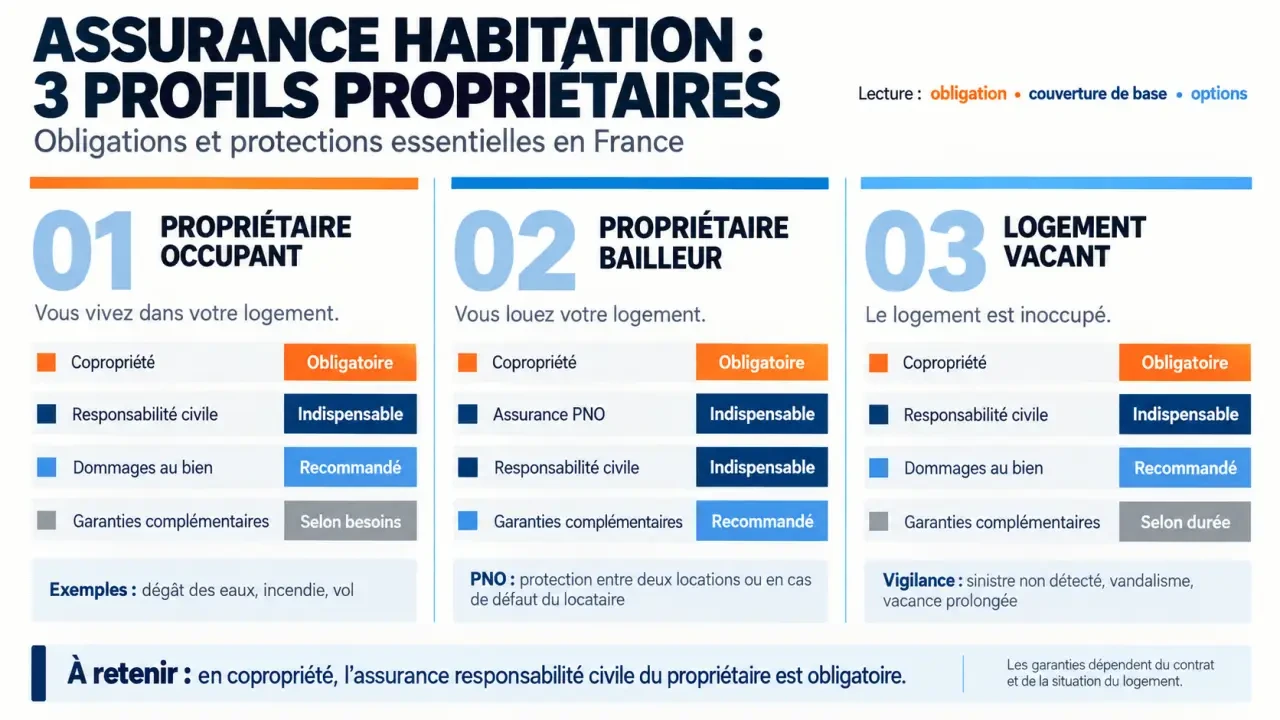
| Your situation | General obligation | Protection to be considered |
|---|---|---|
| Owner occupying outside condominium | No general home insurance obligation | Multi-risk homeowner occupant |
| Owner occupying a condominium | Compulsory civil liability | Multi-risk also covering housing and property |
| Owner landlord in condominium | Compulsory civil liability | Non-occupational owner's insurance adapted to the rental |
| Owner of a vacant non-residential dwelling | No general obligation | Contract explicitly accepting the vacancy |
As Service-Public points out, the co-ownership obligation concerns the co-owner's civil liability. It is used to cover the consequences of damage to others when their liability is incurred, within the limits of the contract. It must not be confused with a guarantee to repair her apartment.
In a single-owner property, owned by a single owner, this co-owner obligation does not apply. However, the absence of an obligation does not remove the owner's liability or the cost of repairs: without adequate coverage, he may have to finance them himself.
Occupancy, rental, vacancy: choose the contract that follows the property
You live in housing
The home multi-risk insurance, or HRM, for occupant owner generally combines civil liability, property damage and furniture protection. Check that the fixed fittings, the equipped kitchen and outbuildings fit into the insured perimeter. For a secondary residence, declare this use: Prolonged absences may change the warranty conditions, especially against theft.
You rent the accommodation
The non-occupant owner insurance, called PNO, meets the needs of the lessor. It may cover damage to property and certain risks falling within its responsibility, according to the formula chosen. The tenant's insurance, including its rental risk guarantee, does not replace that of the owner. A leak from a tenant's equipment and a leak from a lessor's facility does not raise the same responsibility.
In a residential lease subject to the tenant's insurance obligation, ask for his certificate at the entrance and each year. In condominium, also consult the real estate insurance guarantees with the trustee: it does not automatically replace your personal contract. For a furnished or seasonal rental, specify in writing the cover of the furniture and the acceptance of this use.
Housing remains empty between two occupants
An NOC may maintain protection during the rental vacancy, but vacant housing is not automatically covered without time limit. Report the situation and check the residential clauses, the required preventive measures and any restrictions. A permanently empty property may require specific coverage.
Between two tenants, insurance acts as an anchor: it must remain attached to the property when the occupant changes. So organize the continuity of the contract around the key delivery dates, rather than around the rent collection alone. Also plan for a person able to inspect the housing: a leak quickly reduces damage, while an insurance certificate never replaces this surveillance.
Guarantees to be considered beyond civil liability
A multi-hazard home can bring together fire, water damage, weather events, theft, vandalism, ice breaking and electrical damage. Natural and technological disaster guarantees meet specific legal requirements. Do not be content with their presence in a brochure: check the goods concerned and the conditions of release.
- Water damage: Distinguish consecutive damage, leaking and repairing the facility causing the problem.
- Theft and vandalism: control the requirements for closure, security and occupancy.
- Climate events: check the treatment of external fences, outbuildings and equipment.
- Owner's civil liability: Consider damage to neighbours, tenants and other third parties.
- Rehousing or loss of rent after disaster: Look at the duration and circumstances of care.
A maintenance defect or a construction defect may involve the responsibility of the owner, without being fully guaranteed. Insurance is not a maintenance contract: exclusions and prevention obligations remain decisive.
For a lessor, the unpaid rent guarantee, or GLIis distinct from the simple protection of the building. It includes eligibility criteria for the tenant, supporting documents and a procedure to be followed. Lease degradation may be a separate option; their coverage must not be presumed. Legal protection may also be useful in the event of a dispute, subject to its scope of intervention.
The price depends mainly on the good and the level of protection
There is no single rate for proprietary home insurance. The address, surface, number of rooms, type of building, use, outbuildings, value of furniture and history of claims influence the assessment. The allowances and ceilings chosen also change the price.
As a commercial benchmark, LesFurets announces an average price of 272 € per year for an occupying ownerin its data posted for October 2026. This amount is neither a personalized estimate nor a direct reference to an NOC. The unpaid rent guarantee is announced between 3 per cent and 4 per cent of annual guaranteed rents, including expenses ; its conditions must be compared separately.
To estimate the capital of furniture, proceed piece by piece: furniture, appliances, computers, clothing and valuables. Keep invoices and photographs. An underestimated value may limit reimbursement; excessive value may lead to unnecessary protection.
Compare the quotes on what will really stay at your expense
Ask for several quotes with the same characteristics and requirements. A comparator facilitates this collection, but does not exempt from reading contractual documents. LesFurets announces a simulation in about 4 minutes, accessible 24 hours a day and 7 days a week: this speed concerns the approach, not the analysis of guarantees.
- Compare franchises: What amount will remain to be paid for each type of claim?
- Check the ceilings: Are they sufficient for the building, furniture and particular property?
- Examine the old age: Is the refund deduced or according to a guarantee value with conditions?
- Read the exclusions: holiday, seasonal rental, lack of heating or lack of protection can change the coverage.
- Check compensation: supporting documents, expertise, possible advances and announced deadlines.
Before signing, confirm the effective date, declared use and coverage of the annexes. When changing insurers, coordinate dates to avoid interruptions. Termination after one year may be possible under the Hamon law, depending on the contract and status of the subscriber: check the applicable procedure. The right choice remains the one that covers your essential risks with a leftover that you can actually bear.