

In just a few clicks, the calculator 50/30/20 offers a clear and efficient budget management: just instantly visualize the distribution of your income between needs, desires and savings, and then adjust to your priorities to take over without complexity. Available to all, from the young active to the solo parent, this tool allows to adopt the budget rule 50/30/20 without registration or jargon, and offers a concrete and reassuring financial organization.
Instantly manage your budget with the 50/30/20 calculator – test, visualize, adjust!
Would you like to spread your salary without taking the lead? Possible option: an interactive calculator that applies rule 50/30/20. Simply indicate your income, and at a glance, you visualize the division between needs (50%), desires (30%) and savings (20%). The adaptation becomes intuitive – you modify to stick to your reality. This free tool is regularly praised for its simplicity, as it allows to immediately identify where your money goes. Some users find that this clear basis makes it easier to start savings, limit impulsive spending, or anticipate difficult month ends.
In a few seconds, let's start from the example of a net monthly income of 2000 € : the simulator calculates 1000 € for your needs (rent, shopping, bills), 600 € for cravings (cinema, shopping, restaurants), and 400 € to be reserved for savings or repayment of debts. Often presented as the "free 50/30/20 budget calculator" by Sumeria, N26 or Plan & Multiply, this tool centralizes everything you need to take action – without registration or financial jargon.
Do you like it? Click on "Calculate my budget" to generate your personalized distribution, download it in PDF or change it according to your situation (family, variable wages, special needs). Note: the method adapts to all profiles – couple with children, freelance, student, solo parent... Each personnalizes it for a gentle and controlled management. One trainer suggested that many homes find it a reassuring landmark.
What is the 50/30/20 budget rule?
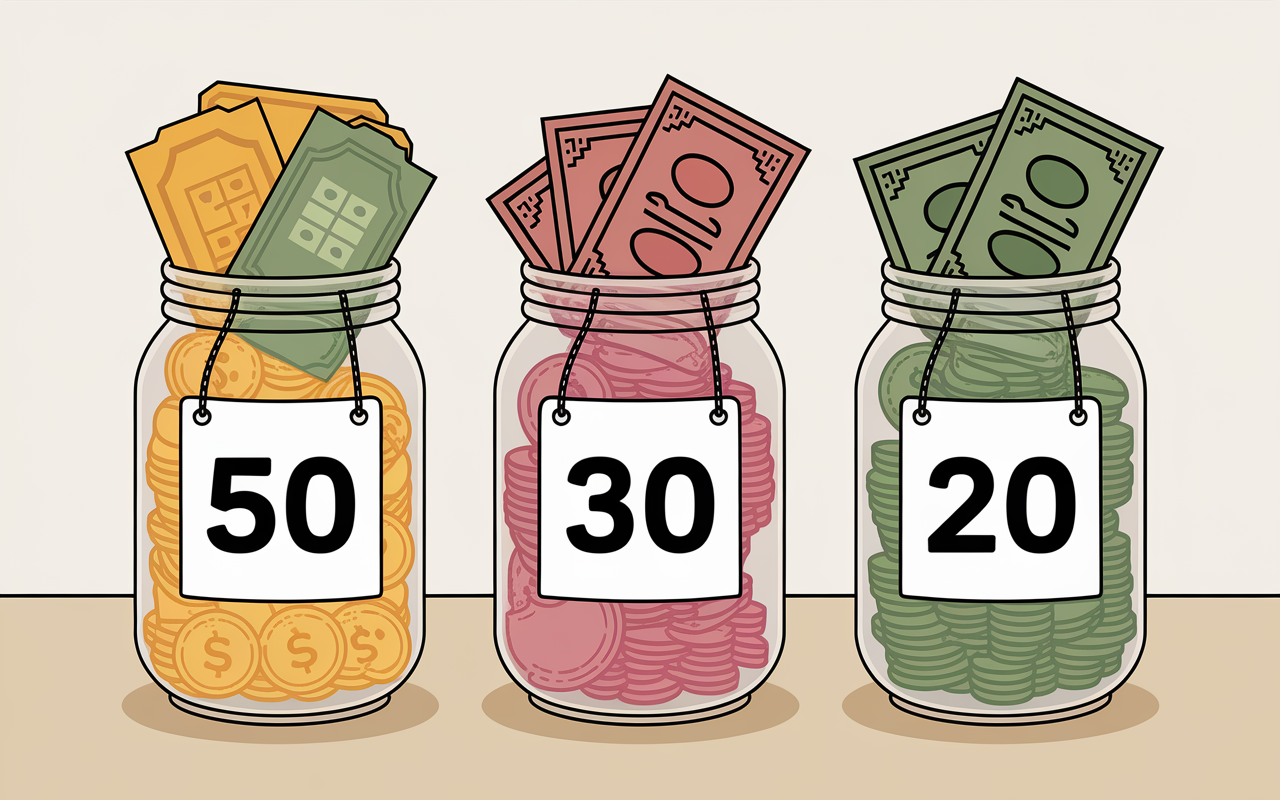
The principle seduces because it brings clarity. It automatically splits your income into three major items, to structure your budget without taking the lead. What is this rule really about?
A rule invented by Elizabeth Warren, all public
The economist Elizabeth Warren popularized rule 50/30/20 – she recommends that 50% of income basic needs, 30% desires and leisure, and 20% savings or repayment of debts. The objective? Simplify financial management for all – students, young adults, families – and offer direct readability on your priorities. According to some professionals, this cutting motivates you to better manage your budget.
Some concrete benchmarks:
- 50% : rent, credit, fixed charges, shopping, transportation
- 30% : outings, cinema, shopping, holidays
- 20% : booklet, investments, emergency funds, repayment of debts
This rule is put forward by online banks such as N26 and in the budget guides (Sumeria), as it limits impulsive overruns and encourages to save regularly, even on a first salary. Sometimes a user finds an unexpected margin of manoeuvre every month.
Why does this method work?
Splitting your spending into three groups reduces questions about "where does my money go?" No more endless Excel tables! Its accessibility allows everyone to adjust their budget as soon as there is a change: rent increase, new expenditure, life change... In two minutes, the budget is updated. Simplicity is also an argument differentiating against other methods considered too complex (zero-based, envelopes, or 70/20/10). A financial advisor reported that it gives novices confidence.
A user testimony is speaking: "With the 50/30/20, I finally manage to put 350 € every month without giving up my recett or Netflix." Is this really so effective? Everyone can find their balance, according to their desires.
Quantified examples to better understand and apply the rule
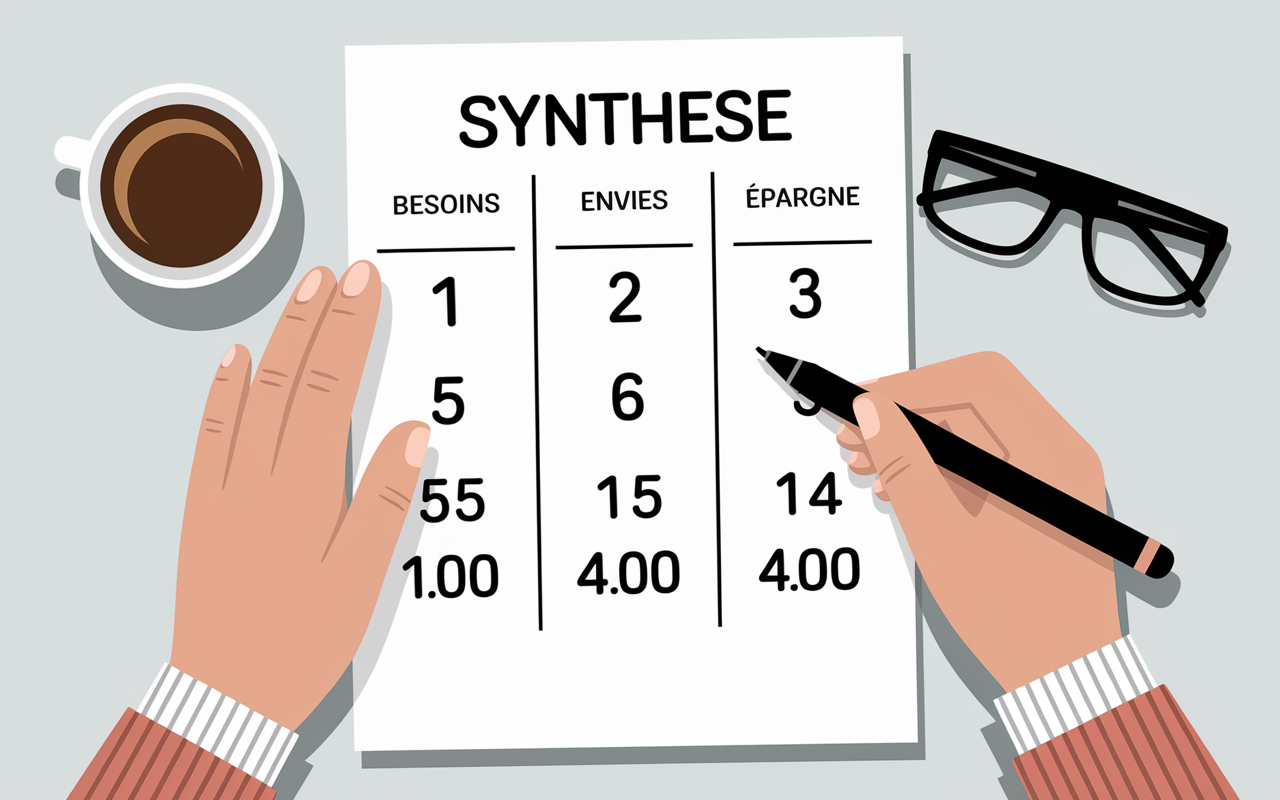
Visualizing the method on your own case turns theory into action! Here is how the 50/30/20 calculator reflects the diversity of profiles: single, couple, family, stabilized or variable income. As you can see, with figures in hand, you better understand the contours of the budget.
Single to 2000 € : typical case of a young urban active person
Example with 2000 € net per month. The calculator proposes:
| Category | Amount |
|---|---|
| Needs | 1000 € |
| Livers | 600 € |
| Savings | 400 € |
As for needs, a rent of 650 €, 200 € racing, 50 € Transport 100 € Invoices are easily included in the quota. Remains 600 € for pleasures and 400 € to invest or allocate to your debts, i.e., an emergency fund of 4 800 € in a year. Some young people stress that they manage to organize leisure without compromising their safety.
Couple with children: adaptation and pro rata
For example, for a combined torque 3800 €The breakdown is as follows:
| Category | Amount |
|---|---|
| Needs | 1900 € |
| Livers | 1140 € |
| Savings | 760 € |
This assembly allows for the integration of child-related charges, nursery or extra subscriptions, and to adjust fairly the "leisure" part between parents and children. Sometimes a household prefers to calculate separately per adult, especially in the case of unequal wages. Nothing prevents modulating according to contingencies or priorities. Parenthood often changes arbitrations – a budget coach mentioned that the simulator is useful for discussing sensitive positions.
Freelance or variable income: the flexibility of the calculator
When income varies between 1600 and 2500 €, better adjust the calculation each month, or even make an average over several months to avoid frustration. Simulators such as Sumeria or Plan & Multiply suggest entering multiple sizes, or simulating a pessimistic ("dark month") and optimistic version. Note: The quarterly version for unstable finances is regularly recommended, the simulator 50/30/20 is designed for these periods of uncertainty. Some freelancers show that they are more calmly adapting their spending as well.
How to use the 50/30/20 calculator? Simple and fast tutorial
Needless to follow a complex tutorial – the calculator instinctively takes control of itself, on smartphone or computer. This is the procedure, point by point.
Step 1: Enter your net income
Simply enter the amount of your monthly or annual income (salary, allowances, aids). The majority of tools allow for variable wages or mixed sources – just get an approximate basis.
A concrete example: on the Sumeria simulator you indicate "1800 €", validate, and just click on the distribution display: needs 900 €, desires 540 €, savings 360 €. It is frequently noted that this step immediately gives visual cues.
Step 2: Automatically view distribution
The calculator instantly displays a camera or summary board. This visualization helps identify positions where you spend too much, or those that you can optimize without depriving yourself. Some tools like N26 or Plan & Multiply also offer targeted suggestions, "you could save 18 €/week (A budget management coach stresses the importance of having a simple synthesis.)
Step 3: Customize, adjust, download
Most simulators allow for changes in amounts by category (e.g., increase desires to compensate for unforeseen expenses, or adjust to your family situation). It is also possible to add specific categories (shared rent, childcare, pro subscription). Finally, PDF export or backup allows you to keep track, or display a history – very useful to track your progress or convince a roommate. Some users share that they consult family history quarterly to see evolution.
Most simulators offer a dynamic FAQ to clarify possible adaptations. A user may wonder whether an expense is a matter of desire or need: the interface then provides direct help, without judgment.
Good to know
I recommend that you consult the FAQ integrated into the calculator: it guides you to easily distinguish what comes with desires or needs according to your situation.
Benefits and limitations of the 50/30/20 method: what it is better to know
The interest around 50/30/20 rests on two major forces: simplicity and readability. That said, this rule is not suitable for all... It is better to identify positive points such as shadow zones before going back.
Concrete data and key arguments
Method 50/30/20 helps save 2400 € 4800 € per year, based on monthly income between 1000 and 2000 €. It motivates a large part of users to limit certain impulsive purchases without sacrificing leisure or projects. Simulators highlight free customization, immediate result and advice adapted as different tools.
Some advantages to remember:
- Adaptation: single, couple, solo parent... each profile finds its formula
- Visibility: a clear benchmark on expenditure items and savings dynamics
- Free: the majority of simulators do not require registration or hidden fees
- Download and save: easy access to history and exports PDF
But for incomes below 1200 €, it becomes very difficult to achieve the 20% savings target. Many families, single parents or freelancers regularly adjust the distribution according to their personal constraints: 50/30/20 is not universal, it serves as a guide, not a fixed rule. Sometimes one finds that a pro-rata or zero-based version can better match – a track to explore if reality is beyond the frame!
Some limitations to know
Inflation, rising rents or unforeseen expenses reduce the amount available for desires or savings. We therefore find that it is better to review the rule several times a year. Interactive tools facilitate these adjustments and provide realistic or optimistic examples to avoid frustration. Some users sometimes notice a confusion between "needs" and "wishes" – like a car, essential for some, leisure for others. The FAQs of the main simulators (N26, Sumeria) offer useful clarifications, a valuable help according to the opinion of some experts in budget management.
FAQ on rule 50/30/20 and budget calculators
Questions always arise about the effectiveness, adaptation or customization of the rule. Here is a selection of frequently asked questions – each answer is to reassure or clarify according to user practice.
Is rule 50/30/20 suitable for low income (less than 1500) €)?
For income less than 1500 €, it is regularly complicated to save 20%. It is recommended that an adjusted version (e.g. 50/40/10) be adopted or that emphasis be placed on debt repayment. Simulators like Plan & Multiply offer "variable revenue" options to anticipate variations. One might wonder: is it possible to keep the method under these conditions? Adjustment remains the key.
How to adapt the method for a couple with unequal wages?
In couples, each can calculate according to their share, or pool income to allocate expenses according to priorities. Some simulators suggest a "couple budget calculator" option: you indicate the income of each adult, and the tool returns a personalized distribution. It is often preferable to review the rule every quarter in case of major changes (arrival of a child, changes in employment...). A family advisor reports that this quarterly follow-up facilitates discussion.
What expenses should be included in the « needs » or « desires » ?
Needs combine what is essential: housing, health, food, transport. The desires include extras: outings, subscriptions, gifts, shopping. In case of doubt, ask yourself the question "If I stop this spending, is my life really affected?" – it is often the border. But there are ambiguous cases: a gym can appear on both sides depending on your health or lifestyle. One trainer noted that this distinction became clearer over time.
Can I use a free Excel calculator instead?
Of course, there are many downloadable models online. Web simulators have the advantage of displaying immediate visualization, like camembert or synthetic board. But what matters is the coherent cutting – no matter the support or tool.
Is the rule effective in the face of current inflation?
Regular adjustments are essential! In the event of an increase in expenses, your priorities change, and in some cases it may be necessary to temporarily reduce the share "save" or "save". On N26 or Goldy, frequent tips are added to accompany adaptation to the rising cost of living.
What if no method seems appropriate? Try several approaches (zero-based, pro rata, envelopes), test simulators, then keep what fits best. The goal is regularity, not perfection... Some professionals say that trialing is the norm, especially at startup.
Comparison with other methods and additional resources
Do you hesitate between 50/30/20, envelopes or zero-based budgeting? A clear comparative table allows for a better choice and understanding of alternatives.
| Method | Simplicity | Motivation Savings | Adaptation profiles |
|---|---|---|---|
| 50/30/20 | ⭐⭐⭐⭐ | ⭐⭐⭐ | ⭐⭐⭐ |
| Zero-based | ⭐⭐ | ⭐⭐⭐⭐ | ⭐⭐⭐⭐ |
| Envelopes | ⭐⭐⭐ | ⭐⭐⭐ | ⭐⭐ |
| Prorata couple/family | ⭐⭐⭐ | ⭐⭐ | ⭐⭐⭐⭐ |
You can enrich your process with additional resources: PDF download guides, video tutorials, or Sumeria and N26 articles. The interactive calculator remains the most motivating entry, but the accompaniment makes the difference over several months. A recommendation often heard from trainers: test, adapt and choose your rhythm, because it is not perfection that counts, but what works on a daily basis.