


The expectation of a legacy is a period of floating, mixing mourning with material concerns. The question that comes back after the funeral concerns the timing: when will the funds be paid into the heirs' account? If the transfer of the notary is the final act which closes the file, it only comes after a rigorous administrative and tax process. On average, it takes between 3 and 6 months for a classical succession, but this period extends according to the nature of the heritage or family arrangement.
Average and legal deadlines for receiving funds
There is no single statutory time limit requiring the notary to pay the money on a fixed date. However, the tax framework imposes a time limit: the declaration of succession. It must be deposited with the tax administration in the 6 months after death in France. This period of 6 months serves as a reference for the overall settlement of simple files.
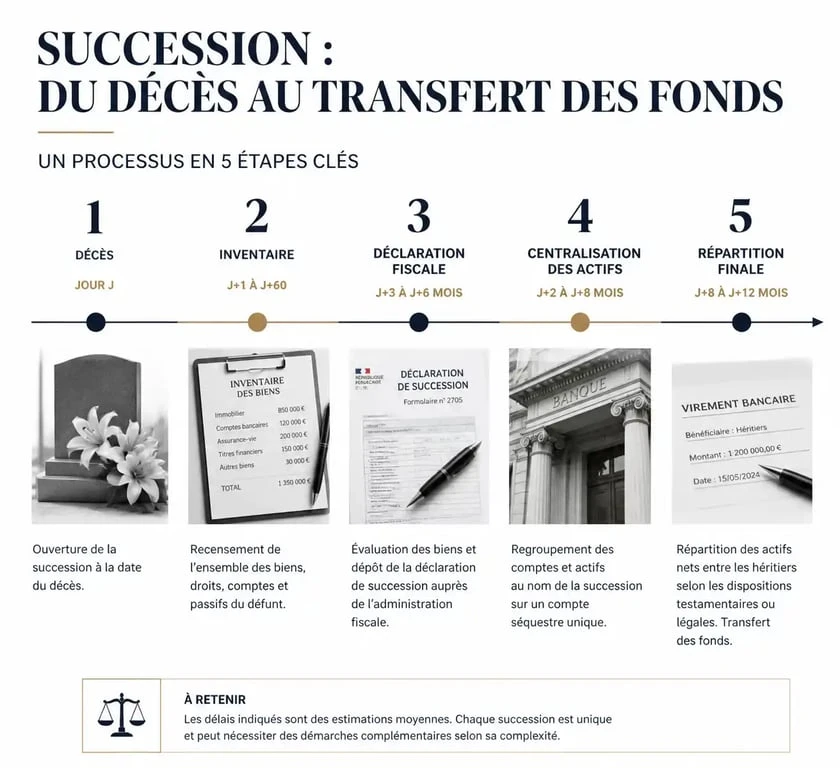
Once the acts have been signed, including the act of sharing, the actual transfer of funds by the notary is quick. In a reactive study, transfer a few days to two weeks. This time corresponds to internal accounting treatment and interbank delays. To reach this stage, several steps must be taken, each with its own pace.
| Type of succession | Average time recorded | Main complexity |
|---|---|---|
| Simple succession (bank accounts) | 3 to 4 months | Recovery of bank balances |
| Real estate succession (one property) | 6 months | Evaluation and certification |
| Succession with sale of a property | 8-12 months | Periods of sale and compromise |
| Conflicting Succession | 18 months and over | Expertise and litigation |
The flow of funds: from the deceased's account to the final transfer
To understand why the transfer takes time, you must visualize the notary as a pivot. When the file is opened, the banks freeze the deceased's accounts. The notary questions the financial institutions to obtain the balances on the day of death. After establishing the act of notoriety, which identifies the heirs, the notary requests the transfer of funds to the study account.
Centralisation of assets in the study account
The notary uses a specific account opened at the Caisse des Dépôts et Consignations to secure the funds. The financial reservoir of the estate is gradually being filled: closure of booklets, sale of securities, collection of rents or reimbursement of overpayments by social organizations. As long as this account has not been centralized all the liquidity and the debts (obstruction fees, taxes, invoices) have not been deducted, the distributable balance is not stopped.
This moment is strategic. The notary checks the creditworthiness of the estate. If debts appear late, they are deducted from the stock before the heirs receive their share. This step explains why a notary cannot make a rushed transfer, otherwise he or she will incur liability if a priority debt arises after the fact.
The signature of the sharing act: the trigger
The act of division ends the division. He details what belongs to everyone. Without the signature of All heirs on this act, the notary does not have the power to disburse the funds. If only one heir refuses to sign or delays returning the document, the entire transfer is blocked, even for those who agree. This is one of the most frequent friction points.
Why can the transfer of your inheritance be delayed?
Several factors outside the notarial study slow down the process. It is rare for the notary to hold the funds voluntarily, as he has every interest in closing his files to collect his emoluments.
Lack of responsiveness of banks and agencies
The notary depends on third parties. Some banks take several weeks to transfer funds from closed accounts to the study. Similarly, obtaining a state of affairs on the part of pension organizations or tax authorities is sometimes lengthy. As long as the notary does not have an exhaustive view of assets and liabilities, he cannot finalize the division.
The search for heirs and the use of genealogists
If the deceased had no children or if some family members have been lost of sight, the notary appoints an estate genealogist. This investigation certifies the list of beneficiaries. Such a procedure systematically adds 6 to 12 months to the initial deadline. The transfer takes place only once the genealogist has identified all the reservatory or legatee heirs.
Real estate for sale
Where an estate contains real estate and the heirs decide to sell it, the final transfer shall be suspended upon signature of the authentic deed of sale. Between offering for sale, finding a buyer and obtaining the loan by the buyer, it often flows Additional 6 to 9 months. The notary may sometimes make a first partial transfer, in the form of a deposit, before the final balance resulting from the sale.
What recourse if the notary does not make the transfer?
If the deadline becomes abnormal, for example more than 6 months for a simple estate without real estate, or if the notary no longer responds, several levers exist. It is advisable to remain factual and to follow a gradation in the steps.
- The notice: Send a registered mail with acknowledgement of receipt requesting a status and a forwarding date. This formalizes your request and often forces the study to react.
- The mediator of the notariat: If the dialogue is broken, you can contact the mediator of the notariat free of charge to find an amicable solution without going through the courts.
- The departmental chamber of notaries: In the event of professional misconduct or prolonged silence, you may lodge a complaint with the President of the Chamber on which the notary depends. An internal investigation may be initiated.
The notary incurs his professional civil liability. If it is proved that an unjustified delay has caused financial damage to the heirs, such as penalties for delaying inheritance rights while the funds were available, the insurance of the notary may be sought to compensate the assignees.
The transfer is the result of complex verification work. Communication remains the key to speeding up the process: the more quickly the heirs provide the requested documents, such as the family booklet, the RIB or the invoices, and agree on sharing, the more quickly the notary can release the funds.