
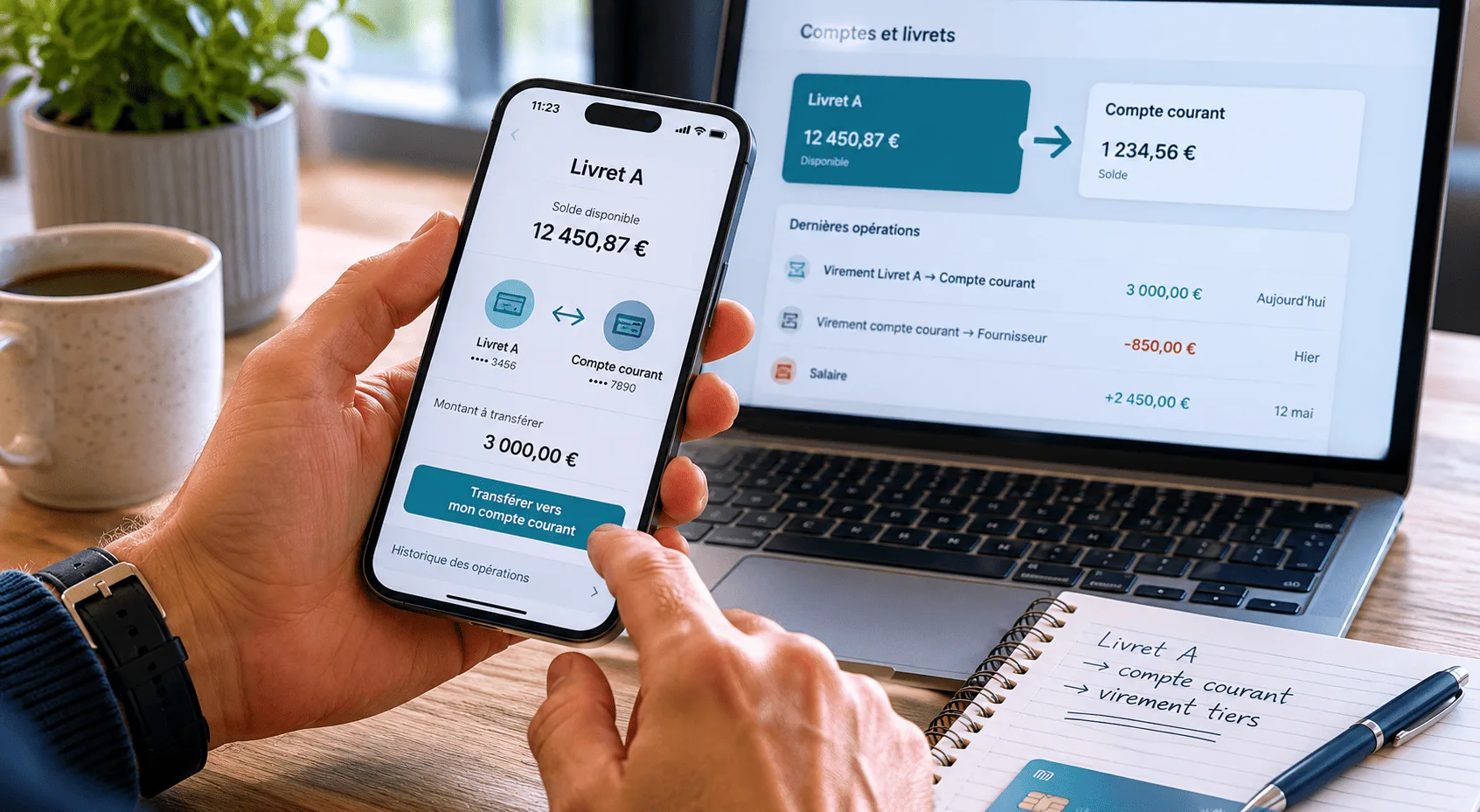

You want to pay an expense or help a loved one, and the idea has just drawn you directly from your Book A. When launching the transfer, surprise : impossible to indicate the account of the recipient. Book A does not behave like a current account, and many discover it at this very moment. The answer is in one sentence, but it deserves some clarification to avoid mishandling. This is what a Booklet A actually authorizes in terms of transfers, what it forbids, and how to circulate your money without blocking.
Can we transfer money directly from Book A?
No, not directly. A Book A does not allow sending money to a third party, or to an account you hold in another bank. The only possible exit is a transfer to your associated current account, i.e. the account of the same bank attached to the booklet when it is opened.
The reason is regulatory. Book A is a savings product, not a payment account. It is used to put money aside, to make it grow modestly and to recover it when needed, but not to pay expenses. All transactions to the outside flow through the current account: first the funds from the booklet are returned to the account, then the transfer to the recipient is made from the account.
The precise operation of the BIR and the operations of the transfer from Book A This is where most of the blockages encountered by savers are concentrated. Once this principle is understood, manipulation becomes simple and fast.
Does Book A have a BIR, and what is it for?
Yes, a Booklet A has a bank identifier, often called RIB by habit, with an IBAN of its own. But its use has nothing to do with a current account.
This RIB is used only for transactions between the booklet and the current account of the same holder, in the same bank. You can use it to transfer money from your current account to Book A, or in the other direction. On the other hand, it does not allow for the housekeeping of a salary, the recording of an automatic levy, or the communication to an employer or supplier as payment details.
It's the most common confusion. The RIB of a current account identifies a payment account, capable of receiving and issuing various flows. The book A identifies a savings account that is closed on the outside, whose only entry and exit doors lead to the associated current account.
How to feed his Book A and withdraw money?
Two operations cover almost all the needs: feeding the booklet from the current account, and repatriating money from the booklet to the same account. Both are done in a few clicks from the customer area, online or on the app, usually free of charge. The only ceiling to know is that of cumulative deposits on the booklet (22 950 euros for a Book A, excluding capitalised interest), not a transfer ceiling as in a current account.
In concrete terms, we select Book A as an account to be debited or credited, we choose the associated current account as consideration, we enter the amount and we validate. No external coordination is requested, since the destination is imposed. The table below separates what is possible directly from what is not.
| Operation | Possible directly from Book A | How to do it in practice |
|---|---|---|
| Transfer to your own current account | Yes | From the customer space to the associated account |
| Transfer to a third party | Not in general | Transfer first to current account, then transfer |
| Receive from current account | Yes | Classic booklet feed |
| Receive a transfer from a third party | Often not | Depends on the bank, to check |
| Homer a salary or a levy | No | Prohibited on a Booklet A |
The exact procedures vary from establishment to establishment. Some banks allow some additional transactions, others restrict even more, hence the interest of checking in its customer space before relying on precise manipulation.
Why is a transfer from Book A sometimes refused?
The most frequent refusal comes from an attempt to transfer to an account that is not the associated current account. The bank blocks the operation, not by mistake, but because the booklet is not designed for this. The solution is always the same: go back to the current account.
The deadlines also surprise. A transfer between Book A and the current account of the same bank is often immediate, or credited in the day. The following transfer, from the current account to a third party, then follows the usual deadlines (about one working day for a regular transfer, a few seconds for an instant transfer). For an urgent payment, it is better to anticipate this double movement than to discover it the day before the deadline.
The case of transfer to Book A from another person
Wanting to turn money directly on the Book A of a relative comes up against the same principle. A third party's booklet is not made to receive external funds, and most banks refuse the transaction. To help someone, the usual way is to transfer the money to their current account, then place it on their own booklet if they wish. Note that a Book A is strictly individual: there is no attached Book A or Book A held to several.
What about the other regulated booklets, LDDS and CEL?
The reasoning applies to all regulated savings. The LDDS (Livret de développement durable et solidarité) and the CEL (Account savings logement) follow the same logic as Book A: they are savings accounts, not payment accounts, and their movements pass through the associated current account. You don't pay a merchant or a relative from an LDDS or a CEL, you first repatriate the funds to your current account.
However, each product retains its own rules and ceilings. The LDDS capes deposits at a lower level than Book A, while the CEL combines savings and entitlement to a real estate loan, with a slightly different operation. The CEL thus follows its own limits, and the details of the CEL ceiling are documented by Online Asset Who wants to compare it with Book A.
To be retained
Book A is a savings account, not a payment account. Money is not transferred directly to a third party from this booklet: everything goes through the associated current account, the only authorized exit door. Its RIB exists, but it is only used for exchanges with this current account of the same holder, never to house a salary or a levy. Keeping this principle in mind avoids most blockages, and each bank specifies its own modalities in the customer area.