


The management of surplus cash is a strategic issue for any company wishing to grow its liquidity while maintaining a high level of responsiveness. At the heart of this strategy is the Investment securities (VMP). Unlike long-term investments, the VMP responds to a need for immediate profitability and rapid availability. Mastering its operation, accounting framework and nuances makes it possible to turn a sleeping current account into a lever of financial performance.
What is an investment security?
An investment security is a financial security acquired by a company with the intention of making a short-term gain. It may be shares, bonds or units of UCITS. The fundamental characteristic of the VMP is the purpose of its acquisition: the company does not seek to take control of another company or to exercise a lasting influence, but merely to place its liquidity temporarily.
The different types of securities concerned
The VMP family is large and adapts to different risk profiles. There are mainly actions, which are titles of ownership representing a fraction of the capital of a company, generally quoted. To qualify as VMP, the holding share must remain a minority, often below the 10% capital threshold. The obligations, for their part, are debt instruments allowing for the collection of regular interest, called coupons, until repayment. The SICAV and FCP risk diversification by investing in a basket of securities managed by professionals, while Treasury bills, issued by the State, guarantee maximum security for very short-term investments.
The distinction with equity
VMPs are often confused with equity securities. Yet their accounting and tax purposes differ. While equity securities are included in fixed assets for long-term holding, the MVs are included in the MVs.active circulating. They are intended to be sold quickly, often within a period of less than one year. This distinction affects the presentation of the balance sheet and the calculation of the company's liquidity ratios.
Why integrate VMPs into its financial management?
The attractiveness of investment securities lies in their ability to deliver higher returns than conventional deposit accounts while ensuring a rapid exit. For a financial officer or financial officer, they are a tool for fine-tuning the capital structure.
Cash management requires elasticity. Where fixed assets freeze the structure, investment securities adjust the wing to meet market opportunities or unforeseen cash flow requirements. This granular approach avoids excessive financial rigidity, while capturing micro-performances that, cumulatively, improve the annual financial performance.
Liquidity and profitability
VMPs are by nature liquid. If there is a need for cash to finance an investment or settle a supplier debt, these securities can be transferred to the financial markets in just a few clicks. This reactivity avoids letting large amounts of money sleep on unpaid accounts, thus limiting monetary erosion due to inflation.
Risk management and prudence
The search for performance involves risks. The value of a share or a share of UCITS may fluctuate. The principle of accounting prudence applies strictly here. If the market value of a VMP becomes less than its purchase value, the company must see a depreciation. However, latent capital gains, corresponding to the potential gain in the event of immediate resale, are never recorded in the accounts before the actual disposal in order not to artificially inflate the result.
The accounting treatment of MPVs: a practical guide
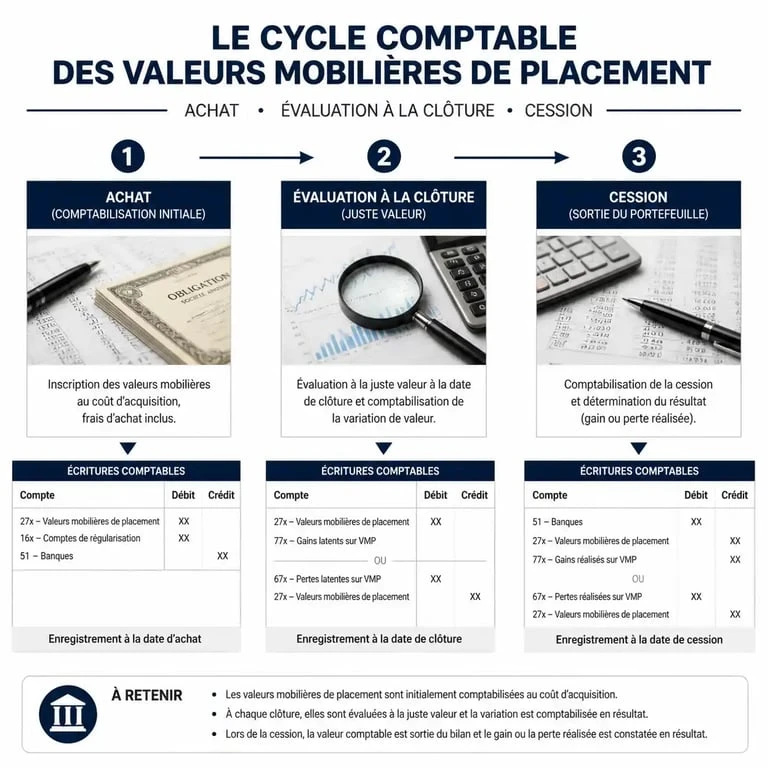
Accounting for investment securities follows the rules of the General Accounting Plan (GCP). These transactions consist of three stages: purchase, year-end inventory and disposal.
Registration upon acquisition
When purchasing, the company registers the VMPs at their acquisition cost. This cost includes the purchase price of the securities. Additional fees, such as bank or brokerage fees, may be recorded as expenses or included in the cost of entry. The accounts used belong to the Class 5 :
| Account | Wording | Use |
|---|---|---|
| 503 | Actions | Capital securities for resale |
| 506 | Obligations | Short-term debt securities |
| 508 | Other VMP | Treasury bills, negotiable receivables |
Assessment at year-end
At the end of each year, the company evaluates its VMP portfolio at market prices, i.e. the stock exchange rate on the last day of the financial year. If the market value is higher than the purchase price, no writing is required, the surplus value remains latent. If the market value is less than the purchase price, a provision for depreciation is mandatory. It impacts the result of the exercise to reflect the likely loss of value.
The assignment and calculation of the financial result
The sale allows the actual profit or loss to be realized. The selling price is compared to the original value. If the selling price is higher, the company shall register a net proceeds on disposal of VMP. In the opposite case, it records a net charge. If a provision had been made, it must be fully recovered at the time the balance sheet is issued.
Tax optimization and regulatory obligations
The tax system of MVs depends on the nature of the securities and the form of the enterprise. For companies subject to corporate tax (IS), realized capital gains are taxed at the normal rate. For these short-term securities, there is no standard concession scheme « long-term capital gains » held for more than two years.
Regulatory oversight
The regulatory framework is evolving to align with international standards. The Accounting Standards Authority (ANC) regularly provides details on the classification of securities. It is necessary for accounting services to stay on standby, as a poor classification can distort the company's creditworthiness analysis during an audit or request for bank financing.
Good practices for secure management
To optimize its investments, it is advisable to diversify the portfolio so as not to focus risk on a single sector. There is also a need to monitor fees, as movement commissions and child care costs can reduce profitability. Setting a liquidity schedule makes it possible to anticipate fiscal or social maturities, thus avoiding the urgent sale of securities during a market vacuum. Finally, validation of depreciation treatment by an accountant is recommended to secure tax compliance.
Investment securities are financial assets. Well controlled, it transforms a passive reserve into an engine of internal growth while preserving balance sheet security. Its management requires exemplary accounting rigour and a clear vision of the investment horizon.