
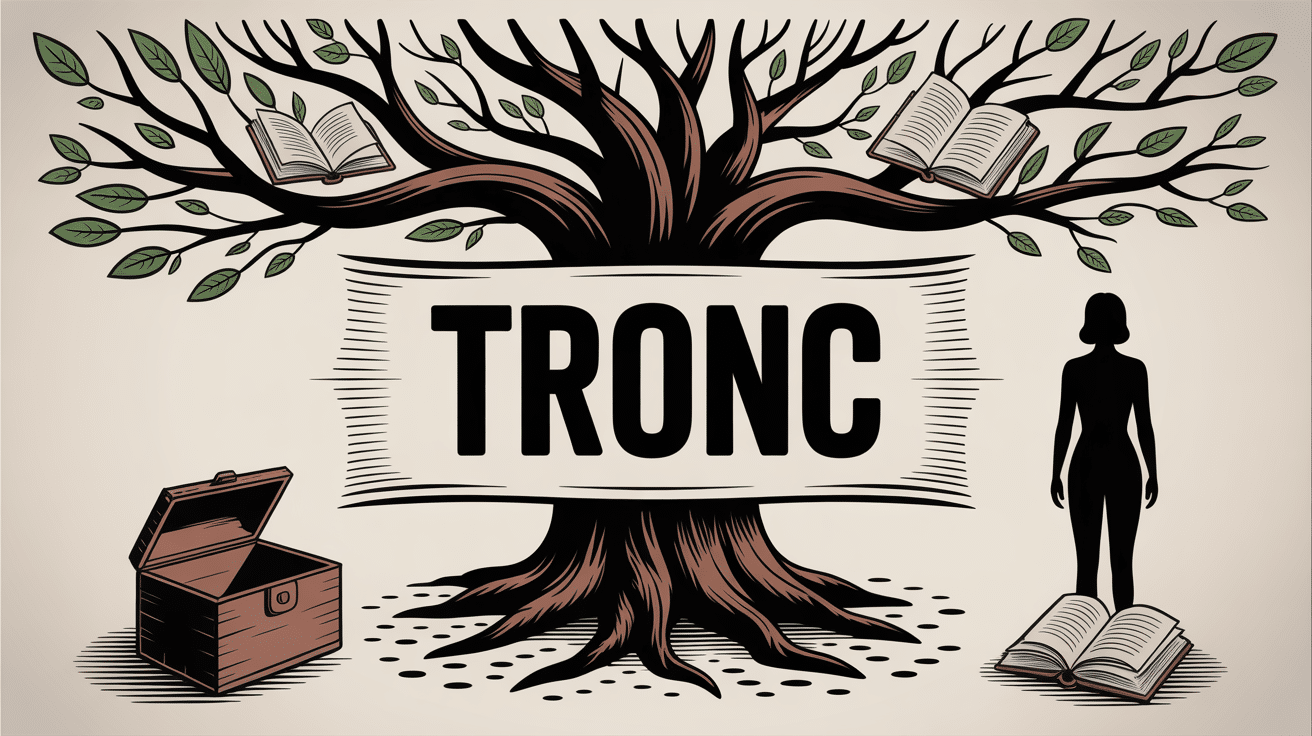

When you cross the request « tronetc », no need to worry: it is simply a typing error that can complicate access to the real definition of the word trunk. A few reperes already make it possible to distinguish without difficulty the usual jobs trunk and its technical variants as « Trunchet »practice to clarify in writing, presentation or academic research.
Here is what one can remember to approach these homonyms with more ease, by relying on clarity and linguistic rigour that facilitates the task in everyday life (this is also the reflex of all those who often manipulate words).
Why research « tronetc » Is she a mistake? Immediate references to understand

After typing « tronetc », the finding is regularly without appeal: no really relevant result appears ? Rest assured, this shell remains frequent. Most often, the expected wording is simply « trunk » (to name the tree, part of the body or a gift box...), and rarely « Trunchet » (tool or specific piece in certain trades). In concrete terms, on references like Le Robert or CNRTL, impossible to find « tronetc » in the French dictionary: therefore there is no need to continue the search in this direction.
It is often found that the confusion arises from the arrangement of the letters on the keyboard or from a hesitation when the word is heard for the first time, especially among students during a school search or in rapid writing. (A spelling teacher recently mentioned that this type of error is one of the most corrected in correction of linguistic duties...)
Light the typographical error: trunk, trunk or trunk?
In practice, in the vast majority of cases, 95 % of the demand « tronetc » hide the will to search for the word « trunk ». It is therefore best to have this reflex when revising a French test or preparing a SVT presentation. Some situations speak for themselves:
- This happens when one dictates to the oral or hastily written, especially on a smartphone;
- Sometimes reading ancient documents written in an unfamiliar graphic;
- It's enough to have a doubt about a common term first heard (for example: "the trunk of a tree, what does it cover in detail?").
Other point – if ever the word « Trunchet » or « Tough » you cross the mind, keep in mind that it is actually technical terms, much less widespread, often limited to very specific trades or dialects (as some artisans or linguists know).
What is the trunk? – Definitions, uses and key examples
The term « trunk » accompanies our daily lives in areas as varied as biology, anatomy or education. Each context corresponds the central notion of "main", "centre" or "support element" with its own nuances. Let us take a closer look and take a concrete look at the examples that make it possible to anchor the definition.
Botanical trunk: the central structure of the tree
For those who observe nature, the trunk refers to the part of the plant situated between roots and branches: it is on it that the whole structure rests. Some adult trunks are only a few centimetres (at young trees), and others peak at more than 30 meters for remarkable specimens, such as redwoods.
Let us add that the trunk ensures the circulation of the sap, carries the canopy and literally concentrates the vital force of the tree. To be remembered: it is the spine of the tree that often indicates it from the first lessons in natural sciences.
Some people also find, like this SVT teacher, that an oak trunk in a family garden easily reaches more than 1.20 m in diameter, not so easy to walk around with arms, even with two!
The trunk of the human body: meaning in anatomy and imageries
In anatomical language, « trunk » refers to the central part of the body, which excludes the head and limbs. It extends from neck to pelvis and encompasses all the main organs: heart, lungs, liver, stomach... School textbooks regularly use this term from college is also why it comes back in the terms "stem muscles" or "stem sections", especially in sports or medicine.
A health care trainer mentioned little that poor control of these technical terms often leads to confusion in biology class.
It can be assumed that the diversity of usage forces students to adapt to the context each time. It's not always obvious in the first classes...
The trunk in religion: gift box or collection
We also call « trunk » the collection box, often placed at the entrance of the churches and mostly made of wood. Some trunks, still visible in historical buildings, bear witness to centuries of usage.
A teacher in art history stressed the astonishment of children during a first visit to the cathedral: discover this meaning of the word « trunk » surprises more than one student, that is to say...
Have you ever noticed the variety of shapes these old boxes can take in museums or on tourist routes? This is a detail that clearly marks the minds on the way out.
The common core of education: a shared foundation of knowledge
In the school sector, « common trunk » corresponds to all the subjects followed by each student in the same class, before choosing a specific route.
In other words, in the second class, all follow the same common trunk all year round, then choose their specialties at the next school year.
Moreover, under a university degree, the common trunk may represent 60-80% the annual teaching time this reality sometimes surprises students during their orientation.
Some professionals generally believe that the common trunk plays a key role in building a solid foundation, which is truly shared by all.
Other jobs: brain stem / team trunk
There is also the expression « brain stem » to name the central part of the brain that acts as a necessary passage between the brain and spinal cord.
In the common language, sports journalists talk about the "team trick" to describe the structure or the most essential members of a group.
This type of expanded job proves the richness of the word is it surprising that this simple term has so many facets in everyday life?
(A neurologist specified that, in his service, understanding this nuance is crucial to avoid any confusion in diagnosis...)
| Background | Definition of « trunk » |
|---|---|
| Botanical | Central part of the tree, between roots and branches |
| Anatomy | Human body centre, without head or limb |
| Religion | Gift box in a church |
| Education | Set of common subjects before specialization |
| Medicine | Brain thorn: essential part of the brain |
Difference between trunk and trunchet: how to retain the shade?
Facing these close words, it happens to meddle « trunk » and « Trunchet ». If a hesitation persists, no wonder: the distinction is about the context and the specialized character of the word « Trunchet ».
A carpentry trainer recently said that even apprentices sometimes mix the terms in the first year...
« Trunk » : generic term VS « Tronchet » : tool or piece of wood
In summary, « trunk » remains accessible to all, while « Trunchet » covers:
- A short piece of tree trunk, often used to make a stake, support or small DIY;
- In leather crafts, it refers to a small shoemaker knife, or a piece of wood cut for precise use;
- Some winemakers also speak of the "trunchet" for the part of the vine located just above the ground, after a specific size (here it is found mainly in the historical wine regions).
In other words, the trunchet is almost always shorter, more technical, and much less known to the general public than the trunk.
Professional example: wood or cooperage trades
In many training courses (including CAP) or cabinetmakers, the term comes back when asked: "Please choose a suitable trunchet for this work."
Moreover, some old trades have abandoned the word, which gradually disappears from modern educational programs.
Below is a synthesis to never reverse both:
| Word | Main use | Example of employment |
|---|---|---|
| Trunk | Center, main part (tree, body...) | The trunk of the plane tree |
| Tronchet | Truncated toe/business tool | Shape a trunchet for the barrel |
Express FAQ – To twist the neck at the last hesitations
To clarify right away, here are the questions that constantly come back around the word « trunk » or when spelling confusion occurs:
What's the right spelling? « Trunk » or « tronetc » ?
Only the form « trunk » refers. The word « tronetc » has no recognized existence in modern French.
If, at the turn of a text, a shell appears, correct it without delay, and keep reading.
Origin of the word « trunk » : Why this word?
By its Latin origin, « trunk » come down from the word « truncus », which meant "cut" or "cut", a translation which was imposed in all major European languages.
Lexiconists in some cases report that the evolution of the term has been accompanied by many jobs in textbooks since the 19th century (and some of its uses still persist today).
Famous literary or historical examples?
No surprise, « trunk » slides into major works: Saint-Exupéry, in « The Little Prince », mentions "A baobab, if allowed to grow, ends up bursting the trunk of the planet. "
The word is also found in regional accounts, where it symbolizes the strength and stature of a central character.
How to use « trunk » in a sentence?
For example: "The trunk of the old plane tree houses each spring a family of birds. "
In a context of anatomy, we will say: "Strengthening the trunk muscles contributes to an optimal posture. "
Such phrases are frequently encountered in sports rehabilitation.
To download to deepen: Fact Sheet PDF – Use and definitions of trunk
To go further, it is worth visiting the presentations of Le Robert, Larousse or CNRTL dictionaries (links above), but also consult your teachers if there is any doubt.
Sometimes a discussion, even a short one, sheds light on a precise meaning or unknown use.
Good reflexes: what to do in case of hesitation on a near term (throttle, trunk, tronetc)?
It is often recommended to consult an online dictionary or reference resource such as the CNRTL.
Spell doubt? A simple check in the search bar ensures you do not let the error pass in an important statement or mail.
Some teachers also notice that adopting this reflection at an early age makes life much easier.
Last point to note: taking the habit of activating automatic correction before putting back any written work makes for sure in serenity (small trick transmitted from generation to generation).
Reliable sources to find each time
- The Robert : definition of "tronc"
- Larousse: definitions and current uses
- CNRTL : history and jobs of "tronchet"
In practice, spelling remains the first ally for effective French-language research. (A lexicographer recalled that a forgotten letter is sometimes enough to blur the understanding of an entire text!)