
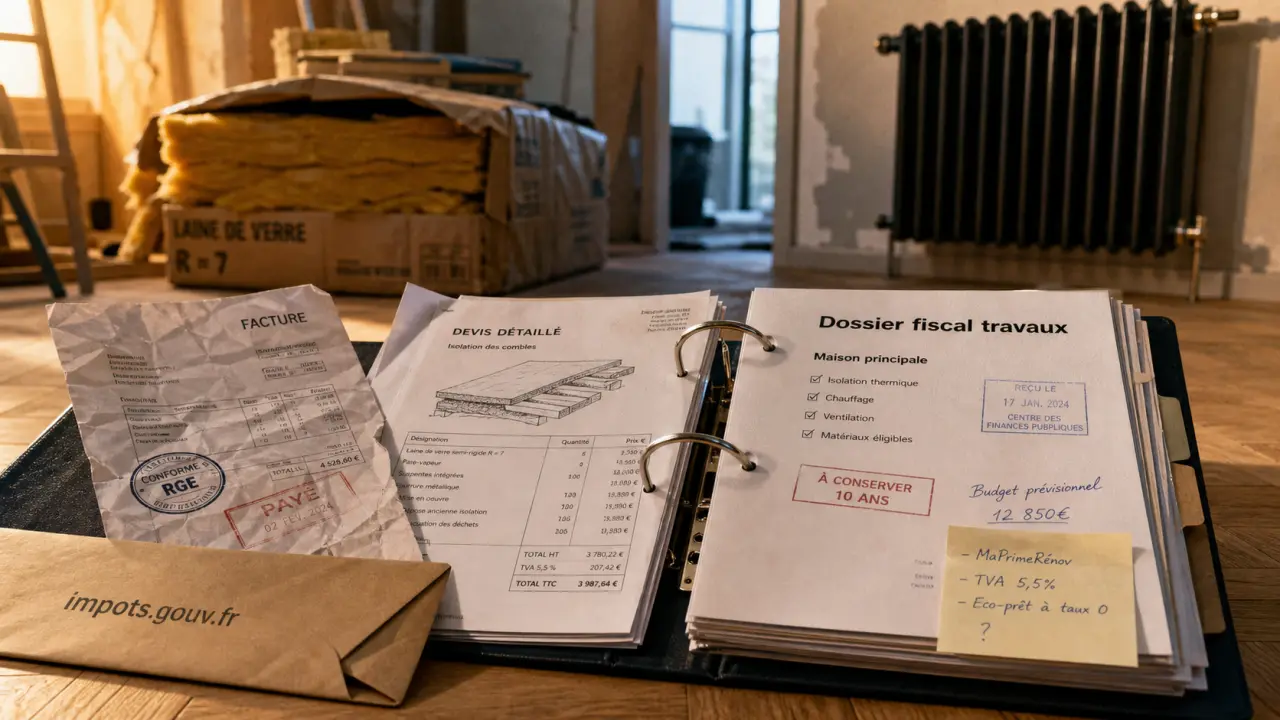

For a principal residence, the basic rule is simple: work is usually not deductible of taxable income as may be certain work in a dwelling leased under the real plan. On the other hand, several expenses related to your main home may qualify for a tax credit, tax reduction or public aid. The challenge is therefore to identify the right device, check the conditions before signing the estimate, and then keep the supporting documentation for the declaration.
Deduction, tax credit, reduction: do not confuse the mechanisms
Tax vocabulary is often confusing. To say that work is « tax deductible » is common, but this is not always legally correct. To properly manage your situation, you must distinguish three simple mechanisms: deduction, tax credit and tax reduction.
Aids and tax credits for your energy renovation work · Discover the state aid schemes and eligibility conditions to finance your energy renovation projects.
| Mechanism | Tax effect | Typical case for the main residence |
|---|---|---|
| Deduction | The expenditure reduces taxable income. | Rare for a principal residence occupied by its owner. |
| Tax credit | It reduces the tax payable and can be refunded if the amount exceeds the tax owing. | Personal services, certain equipment or facilities according to applicable rules. |
| Tax reduction | It reduces the tax owing, without refund beyond tax. | Some real estate investments, but generally excluding occupied principal residence. |
For an occupying owner, therefore, the most common benefits do not take the form of a direct deduction. Energy renovation works are mainly supported by such aids as MaPrimeRenov and energy premiums, while some self-sufficiency-related schemes or some home-based services involve targeted tax schemes.
Works and expenses that may open a tax advantage
Energy renovation: mainly aid, not a conventional deduction
Isolation, changing a heating system, ventilation or some work to improve the energy performance of the main residence is often sought for their tax impact. In practice, these expenses are mainly supported by aid schemes, such as MaPrimeRenov, energy saving certificates and certain support schemes offered via France Rénov. The use of a qualified professional, especially RGE when the device requires it, is often indispensable.
Before you reason post by post, look at your housing in a global way: heat loss, cold walls, inadequate ventilation or oversized equipment. This approach makes it possible to better prioritize the work. Installing high-performance equipment in a poorly insulated housing can produce a limited gain, while a coherent combination of insulation, ventilation and heating improves both the bill, winter comfort, summer comfort and indoor air quality.
Housing adaptation: home maintenance and accessibility
Work designed to adapt the principal residence to loss of autonomy or disability may also qualify for a tax advantage or specific support. Depending on the situation of the home and the applicable rules, it may be equipment that facilitates access, circulation or daily use of the housing: adapted shower, grab bars, secure coatings, motorization or facilities that limit the risk of falling.
This type of expenditure must be carefully prepared. The administration can request specific items: detailed invoice, exact nature of the equipment, address of the accommodation, company identity and date of payment. If the accommodation responds to a medical, age or disability situation, keep the documents that justify the eligibility of the home.
Accommodation-related services
Some expenses are not real estate work in the strict sense, but they involve home maintenance or home help in the principal residence. The personal services tax credit is equal to 50% of expenditure, within the limit of a ceiling generally between 12 000 € and 20,000 € according to the composition of the household and the nature of the benefits.
Depending on the case, this may involve small gardening, small DIY, home care or routine maintenance, provided that the rules for personal services are respected. The invoice or annual certificate of the provider body then becomes the central part to be kept.
Expenditures often confused with deductible work
Embellishment, comfort and current maintenance
Repainting a room, changing a floor for aesthetic reasons, refurbishing a kitchen or modernizing a bathroom does not automatically open up a tax advantage in a main residence. These works can improve the value and comfort of the property, but they are not deductible from income tax when you occupy the home.
The difference is often made on purpose. A decorative replacement is rarely eligible. Equipment meeting a specific energy saving, accessibility or home help requirement may be available if the device exists and all conditions are met.
Rental investment: another tax framework
The arrangements such as Pinel, Denormandie, Loc-Benefits or the real property income regime concern rental investment, not the principal residence occupied by its owner. The Pinel period extends from 01/09/2014 to 31/12/2024, but this benchmark does not transform the work of your own home into an deductible expense.
If you own both your principal residence and rented accommodation, you must separate invoices, addresses and tax plans strictly. The work done in a rental property may be governed by different rules, particularly with regard to the real or property deficit, whereas those of your principal residence are rather covered by targeted tax credits or aid.
Conditions to be checked before starting work
The principal residence and the date of payment
The housing concerned must correspond to the conditions of the intended arrangement: principal residence, actual occupation, sometimes seniority of the dwelling or profile of the beneficiary. The date to be retained is often the date of payment of the expense, not the only date of the estimate or start of the construction site. This is an important point if the work spans two years.
Before validating a quote, check the applicable rule on impots.gouv.fr or to a French energy consultant. The rules may vary depending on the nature of the work, the income of the household, the type of housing and the company chosen.
Professional and detailed invoice
An imprecise bill can lose an advantage. It must clearly identify the undertaking, the address of the site, the nature of the work, the equipment supplied, the amounts paid and the date of settlement. For energy renovation, the company's qualification may be essential when the device requires an EMR professional.
- Ask for a detailed estimate before signing.
- Check eligibility criteria before making a deposit.
- Avoid global bills without sufficient detail.
- Keep proof of payment and any certificates.
- Separately classify the aid received and the amounts actually paid.
Declaration, supporting documents and supplementary aid
Where to report the expenditure concerned
Creditable or tax-reduced expenditures are reported with the tax return, often using the dedicated items and, as appropriate, the supplementary return. 2042RICI. The online service on impots.gouv.fr guides users according to the available boxes, but it does not replace the prior verification of eligibility.
You usually don't have to send all invoices at the time of reporting, but you must be able to submit them if the administration requests. Keep them for several years with quotes, certificates, EMR certificates, aid notifications and payment statements.
MaPrimeRenovation, energy and support premiums
For energy work, the right reflex is to study the aids before starting the work. MaPrimeRenovation and energy premiums can greatly reduce the remaining burden, but they follow specific steps. In some cases, the application must be submitted prior to the commencement of work, a qualified company must be selected, and evidence must be provided on time.
You can consult France Renovation to obtain a neutral orientation, to identify the support that can be mobilised and to avoid too fast commercial offers. For certain equipment, account must also be taken of planned developments: the abolition of the tax credit for charging stations from the 01/01/2026 means that expenditure paid in 2026 will no longer be eligible for this appropriation.
The simple method to secure your advantage
The simplest method consists of four steps: qualifying the type of work, identifying the applicable device, checking the conditions before signing, and then preparing the declaration. This avoids two common errors: believing that a site is automatically deductible because it concerns the main residence, or finding out too late that assistance required a prior request.
- Note the main objective of the work: energy, autonomy, maintenance, comfort or rental investment.
- Check the corresponding device on an official website.
- Check the conditions of professional, housing and payment date.
- Make a detailed invoice and keep all supporting documents.
- Report only eligible amounts in the return.
In summary, not all of the principal residence work carried out in 2024 is tax deductible, but some may provide a real benefit if it falls within a specific framework. The tax gain depends less on the total amount of the project than on its nature, the quality of the proofs and the timeliness of the procedures.