
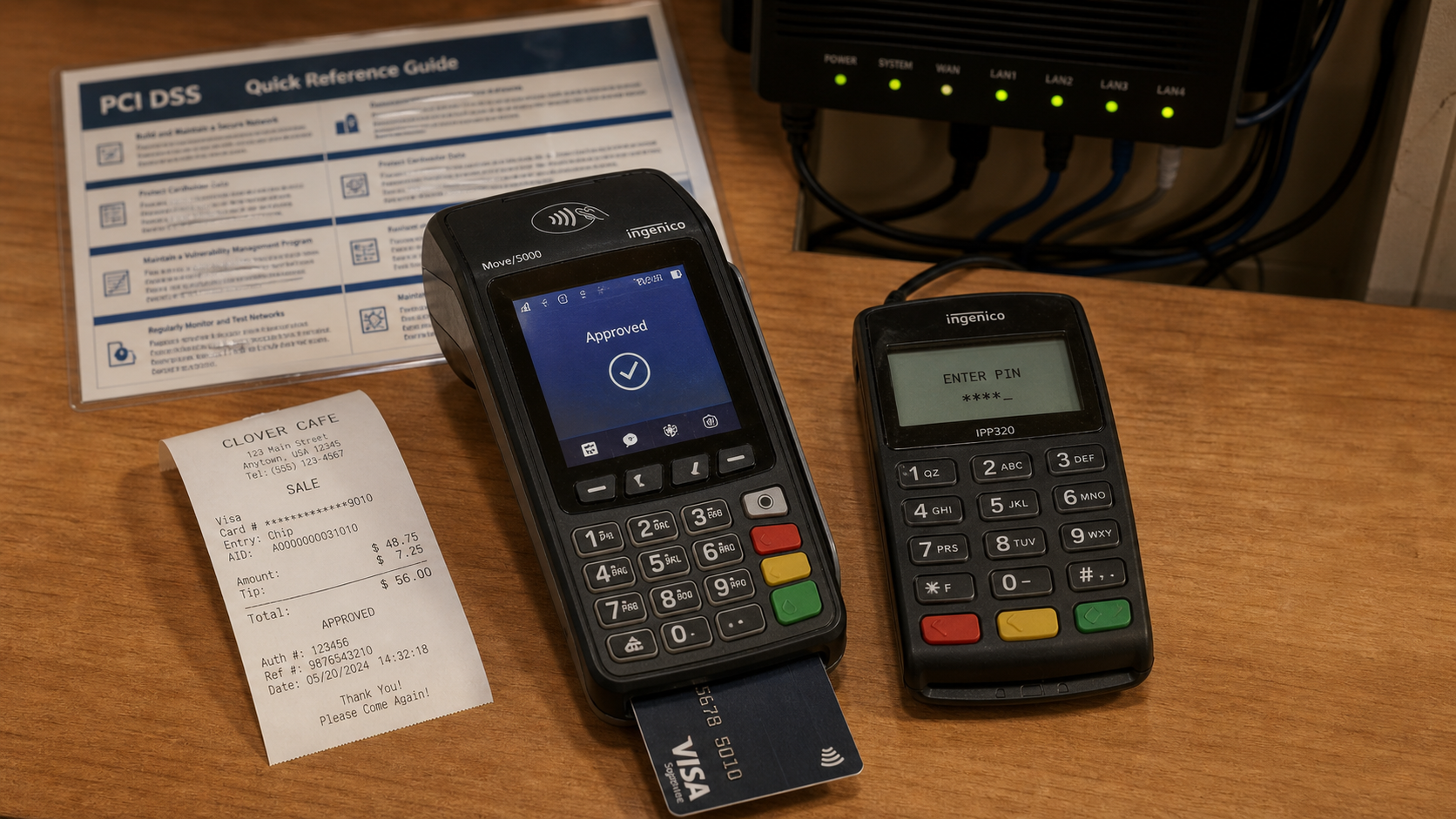
The acronym TPE, for Electronic Payment Terminal, means the device that allows traders and professionals to accept payments by credit card. Much more than just a card reader, this device acts as a secure interface between the customer, trader and banking institutions. He orchestrates instant data verification to validate each transaction.
What is a TPE and what is its role in cashing?
The TPE is a complete computer system. Its mission is to read the information contained in a credit card's chip or magnetic track, seek permission from the bank and finalize the transfer of funds.
The technical operation of a CB transaction
When a card is inserted or approached from the terminal via the NFC For the contactless, the TPE initiates a secure dialogue. It checks the authenticity of the card through standardized protocols such as EMV. The device then requests permission from the customer's bank via a telecommunications network. Once the agreement is received, the TPE generates a receipt that validates the transaction.
Security at the heart of the payment terminal
The TPE works like a digital safe. It respects the certification PCI DSSwhich prevents legible storage or interception of sensitive banking data. This security reduces the risk of fraud and unpaid payments compared to cash or cheque payments.
The 3 large families of payment terminals
The structure of your point of sale and the nature of your activity determine the type of device you need. There are three main categories.
The TPE fixes: the counter solution
The fixed terminal is permanently connected to the counter. It is connected to the area and uses a wired connection, such as the Ethernet or a telephone line, to communicate with bank servers. This is the standard option for shops, pharmacies or bakeries. It can be supplemented by a PinPad, a deported keyboard allowing the client to enter his code in complete discretion.
The portable TPE: freedom inside
The portable terminal works on battery and communicates with its base via Bluetooth or Wifi. It is suitable for restaurants or cafes, as it allows to bring the reader directly to the customer's table. Its scope remains limited to the perimeter of the commercial premises, as it must remain close to its connection terminal.
Mobile TPE: for mobile activities
For mobile traders, delivery agents or professionals, mobile EPT is the right solution. Equipped with a multi-operator SIM card, it connects to 3G, 4G or 5G mobile networks to validate transactions everywhere. It does not require a fixed line or local network.
| Type of TPE | Connection mode | Ideal use | Mobility |
|---|---|---|---|
| Fixed | Ethernet / IP / RTC | Shop, counter | None |
| Portable | Bluetooth / Wifi | Restaurant, terrace | Limited to premises |
| Mobile | GPRS / 3G / 4G | Contracts, deliveries | Total |
Why equip an electronic payment terminal?
TPE is a growth lever for any structure. Denying credit cards limits sales opportunities, as this method of payment has become the norm. The use of a terminal stabilizes financial management by automating the flow of transactions. This synchronization between sale and credit on the bank account provides immediate accounting visibility and secures cash flow.
Risk reduction and time savings
The EPR secures revenue. Unlike cash, there is no risk of physical theft or counterfeit currency. The merchant also saves time at the cash close thanks to the telecollection, which automatically transfers the day's transactions to the bank, thus limiting manual counting errors.
Improved customer experience
Payment is the last step in the customer journey. A modern TPE, fast and compatible with digital wallets like Apple Pay or Google Pay, smooths the cash flow and reinforces the company's professional image.
Conditions of access: who can obtain a TPE?
The payment terminal is not reserved for major brands. However, certain administrative conditions are necessary to sign a monetary contract.
Professionals and businesses
Any entity with a number SIRET can get a TPE. This includes companies such as SARL or SAS, as well as micro-entrepreneurs. The bank or monetary provider usually requests a professional bank identification statement (BID) to link the terminal to the company's account.
The special case of associations and individuals
Associations Law 1901 can equip themselves with a TPE to collect contributions or sell products, on presentation of their statutes and proof of registration in prefecture. For individuals, access is more restricted as most conventional solutions require a declared activity. However, some fintechs offer simplified readers connected to a smartphone for one-off sales, subject to legal limits.
How to choose the right provider and model?
The money market has evolved and is no longer restricted to traditional banks. Before choosing, analyze three fundamental criteria.
The first criterion is the volume of transactions. If you are cashing little, prefer offers without a fixed subscription, where you pay only one commission per sale. If your volume is large, a classic bank subscription with a reduced commission rate will be more profitable.
The second criterion concerns connectivity. If your shop is located in an area where the Wifi is unstable, a TPE with an integrated 4G SIM card is essential to avoid failure of connection in front of the customer.
Finally, consider the need for integration. Some TPEs run on Android and allow to install cashier software directly on the device, which represents a gain of space and efficiency for small businesses.
In short, TPE is the central tool of your cashing strategy. Whether fixed, portable or mobile, it guarantees the smoothness of your financial exchanges and the confidence of your customers. By understanding its technical specificities and market offers, you transform a technical constraint into a management asset for your business.