
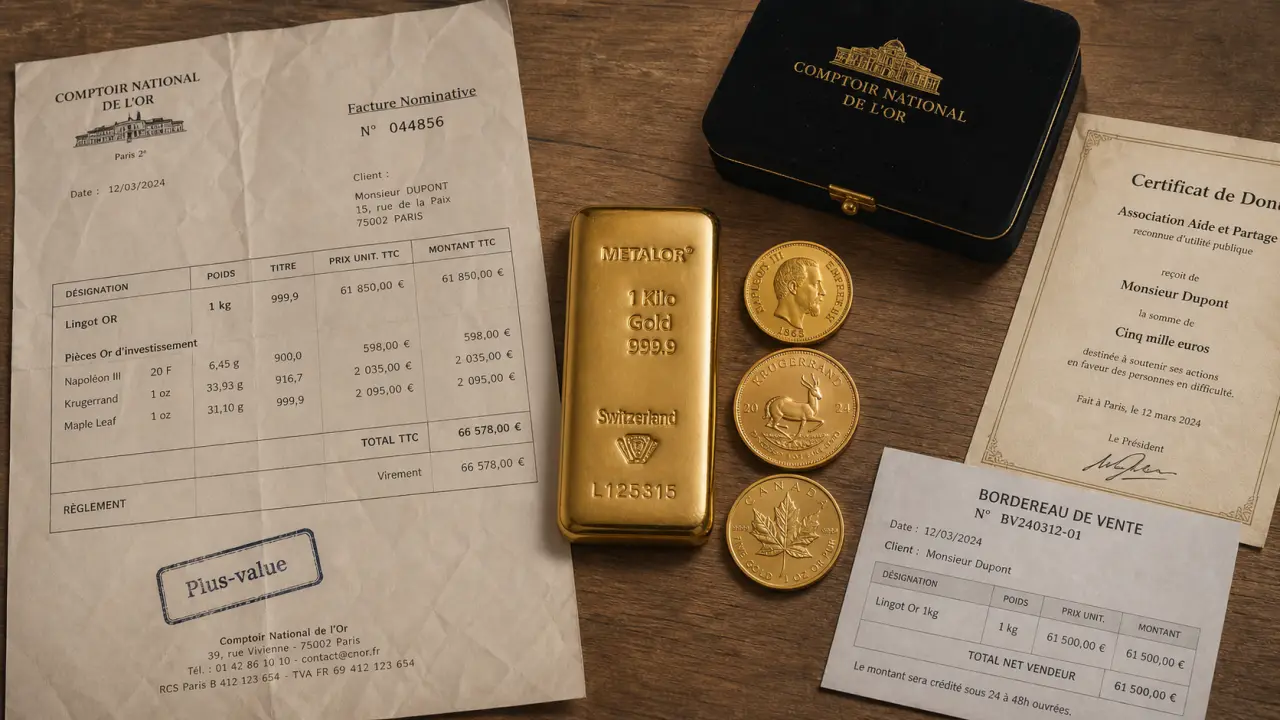

Gold taxation depends mainly on a simple question: do you sell ingots, coins, jewellery or a gold object, and can you prove their origin? In France, tax on gold does not work as tax on a traditional financial investment. Two schemes may apply when reselling, with very different consequences on the amount actually received.
To avoid a bad surprise, it is necessary to distinguish purchase, possession, sale and transmission. However, resale is still regulated. The right reflex is, therefore, to prepare his proofs before even asking for an estimate.
Purchase and detention: what is really taxed
Holding physical gold does not in itself entail a specific annual tax. Taxation occurs mainly at the time of purchase according to the nature of the property and then at the time of disposal. This distinction counts because a Ingot, a piece of investment and a jewel are not always subject to the same rules.
Reporting tax on the sale of precious metals and articles of art · Access the official form to report and pay the flat rate tax on your sales or exports of precious metals, jewellery and articles of art.
Investment: no VAT on purchases
Purchaseinvestment is not subject to VAT. This category includes ingots and parts meeting the applicable tax criteria. It is one of the patrimonial interests of physical gold: entry into custody can be without value added tax, unlike many consumer goods.
This lack of VAT does not mean that there is no tax on exit. On resale, the administration is interested in the sale price, the existence of surplus value and the evidence available. One nominative invoicean act of donation or a document of succession can then become decisive.
Jewelry and gold objects: a different logic
Gold jewellery is more taxed on precious items. On purchase, they can pay VAT at 20%. For resale, an exemption may apply where the selling price is less than 5 000 €. This threshold counts for family sales, antique jewellery or items transmitted and then resold on an ad hoc basis.
Beyond the weight of the metal, a jewel can also have artistic, historical or sentimental value. Before selling, it is prudent to distinguish the weight of fine gold, the quality of manufacture, the possible presence of stones and the interest of the object as a piece of jewellery.
The two systems of gold tax on resale
In a sale of physical gold, two tax regimes dominate: the flat-rate tax on precious metals and the tax on real capital gains. The choice does not depend solely on the rate. It is mainly based on your ability to document the purchase and length of detention.
| Scheme | Rates: | Basis of calculation | When to Consider |
|---|---|---|---|
| Fixed charge on precious metals | 11.5 %, including 0.5 % CRDS | Total selling price | When procurement documents are missing |
| Tax on real surplus value | 36,2 % | Realized gain | When price and acquisition date are proven |
| Duration-related exemption | 0 % after 22 years | Real surplus value | When long detention is justified |
The flat fee: simple, but sometimes expensive
The tax on precious metals, often known as TMP, amounts to 11.5% of the total amount of the sale, of which 0.5% is CRDS. It applies to the price received, not the gain. This means that it can be due even if you sell no real profit compared to your purchase price.
This scheme has the advantage of simplicity: it does not require a precise calculation of surplus value. On the other hand, it can be penalizing for a large sale or for expensive purchased gold. In the absence of workable evidence, it often becomes the default scheme.
The tax on surplus-value: more demanding, often fairer
The capital gains tax, or TPV, is set at 36.2% of the realized surplus value. It therefore covers only the difference between the selling price and the purchase price. If you prove you bought your gold 12,000 € and you sell it 14,000 €, taxation targets the gain of 2,000 €, not the 14 000 € cashed.
This regime becomes interesting when the surplus value is low, non-existent or reduced by the length of detention. However, it is necessary to produce reliable proofs: nominative invoice, document identifying coins or ingots, act of donation, certificate of succession or any element clearly establishing the origin and date of acquisition.
Choose the most advantageous scheme without leaving the legal framework
Optimizing gold taxation is not about circumventing the rule, but using the system provided for your real situation. The central point is the traceability. The clearer your record, the more freedom you keep when you sell.
Duration of detention: the reduction that changes everything
With the surplus-value regime, a 5 per cent reduction per year applies from the third year of detention. After 22 years, the exemption becomes total. This rule changes the tax interest of a long retention, provided that it can prove the date of entry into the heritage.
Example: a person resells gold with an added value, but has an old and nominal invoice. If detention is long enough, the reduction can significantly reduce the taxable base or even cancel it after 22 years. Without proof, it is likely to switch to the 11.5 % flat-rate tax on the total selling price.
The "raft" reflex: keep together what allows you to float
A physical gold tax file looks like a raft: each single piece looks modest, but the set keeps you floating when you sell. The invoice alone may not be sufficient if it does not link the goods sold to the original purchase; a photo of the ingots or parts, a safe book, a delivery slip, a sharing act or a estate inventory can enhance the consistency of the record. The idea is not to accumulate paper at random, but to build a legible chain of possession, capable of connecting the metal, date, price and owner.
Loss of value or lack of gain: why evidence remains useful
If you sell cheaper than the purchase price, the surplus-value regime can avoid unfair taxation on a deficit transaction. But we still have to be able to demonstrate this loss. Without proof, the flat rate tax may apply to the amount of the sale, even when the transaction has not enriched the seller.
Before any assignment, collect your documents, compare the two plans and ask the trader in charge of the transaction what reporting option will be used. The best tax is prepared before signing, not after payment.
Declaration, payment and justification: the steps to be taken
Gold tax is in principle declared at the time of sale. When the transaction passes through a professional, the professional may collect the necessary information and complete certain formalities. This does not exempt the seller from providing accurate documents or keeping a copy of the record.
Forms and information to be provided
Declarations related to precious metals may involve a CERFA form, including the CERFA No 11294*13 according to the declared situation. The expected information generally relates to the seller's identity, the nature of the property, the sale price, the tax system used and, in case of an option for the actual gain, the evidence of the acquisition.
To secure the operation, prepare a simple list before the appointment:
- nominative purchase invoice or equivalent document;
- proof of date of acquisition or entry into the patrimony;
- precise description of the goods sold : ingot, coin, jewel, weight, possible number ;
- act of donation, succession or sharing if the gold has been transmitted;
- estimate or sales slip delivered through the intermediary.
Non-reporting: Unnecessary Risk
Not reporting a taxable sale is subject to recall, interest and tax penalties. Risk is not only financial: a poorly documented transaction can also complicate a succession, property control or future resale. Compliance therefore remains the best protection, especially for high amounts.
Article 150 VJ of the CGI covers certain exemptions and special situations relating to divestitures. In case of doubt about a large amount, complex family transfer or tax residence abroad, it is preferable to have the treatment validated by a tax adviser or notary.
Jewellery, Estate, Donation and Non-Residents: Cases of Care
Gold taxation becomes more sensitive when the property has not been purchased directly by the seller. It is common: inherited pieces, ingots donated by a parent, antique jewelry preserved in a family. In these situations, the date and value of entry into the heritage must be carefully established.
Transmission: Donation and estate do not replace proof
Receiving gold by donation or succession may provide a tax starting point, provided that the act makes sufficient reference to the goods transmitted and their value. An estate inventory, a notarial act or a donation declaration may allow for a later choice for taxation on the actual surplus value.
Conversely, a gold simply "found" without a document leaves little margin. Even if family detention is old, the administration expects evidence. For family assets, it is useful to formalize the transmission rather than to let coins and jewellery circulate without a written record.
Non-resident: verify the agreement and place of assignment
Non-residents must pay attention to the country of tax residence, the place of sale and any applicable conventions. An assignment made in France may entail French obligations, without excluding consequences in the country of residence. The right regime is not only derived from the seller's nationality.
In practice, the more international the situation, the more rigorous the documentation must be: proof of purchase, proof of tax residence, foreign succession documents and translation if necessary. For a significant sale, professional support avoids choosing an inappropriate scheme or declaring twice inconsistently.
The rule to be retained is simple: the flat fee secures poor files with proofs, while the real surplus value rewards well-documented files and lengthy detentions. Before selling, take the time to reconstruct the history of your gold: this is often where the most important tax economy is played.