
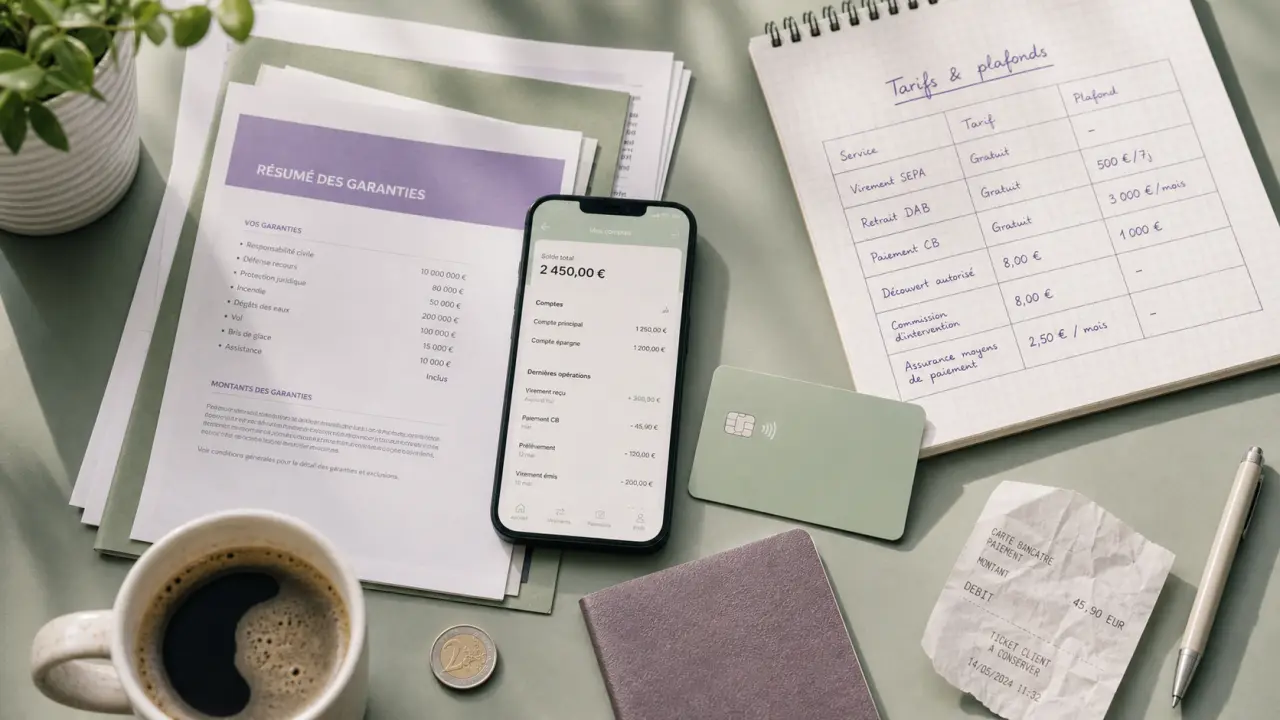

At LCL, the price of a credit card depends on the level of service sought. Pick-up and payment card for young people, classic card, premium card or high-end formula, each option meets a different use. To compare correctly, one must look at the basic tariff, but also costs abroad, ceilings, immediate or deferred debit, as well as insurance included.
LCL credit cards and their basic rates
The LCL range covers several profiles, from young people who discover banking autonomy to customers who want a simple card for everyday life, to regular travellers and those looking for high ceilings with wider assistance. The table below gives a quick reference to locate each map and its level of service.
See current LCL bank rates · Access the full guide to banking fees and services to manage your budget transparently with LCL.
| LCL card | Tariff indicated | Most suitable profile | Main use |
|---|---|---|---|
| My MapLCL Mastercard | 12 €/year | Young people, first supervised uses | Limited payments and withdrawals |
| Innovative Mastercard | 4.30 €/month | Simple daily use | Pay, withdraw, manage your budget |
| Visa Cleo | 4.30 €/month or from 1 €/month for students | Students, young people, controlled budget | Classic international card |
| Visa First | 12 €/month, 6 €/month for 18-29 years, free 4 years for students | Casual travellers, families, eligible young people | More comfortable guarantees and ceilings |
| Mastercard Platinum+ | 19.50 €/month | Clients seeking more services | High ceilings and enhanced assistance |
| Infinite Visa | 30 €/month | High-end, frequent or demanding needs | Premium services, ceilings and support |
These amounts are used as a basis for comparison, but must be verified in the LCL tariff guide at the time of subscription. The rate may depend on age, student status, group offer or account formula. In other words, a card displayed at a given price may return differently depending on the profile.
Accessible maps to start with
My MapLCL Mastercard displays an annual rate of 12 €/year with voluntary limited ceilings. Withdrawals may range from 30 to 200 € for 3 days, while payments can reach up to 300 €/month. It is primarily a need for learning, with a reassuring framework to track spending and avoid budget gaps. For a first account, it is a simple and readable solution.
Innovative Mastercard and Visa Cleo, at 4.30 €/month, address more to those who want a daily card. Visa Cleo becomes particularly interesting for students thanks to its price from 1 €/month, provided that the eligibility criteria laid down by the bank are met. In both cases, the main interest is to have a clear, convenient card without paying for little-used services.
Premium and premium cards
Visa First marks the transition to a more complete card, with a rate of 12 €/month, reduced to 6 €/month for 18-29 years and free 4 years for students according to the conditions indicated. It is appropriate when travel, major purchases or assistance needs become more frequent. The gain is then played on the ceilings, guarantees and comfort of use, not only on the image of the card.
Mastercard Platinum+, at 19,50 €/month and Infinite Visa, at 30 €/month, respond to more intensive uses. Their interest depends less on the prestige of the map than on the actual use of ceilings, guarantees, assistance and associated services. If you rarely use these benefits, the cost may seem high. If you travel often or if your payments are larger, the level of service becomes more meaningful.
Additional costs: what may exceed the contribution
The monthly rate is only part of the cost of a bank card. Withdrawal fees, non-euro area payments and certain options may change the annual budget, especially if you regularly travel or buy in foreign currency. This is often where the difference between two cards becomes visible.
Payments and withdrawals abroad
For a Visa First, payment costs abroad are 1.2 € + 2.85%. Foreign withdrawals are charged 3 € + 2.85%. For Mastercard Platinum+ and Infinite Visa, the fee shown is 1.2 € +2.2% for payments, and 2.35 € +2.2% for withdrawals.
The difference may seem small on a single operation, but it becomes noticeable on a stay with several withdrawals or significant expenses. Purchase of 500 € in foreign currency does not produce the same cost according to the card used. If your payments remain concentrated in France, this difference is less. If you often go abroad, it quickly becomes important in the calculation of the actual annual cost.
Immediate debit, deferred debit and contactless payment
LCL cards can offer immediate flow or deferred flow rate, according to the map and conditions of access. Immediate debiting facilitates day-to-day monitoring of the balance. Deferred debit brings payments together on a given date, which can help smooth spending, but requires tighter budgetary discipline. The choice between the two depends mainly on how you manage the account.
Contactless payment is available up to 50 €, which covers most small current purchases. This feature improves user comfort, but it does not exempt regular monitoring of operations from customer space or mobile application LCL My Accounts. A simple follow-up avoids bad surprises at the end of the month.
Ceilings, guarantees and services: compare the real value
Two cards at different rates do not compare only with their prices. Payment ceilings, withdrawal ceilings, insurance and assistance determine the actual value of the card on a daily basis. A cheaper card may be enough for local use. A more expensive card becomes more interesting if you need margin or protection.
Customizable ceilings as needed
Payment ceilings can be customizable up to 15,000 €. The withdrawal ceiling can be up to 1,000 € Every three days. These levels do not necessarily concern all cards or customers: they depend on the product held, the profile, the financial situation and the bank's agreement.
Before choosing, it is useful to look at its actual expenses: plane tickets, hotel reservations, security deposit, online shopping, one-time business expenses. A card that is too limited can block a large payment even if its price seems attractive. On the other hand, a larger map than your current needs may cost more without providing practical utility.
Insurance and assistance included
LCL bank cards incorporate varying levels of insurance and assistance. Classic cards mainly cover current needs, while premium and high-end cards can provide broader protection, especially when travelling or in case of incidents requiring assistance. The level of coverage therefore depends directly on the chosen card.
The right reflex is to check the guarantees before paying for a major trip or service with the card. In many cases, the activation of a guarantee depends on total or partial payment with the card concerned. The insurance notices specify the conditions, exclusions and compensation ceilings. This point counts as much as the posted rate.
A bank card works as a reserve of flexibility and security. The larger the reserve, the more margin you have in the face of unforeseen events, but you pay for this capacity even when you do not use it. If you're almost never traveling, extended international coverage can remain of little use. If you often book hotels, rent vehicles or go with your family, this reserve becomes a concrete advantage.
Which LCL card chooses according to your profile?
The best choice depends on three simple criteria: your age or status, your travel frequency and your need for ceilings. By reasoning by profile, the comparison becomes more legible. It is then sufficient to bring the displayed rate closer to the actual use.
- Young or first account: MyMapLCL Mastercard allows you to start with low cost and limits adapted to the learning of banking management.
- Student: Visa Cleo from 1 €/month or Visa First free 4 years for students can be interesting depending on eligibility and mobility needs.
- Daily use in France : Innovative Mastercard or Visa Cleo are often enough to pay, withdraw and track expenses without overpaying little-used services.
- Occasional traveler: Visa Premier becomes relevant thanks to its guarantees, ceilings and higher level of assistance.
- Frequent traveler or high expenses: Mastercard Platinum+ or Visa Infinite can be justified if ceilings, fees abroad and associated services are actually used.
A simple method for estimating the annual cost
To compare, add the annual fee and your likely fee. For example, a 12 card €/month costs 144 €/year excluding specific operations. Then add the planned foreign withdrawals, the total amount paid in currency, then compare with a cheaper but more expensive card for non-euro area use. This reading gives a more accurate picture of the total budget.
You can also create your own mini-simulator in a spreadsheet with four lines: annual subscription, number of withdrawals outside the euro area, total amount paid in currency, need for travel guarantees. This approach avoids choosing only on the displayed price and highlights the map actually adapted to your lifestyle. It remains simple, but helps to decide without being guided by the entry rate alone.
Subscribe or adjust your card without mistake
The subscription can be prepared online, from the customer area, the mobile app or with a LCL advisor. The exchange with an advisor remains useful if you hesitate between two cards, if you want a deferred debit, or if your ceilings must be adapted to one-time expenses. This step also allows to verify the conditions related to age or student status.
Before validating, check four points: monthly or annual rate, young or student conditions, non-euro area charges and level of guarantees. If you already hold a LCL card, a change of card can also be considered when changing your situation: leaving for school, first job, moving, long journey, income changes or a child's arrival. The right choice then depends on your real use, not just a level of range.
Finally, consider regularly consulting the LCL tariff guide and the records associated with your card. Prices give the cost of access, but the conditions of use determine the real comfort on a daily basis. It's the best way to compare without mistake.