
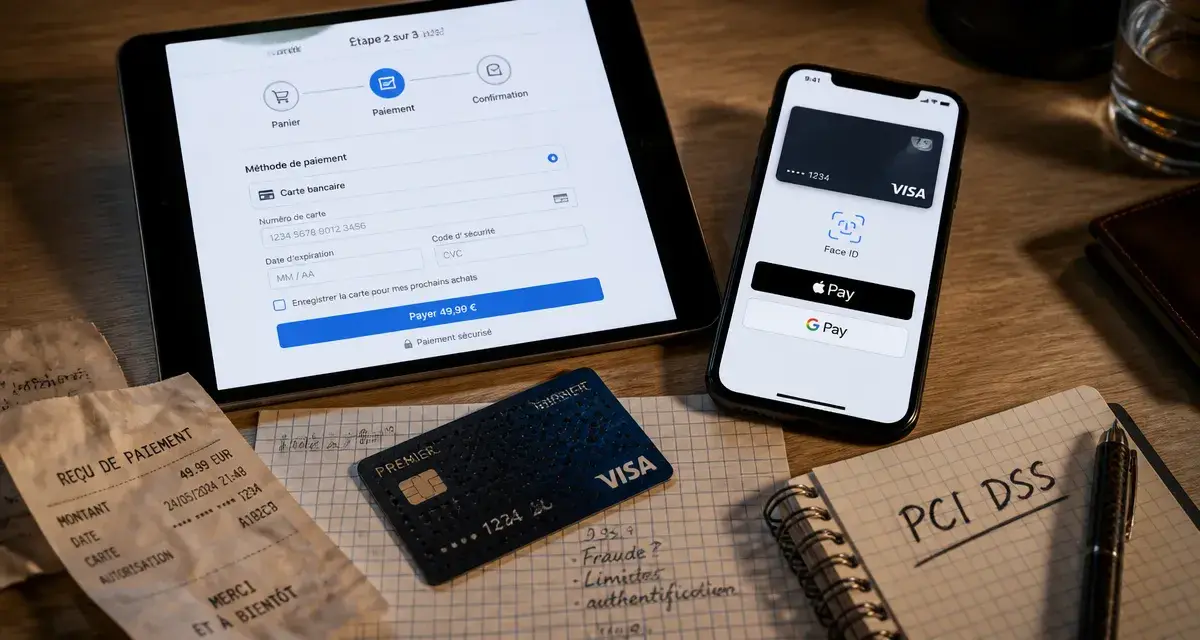

The drop out of the basket is the first obstacle to the growth of an online shop. Often it is neither the product nor the price that discourages the buyer, but a complex or unreassuring payment tunnel. Choose the right one payment solution for your e-commerce is not just about comparing commissions. It is a strategic lever that directly impacts your conversion rate, your cash management and the protection of your financial data.
The two large families of payment providers
To collect sales on the Internet, two main models coexist. Understanding how they work makes it possible to identify the one that corresponds to the maturity of your business.
Full-service payment service providers (PSP)
PSPs like Stripe, PayPal or Mollie are the favourites of e-commerce sites. Their strength is simplicity: they provide the technical platform and merchant account needed to receive the funds. Account opening is fast, dematerialized, and does not require a distance selling contract (VAD) with a traditional bank.
These solutions are suitable for business start-ups or companies which favour rapid integration via Native modules on Shopify, WooCommerce or PrestaShop. On the other hand, the cost per transaction may be higher than in the traditional banking model, especially for large sales volumes.
Banking solutions with VAD contract
Traditional banks offer their own payment gateways, such as Payplug, Monetico or Scellius. To use them, you must sign a distance selling agreement with your bank advisor. This model often offers more competitive transaction fees for large volumes, as commissions are negotiable.
The advantage is the centralization of your financial flows: money arrives directly in your professional account without third-party intermediary. However, technical integration is sometimes more rigid and the contract validation process is longer than with a modern PSP.
Essential criteria for selecting your payment solution
Beyond price, several factors determine the effectiveness of a payment solution in the daily life of an e-commerce.
The diversity of means of payment accepted
If credit cards remain the dominant method in France, the absence of alternatives can cause sales to lose. Digital wallets like Apple Pay and Google Pay simplify payment on mobile by removing the manual entry of card numbers. For high baskets, propose a solution of split payment (BNPL) as Alma or Klarna has become a standard for increasing the average basket.
User experience and mobile integration
A payment solution must blend into the design of your site. Redirections to an external page, often poorly optimized for smartphones, create a breach of trust. Priority should be given to solutions for integration in « iFrame » or via customizable input fields, so the customer stays in your graphic universe throughout the purchase tunnel.
Flow management and speed of payments
Cash management is the nerve of war. Some solutions transfer funds to J+1, while others impose 7 days or minimum thresholds. It is crucial to have a management portal clear to track transactions, make partial refunds with one click and export your accounting data without error.
Consider the financial flow of your shop as a hydraulic circuit. Your payment provider's infrastructure acts as a valve Regulation. An efficient solution adjusts the debit in real time: it lets legitimate transactions pass with fluidity while blocking fraud attempts by behavioural analysis. This modulation capacity differentiates a simple payment terminal from a partner able to maintain the stability of your ecosystem during load peaks, such as balances or Black Friday.
Security and compliance: the pillars of trust
Online fraud is evolving, and your responsibility as a trader is committed to protecting your customers' data.
PCI DSS Standard and TLS Protocol
Any payment solution must be PCI DSS (Payment Card Industry Data Security Standard) certified. This international standard ensures that sensitive bank card data is processed, stored and transmitted in a secure environment. By using a certified provider, you delegate this technical and legal responsibility.
Strong authentication with 3D Secure 2
Since the European Directive DSP2, 3D Secure 2 is the standard. It allows strong authentication of the cardholder, for example via a notification on the customer's banking application. A modern solution manages the « frictionless », asking for authentication only when the risk is proven, so as not to overburden the purchase route unnecessarily.
Understanding actual costs: visible and hidden costs
The cost of a payment solution is not limited to the commission rate displayed. A fine analysis of the tariff structure is necessary to avoid bad surprises.
| Type of fee | Description | Points of vigilance |
|---|---|---|
| Transaction costs | Percentage of amount + fixed share. | Check rates for cards outside the Euro zone. |
| Monthly subscription | Fixed cost to access service. | Common in banks, rare in PSP. |
| Refund costs | Cost applied on repayment. | Some claimants retain the original fee. |
| Dispute costs | Cost in case of back-invoicing. | May reach 15€ 30€ per file. |
The impact of retro-billing on your profitability
Backbilling occurs when a customer disputes a debit with his bank. If you cannot prove delivery, the claimant withdraws the funds and applies a penalty. A good solution must provide defence tools, such as the ability to transmit proof of delivery directly to the dispute management interface.
The currency and international card trap
If you sell abroad, check the conversion fee. A 1.5% rate can absorb a significant part of your margin. Some solutions allow cash in several currencies without immediate conversion, a major advantage for international e-commerce.
Technical integration and maintenance
The choice depends on your infrastructure. If you use a CMS such as PrestaShop or WooCommerce, the existence of a official plugin regularly updated is essential. These modules allow codeless configuration and automatic management of the command statuses.
For custom developed sites, the quality of API documentation is the number one criterion. A well documented API allows developers to integrate advanced features, such as recurring subscriptions or post-delivery payment, while ensuring system stability during security updates.