
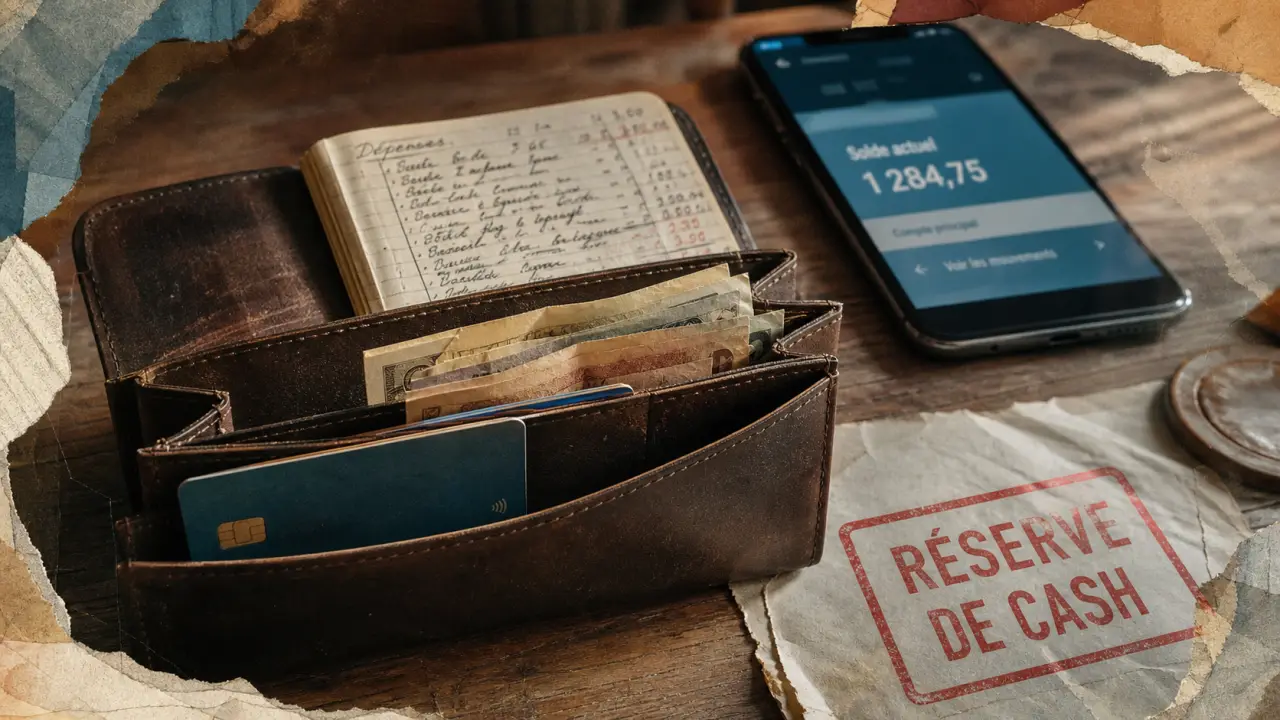

Taking all his money from the banks in 2025 is not usually the most prudent answer. Rather, the real question is what part to keep available, what part to leave on current account, and what part to place elsewhere to limit costs, practical risks and loss of purchasing power.
The concern is understandable: rising bank rates, fear of default, fraud of transfers, economic uncertainty. But a massive withdrawal also exposes to very concrete problems: theft, loss, lack of recourse, difficulty in paying certain expenses and money that does not produce any yield. The reasonable objective is therefore to organise a security reserve, not getting out of the banking system in panic.
Remove all his money: a false good idea in most cases
Bank risk exists, but it is not managed by panic
The bank is not a magic safe, but it remains a central tool to receive a salary, pay rent, pay SEPA levies, maintain traceability and access means of payment. Removing all of its savings amounts to replacing an institutional risk with several domestic risks: burglary, fire, oblivion, family pressure, difficulty justifying the origin of the funds during a future deposit.
It is also necessary to distinguish between current account savings. The current account is used to circulate money of the month, it is not designed to store large sums of money on a sustainable basis. On average, the French retain 14 000€ Current account. This amount may give a sense of security, but it is often excessive if money sleeps without remuneration and remains exposed to expense or monetary erosion.
The right reflex: distribute rather than remove
A stronger strategy is to allocate its money by use: a pocket for current expenditure, a Emergency reserve Easily accessible, a small sum in cash, and then savings media adapted to its horizon. This logic avoids dependence on one channel. It also protects against two opposing excesses: leaving too much money on an unhelpful current account, or keeping too much cash at home.
Imagine your finances as a multi-compartment system: if everything is grouped together in the same place, the slightest incident blocks the rest. If the compartments are well separated, the money remains available without weakening. An overinflated current account immobilized from cash; A house filled with tickets creates physical vulnerability. In between, an organization in compartments gives flexibility: credit card, cash, savings available, longer term investments. It is this ability to adapt quickly, without imbalance, that makes the real financial resilience.
What changes on the banks side: enhanced security and rising costs
Better managed transfers
In 2025, one of the important points concerns the enhanced transfer security. The verification between the IBAN and the beneficiary's name is intended to reduce errors and certain frauds, particularly when the user seizes a bad recipient or is under an attempt to usurpate. Instant 24/7 transfers also change habits: money circulates faster, which is convenient, but requires more vigilance before validation.
Compare the main bank rates by department and bank · Visit the official website to search for and compare bank rates by department, type of bank and services.
In concrete terms, it is necessary to check the beneficiary, beware of urgent requests, never modify a RIB received by simple e-mail without control, and keep a bank capable of blocking or quickly contesting a suspicious transaction. Banking security depends not only on rules, but also on your daily actions.
Bank charges weigh more on small budgets
The most tangible issue for many households is the increase in fees. Account management charges increased by an average of 8.95% in 2025. Accountancy fees are within an annual range of 0.48€ 24€. Cards also change: +2.91% for immediate debit cards and +2.98% for deferred debit cards.
Other tariff lines deserve special attention. The implementation of a SEPA levy mandate is increasing by 16.67%. An occasional transfer to the counter costs on average 5€. For overdrafts less than 400€, the new average package reaches 6.05€. These amounts may seem modest in isolation, but they become significant when they repeat themselves.
Protections exist for fragile customers
Persons in financial fragility benefit from specific protections, including a cap on incident costs of 3€. This is important: before you withdraw your money for fear of fees, it may be more efficient to ask your bank for the terms of the fragile customer offer, compare the rate schedules and eliminate unnecessary services.
| Post to be monitored | Useful benchmark | Simple Action |
|---|---|---|
| Account management | Average increase of 8.95% | Compare banks and online offers |
| Carte bancaire | +2.91% to +2.98% by flow | Check if the top card is useful |
| Transfer to counter | 5€ on average | Focus on secure customer space |
| Discovered less than 400€ | Average package size 6.05€ | Put a pay alert |
How much to keep in cash without falling into excess?
Cash reserve is used for outages, not to replace the bank
The European Central Bank and the Bank of France recommend keeping a small amount of cash at home to deal with a temporary situation: failure of payment terminal, power cut-off, unavailability of a distributor, card problem or local crisis. The often cited landmark is 70 to 100€ per household member, to cover about 72 hours of autonomy.
This amount is not intended to finance several months of life. It is used to purchase food, fuel, medication or a transport ticket if electronic payments become unavailable. For one person alone, 70 to 100€ may suffice. For a four-person home, the reserve can therefore be around 280 to 400€, to adapt according to the age of the children, the location and dependence on the car.
Practical rules for storing liquid
The cash must be kept discreet, accessible to adults in the home and stored in an unobtrusive location. It is better to favour several small denominations rather than a hard-to-use ticket. Also think of renewing this reserve on time: it must be composed of banknotes in good condition, usable immediately.
- Keep a limited amount, consistent with 72h of essential expenses.
- Avoid talking around you about the amount kept at home.
- Do not store the entire reserve at the same location if the fireplace is large.
- Mentally note its use: emergency, breakdown, essential displacement.
- Do not confuse crisis reserve with precautionary savings.
How much to leave on his current account? A simple method
Part of Actual Spending of the Month
The right current account balance depends on your spending rate. First add your fixed charges: rent or credit, energy, insurance, telephony, subscriptions, monthly taxes, transport. Then add your usual variable expenses: food, health, leisure, fuel. The current account must cover these outings with a margin, without becoming a car park with savings.
A conservative approach is to keep the equivalent of one month of current expenditure, plus a cushion for tax offsets. If your monthly expenses are 1,800€, keep 2,000 to 2,500€ can be consistent according to your income dates. The surplus can be transferred to an available savings or a suitable investment.
Adapt according to profile
An employee with regular income does not have the same needs as an independent, pensioner or single parent. Self-employed people often have to keep more cash to absorb late payments and contributions. The retiree may prefer regularity and simplicity. A household with children must provide for more unplanned: health, school, transportation, equipment.
- Calculate your monthly fixed expenses.
- Add your average variable expenses.
- Add a realistic margin of safety.
- Transfer surplus to separate savings.
- Review the amount every six months or after a change of situation.
This method answers the question better than total withdrawal. It reduces the amount unnecessarily exposed to current account while keeping enough liquidity to live normally.
Alternatives to massive withdrawal to protect your money
Diversifying media and institutions
Protecting your money does not mean keeping everything in the form of notes. This can include several accounts, multiple institutions, regulated savings, time-bound investments and better monitoring of fees. Diversification reduces dependence on a single actor and facilitates access to funds if a service is temporarily unavailable.
| Solution | Main asset | Limit to know |
|---|---|---|
| Current account | Immediate availability | Costs and frequent lack of performance |
| Home cash | Helpful inoperative or short emergency | Risk of theft or loss |
| Available savings | Separation between budget and reserve | Variable yield according to medium |
| Second bank | Alternative access to payments | Additional administrative management |
| Diversified investments | Long-term objective | Risk and horizon to be understood |
Good reflexes before taking a big sum
If you want to withdraw a large sum, please inform your agency: distributors and counters do not always have the amount requested immediately. Also check your card withdrawal limits, deadlines, and bank conditions. Avoid carrying a large sum alone and never withdraw under the pressure of a third party, even as an advisor, policeman or technician.
In practice, the most balanced decision is to keep a little cash, optimize the current account balance, reduce unnecessary costs, enhance the security of its transfers and diversify its savings. To withdraw all his money from the banks in 2025 is therefore not a protective strategy: it is often a risk shift. A clear, proportionate and regularly revised organization protects your savings better than a radical gesture.