
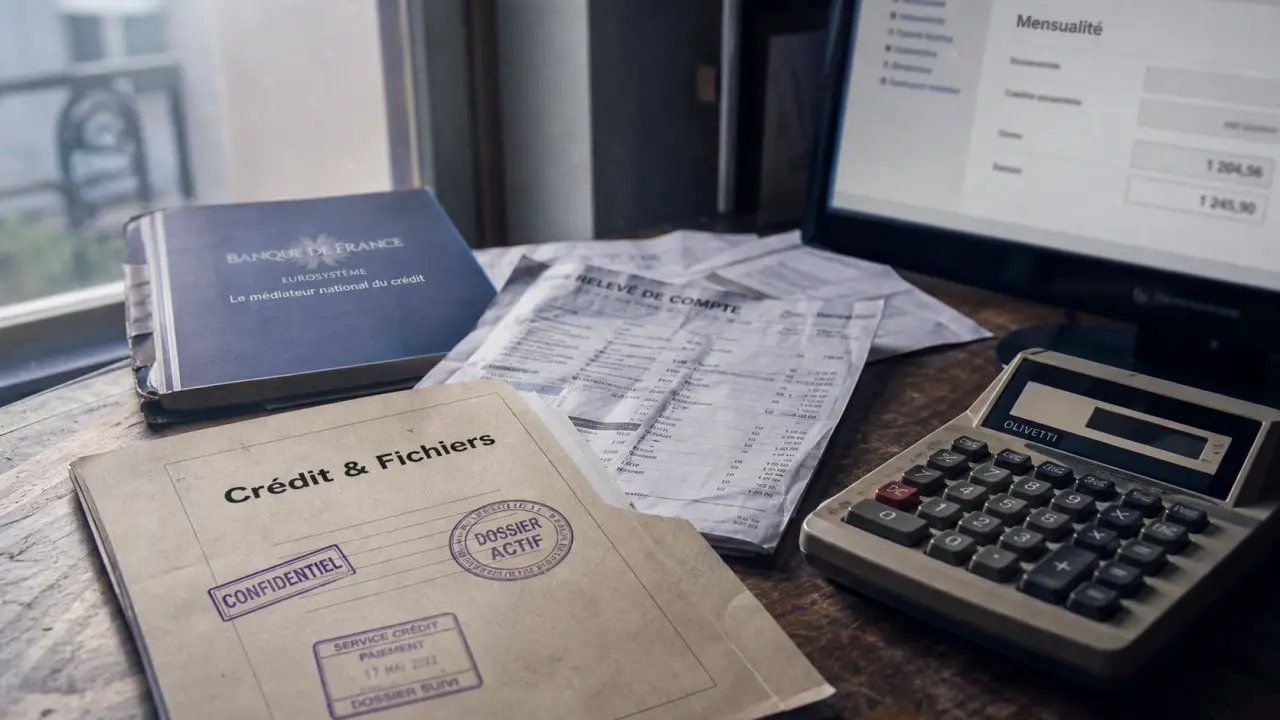

When a bank refuses a loan, a bank file blocks an application or monthly payments become too heavy, you often look for a « credit Bank of France ». The term is confusing because the Bank of France does not distribute loans to individuals. It informs, protects, manages certain bank files and treats over-indebtedness situations. The solution therefore depends on your case: refusal due to the wear rate, FICP stamping, need for mobility or debt already too high.
What the Bank of France really does for credit
The Bank of France does not replace a commercial bank and does not offer traditional personal credit. Most importantly, it plays a reference role in understanding the rules of credit, verifying its situation and ascertaining possible remedies. This is often where the search for a solution begins when the traditional banking system closes.
Monthly calculator
Note: This tool is provided as a guide to test the sustainability of your project. It does not assess your eligibility with financial institutions and does not replace a personalized study before filing a file or applying for microcredit.
A role of information, control and protection
The Bank of France publishes information on bank credit, consumer credit, the wear rate, incident files and over-indebtedness procedures. It also allows you to view its possible inclusion in some files. This check avoids filing a new application without understanding the reason for blocking.
It also intervenes in the over-indebtedness procedure. When a file is submitted, the committee examines the financial situation of the household and may propose appropriate measures, such as rescheduling, temporary suspension of certain debts or, in the most severe cases, partial or total cancellation according to the applicable rules.
The rate of wear, a ceiling that can explain a refusal
Credit may be denied even if the request appears reasonable. One possible reason is to exceed the rate of wear, i.e. the maximum statutory interest rate that lenders cannot exceed. This ceiling includes interest, certain costs and insurance when it is mandatory or included in the total cost.
If the risk profile leads to too high a rate, the bank may refuse the loan because it cannot offer financing beyond this limit. The refusal therefore does not always have a personal significance. It can simply result from a legal framework designed to avoid too costly credit.
Bank of France file: understanding what is blocking access to the loan
Being registered with the Banque de France does not necessarily mean that no credit is possible, but access to finance becomes much more difficult. Institutions consult these files to assess the risk before granting a loan.
View your bank incident files (FCC and FICP) · Easily access your personal information stored in bank incident files to verify your financial situation.
FICP, FCC, FNCI: three files not to be confused
The FICP, Individual Credit Repayment Incident File, includes credit-related payment incidents and certain over-indebtedness situations. This is the file most directly related to the loan refusal.
The FCC, Central Cheques File, concerns incidents related to unfunded cheques and bank card withdrawals. It may lead to restrictions on the use of certain means of payment. The FNCI, National File of Irregular Cheques, is used to verify whether a cheque presents an anomaly, for example when it is declared lost, stolen or linked to a closed account.
| File | What he reports | Possible impact |
|---|---|---|
| FICP | Credit repayment incident or over-indebtedness procedure | Frequent refusal of conventional credit |
| FCC | Check incident or card withdrawal | Banking restrictions and distrust of lenders |
| FNCI | Irregular cheque, closed account, opposition | Enhanced verification when accepting a cheque |
Check your situation before re-applying
Before applying for a new credit agency, it is preferable to check exactly what is entered. This can be done at the Bank of France, in particular via its online services or at a reception point. You can also consult practical information on the site of the Bank of France.
This step avoids looking for a blind solution. A refusal may come from an unregularised old incident, too high a debt, a lack of life or an incomplete record. Identifying the real pattern allows you to choose between regularization, microcredit, budget support or the filing of an over-indebtedness file.
Microcredit: the most realistic alternative in case of bank refusal
Microcredit is not an easy credit or an automatic loan to registered individuals. It is a supervised financing, usually associated with support, for people who do not have access to traditional bank credit but whose project remains coherent and repayable.
Personal microcredit: to finance a useful need
Personal microcredit can be used to finance a social or vocational integration project, such as the purchase or repair of a vehicle for work, training, equipment for employment, mobility costs or the stabilization of a personal situation. The maximum amount indicated for personal microcredit is EUR 8 000, with a repayment period of up to 5 to 7 years maximum.
Demand is not usually made as a conventional online credit. It often involves a support structure, association, communal social action centre, local mission, social organization or specialized network. This structure helps prepare the file and verify that the refund will not aggravate the situation.
Professional microcredit: creating or consolidating an activity
Professional microcredit is aimed at people who wish to create, resume or develop a small business. The maximum amount may be EUR 17,000. Again, the stakes are not limited to getting money. Accompaniment is used to verify the viability of the project, foreseeable expenses and repayment capacity.
For a financially vulnerable person, this approach is often more protective than a quick mini-credit. Too short, too expensive or poorly calibrated funding can relieve the urgency at the moment, and then move the difficulty over the following months.
A microcredit dossier is built around a simple point: the need must improve the situation, not degrade it. The lender and the accompanying structure therefore look at the usefulness of the project, the level of income, the fixed expenses and the real place of monthly payments in the budget. The clearer the file, the easier it is to assess whether funding remains sustainable.
Preparing an application is not just about gathering evidence. It is necessary to explain why the need exists, what it changes in daily life and how the reimbursement is inserted into the budget. This concrete reading of the project counts as much as the documents transmitted.
Which solutions according to your banking situation?
There is no single solution for obtaining credit despite a blockage. The correct strategy depends on the nature of the refusal, the type of filing and the level of debt. Comparing options avoids unrealistic promises.
| Situation | Possible solution | Point of vigilance |
|---|---|---|
| Refusal due to wear rate | Reduce the amount borrowed, extend or adjust the project, compare insurance | Do not multiply requests without understanding the total cost |
| Need car to work | Personal microcredit with social support | The project must improve the situation on a sustainable basis |
| FICP file | Regularization of the incident, file verification, microcredit according to file | Traditional credit remains difficult while the risk is high |
| Overdebt | File with the over-indebtedness commission | Taking credit can make the situation worse |
| Owner with high financial stress | Study heritage solutions, including sales with specialized advice | Complex solution, to be analysed legally and financially |
Regularize before borrowing again
If registration comes from a payment incident, the priority is often to regularize the debt concerned. Once the situation has been corrected, the institution that originally registered must provide the information necessary to update the file. It is then prudent to verify that the deletion or modification has been taken into account before filing a new application.
If the problem comes from a separation, a credit subscribed to two or a common good, it is not enough to stop paying its share. As long as the credit agreement is not amended or terminated, co-borrowers generally remain committed according to signed terms. In this case, contact the lender, review the terms of the contract and, if necessary, seek legal advice.
Beware of rapid credit when the situation is already fragile
Mini-credits and immediate cash offers may seem convenient when an account is under pressure. But if the budget is structurally unbalanced, a new repayment may speed up over-indebtedness. The right reflex is to calculate the rest after all the fixed charges: rent, energy, food, insurance, transport, pensions, taxes and credits.
From 20 November 2026, consumer credit will be more regulated in the context of European regulatory developments. The aim is to strengthen consumer protection, particularly in the face of more accessible and sometimes underestimated forms of credit.
Overindebtedness and consumer credit framework
When debts accumulate, looking for a new loan can become risky. The credit can fund a solid project, but it is not used to make up a long-term deficit budget. In a context where file filings have increased by almost 10% in 2024 and 2025It is better to address the cause of the imbalance than to prolong late payments.
File folder to be protected
An over-indebtedness file is filed with the Bank of France. The Panel examines the applicant's resources, expenses, debts and good faith. If the file is admissible, some protections may apply and solutions are sought with creditors.
This approach can be impressive, as it formalizes a financial difficulty. Yet it can avoid the chain of costs, stimulus and relief credits. It allows the whole situation to be handled rather than a single unpaid one at a time.
Prepare a clear and honest file
To move forward effectively, gather proofs of income, expenses, credits, tax debts, unpaid rents, overdrafts, pensions and stimulus letters. The aim is not to present a perfect dossier, but a complete one. The more legible the situation, the more the orientation will be adapted.
In case of doubt, it is possible to approach a budget advisory point, a social worker, a specialised association or directly from a Bank of France reception point. Accompaniment helps to distinguish between banking negotiations, realistic microcredit or over-indebtedness procedures. It is often this clarification, more than a new loan, which allows us to regain control.