
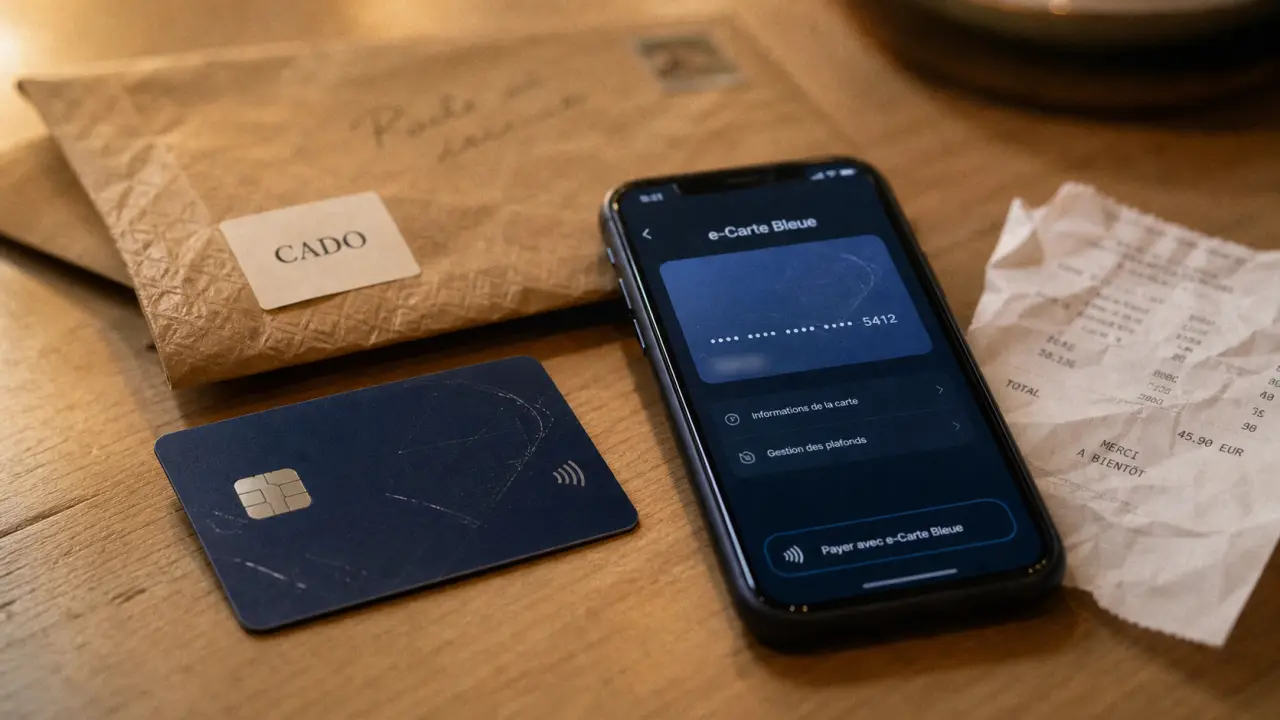

Choose a Map The Post Bank depends mainly on the intended use: daily purchases, withdrawals, budget to keep under control, online payments, travel, first young account or business needs. The offer covers international bank cards, the service e-Blue Card to secure remote purchases, and CADO Card to offer a purchase credit usable in a wide network of brands.
The Post Bank cards to distinguish before comparing
When looking for a bank card The Postal Bank, you must first separate three families: the payment card linked to a current account, the virtual card service for the Internet and the gift card. They do not meet the same needs and do not necessarily replace themselves.
Review, Visa Classic, Visa Premier: the current account card
International bank cards from La Banque Postale are linked to an account and allow you to pay for purchases or withdraw money according to the limits, options and terms of the contract. The map Review is usually thought to maintain strict control of the budget, while the cards Visa Classic and Visa First are aimed at wider uses, with greater flexibility and associated services.
The right choice depends on very concrete criteria: do you need a card for regular in-store payments? Online shopping? Frequent travel? Or, on the contrary, a tool to limit the risk of budget overruns? Before you subscribe, you also have to check the type of debit, payment and withdrawal ceilings, the insurance included and the conditions related to any overdraft authorization.
Blue e-Card: useful for remote shopping
The e-Blue Card is a virtual card service for online payments. Its principle is simple: instead of entering your main bank card data on a merchant site, you generate a single-use virtual card number. This number is used for a specific purchase, which limits the exposure of the real card number.
This service is particularly suitable for people who often order on the Internet or who want to reduce the risk of keeping bank details by some merchants. The management and history of e-cards is done via the customer area, with a history of purchases on 90 days. The service also includes: Delivery insurance, to be examined in the Insurance Information Notice for the exact conditions of application.
CADO Card: the gift card for individuals and businesses
Next to the bank cards, Bank Postale also offers the CADO Card. It is not a card linked to your current account, but a gift card that can be used in more than 500 signs. It may be suitable for an anniversary, a thank you, a reward or for business gratuity operations.
For major orders, including an order for CADO securities greater than 5000 €, a dedicated commercial service can be requested. The available information indicates that the 9:00 to 18:00. For a company, the interest is not limited to the gift: the card can also be used for internal events, loyalty operations or employee benefits, subject to compliance with applicable rules, especially around ACOSS events.
Which card to choose according to your usage profile?
The best method is to use your habits rather than just compare the titles. An adapted card is the one that avoids both unnecessary services and annoying daily limits.
Consult the bank rates and preferential offers of La Banque Postale · Discover the advantageous pricing conditions for young people and families on La Banque Postale's credit cards and insurance.
| Profile | Option to be looked at first | Point of vigilance |
|---|---|---|
| Budget to be monitored | Map Account analysis and tracking | Ceilings, authorities and operations of the balance |
| Standard daily use | Visa Classic | Cost of formula, debit, withdrawals and payments |
| Enhanced travel or services | Visa First | Including guarantees and insurance conditions |
| Frequent online purchases | Blue e-Card Service | Compatible sites, tracking virtual numbers |
| Gift or gratuity | CADO Card | Ensigns accepted, amount, use by beneficiary |
For a young person: look at the price, but also budget education
Young offers are an important subject at La Banque Postale, as rates depend on the age of the holder. The Account Form is indicated as free for 12-17 years. For 18-25 years, the available information mentions 2.50 €/month with a Realys + Insurance card, and 3 €/month with a Visa Classic/Premier + 1st year insurance card. For 26-29 years, the amounts shown are 4 €/month with a Realys + Insurance card, and 5 €/month with a Visa Classic/Premier + 1st year insurance card.
Beyond the price, a first card is often used to install good reflexes: consult your balance, understand the effect of a deferred or immediate payment, identify recurring expenses and keep a margin before a levy. For a young person, a card that is too permissive may be less useful than a card that makes the budget readable.
An isolated payment sometimes seems trivial, but the budget functions as a chain effect suite. A forgotten expense can delay another, and then cause a balance that is too fair at the time of a subscription, rent or full transport. Before choosing the map, list the fixed expenses, variable expenses and drawdown days. This simple chronology avoids reasoning only on a monthly ceiling and helps to choose a card that absorbs small daily deviations without creating tension on the account.
For an individual who buys online: combining physical card and virtual card
If you already use a credit card for your current expenses, the e-Blue Card can be considered as an additional security layer for remote payments. It is particularly relevant when ordering from new sites, when you do not want to register your main card, or when you want to isolate your online shopping more easily.
The right reflex is not to confuse technical security with commercial vigilance. A single-use virtual number protects the coordinates of your main card, but it does not replace the seller's verification, return conditions, delivery costs or site identity. Delivery insurance included with the Blue Card can be an asset, provided you read the exclusions and procedures to be made in case of a problem.
Rates, conditions and points to check before subscribing
The rates for a card The Postal Bank vary according to the account formula, age, type of card and associated services. The young amounts quoted above provide a benchmark, but the rate applicable to your situation must always be verified in the current tariff brochure or with an advisor.
What influences the real cost of a card
The price shown is only part of the comparison. Any costs associated with off-grid withdrawals, payments or withdrawals abroad, card replacement, insurance or support services and management options must also be considered. If you travel little, a very complete map can be oversized. Conversely, if you often leave, international warranties and terms of use can justify a higher-end card.
A further discrete but useful element concerns the threshold of non-perception of dagios, indicated with a maximum per quarter of 3 €. This means looking not only at the map, but also at how the account works in the event of a small overdraft or one-time incident. A card always fits into a broader relationship with the current account.
The documents and criteria to be anticipated
In order to obtain a card, it is usually necessary to be the holder or co-owner of the account concerned, to provide the proof requested and to accept the contractual conditions. Depending on the profile, the bank can offer one card rather than another, especially based on age, income, account status, intended usage and desired options.
Before validating, request or consult the relevant documents: rate terms, insurance information notice, payment and withdrawal limits, debit terms, opposition terms, loss or theft rules. This step seems administrative, but it avoids bad surprises when you need a guarantee, assistance or a one-time ceiling increase.
Security, insurance and online management: services that change usage
The value of a card is not limited to payment. The associated services can make a difference in specific situations: undelivered purchase, lost card, ceiling to be adjusted, payment refused, expenditure tracking or need assistance.
Manage your card from customer space and application
The online customer space and mobile app allow access to current management functions. Depending on the options available, you can track your transactions, view certain information related to your card, access related services or find the e-card history. For the e-Carte Bleue, the purchasing history on 90 days facilitates control of payments made with virtual numbers.
This online management is useful provided it is regular. A weekly consultation is often enough to identify a forgotten purchase, a renewed subscription or an unusual transaction. In case of doubt, it is better to react quickly: opposition, contact with customer service, verification of guarantees or consultation of the insurance notice.
Insurance: check the trigger, not just the title
Not all card or service insurances work in the same way. Certain guarantees apply only if the purchase was paid with the card concerned. Others depend on the type of claim, the reporting period, the evidence provided or the nature of the property purchased. The delivery insurance included with the e-Mape Bleue, for example, must be analysed through its precise conditions.
The most reliable reflex is to keep the evidence: order confirmation, invoice, carrier tracking, exchanges with the seller, proof of payment. In the event of a dispute, these elements speed up the request and avoid finding out too late that a document is missing on the file.
Subscribe, order or manage: the simplest route
For an account-related credit card, you can go to the customer area, the app or an advisor The Postal Bank to study the cards available according to your profile. If you are already a customer, online management can facilitate certain steps; If you open an account, the choice of card is usually made with the chosen formula.
For the Blue Card, the objective is to activate a complementary service for remote shopping, and then use it when you pay on the Internet. For the CADO Card, the route is different: it is to order a gift card, with particular attention to the amounts, the accepted signs and, for companies, the order volumes and the frame of use.
Before deciding, summarize your need in one sentence: « I want to control my budget », « I want to pay online with less exposure », « I want a card to travel », « I want to offer a purchase credit ». This sentence is often enough to rule out unnecessary options and ask the right questions to the advisor or in the customer space.