
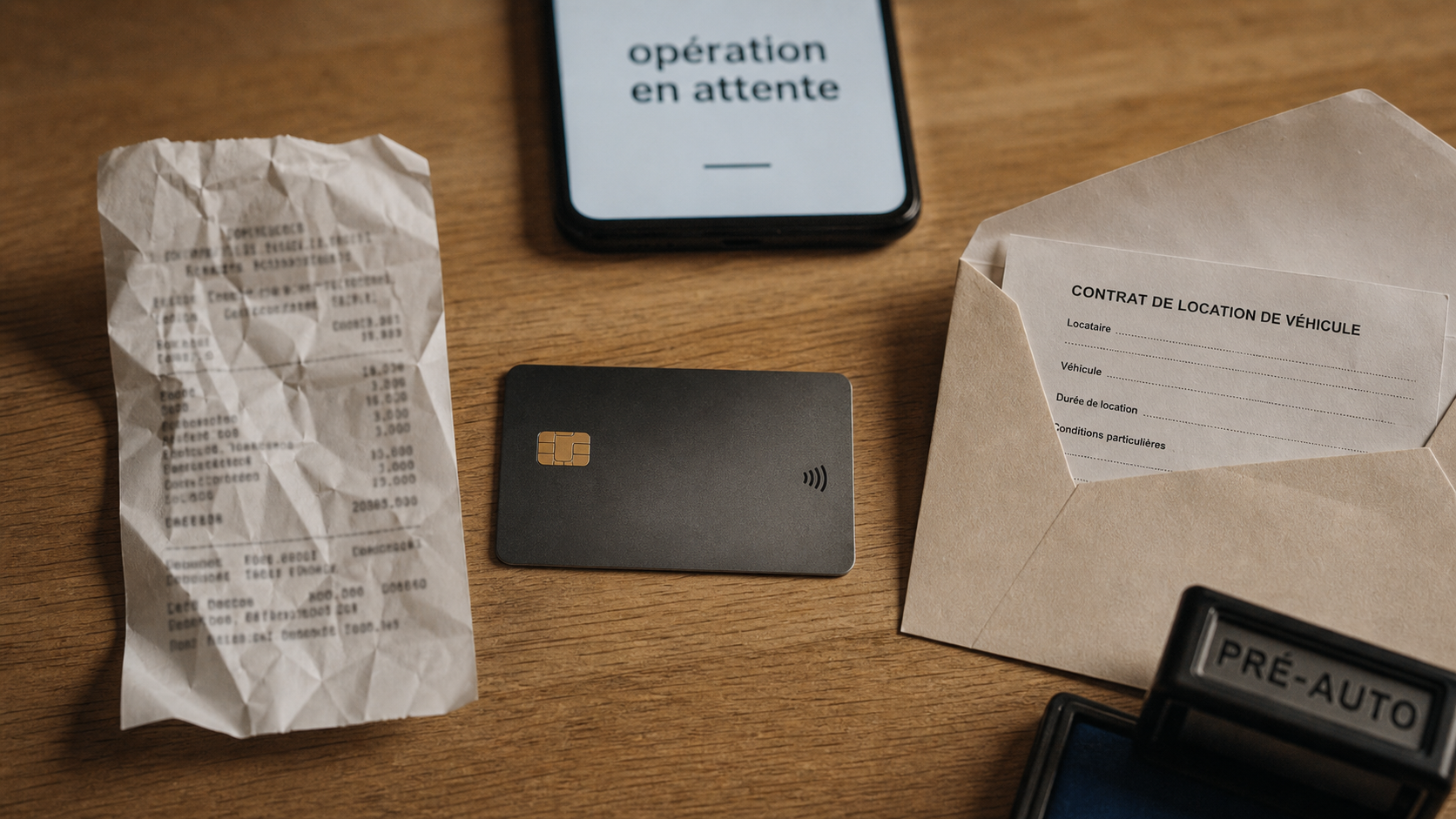

A bank pre-authorisation is not an immediate payment: it is a temporary blocking d It is often found at the hotel, at a car rental company, at a fuel station or on some online booked services. Money is not debited until the transaction is finalized, but it can reduce your balance available and your payment ceiling for several days.
What a bank pre-authorisation really means
Bank pre-authorisation, also known as bank footprint, consists of a trader asking your bank to reserve an amount on your card. This money serves as a guarantee: it confirms that the card is valid, that the limit available is sufficient and that the merchant can be paid if the service is consumed or if the contract fees apply.
In concrete terms, the merchant seizes an amount on his TPE, his booking software or his payment platform. The bank then checks whether authorisation can be granted. If so, the amount is temporarily locked in. It does not always appear as an operation debited on the statement, but it can remain visible in the banking space under a statement close to « pending operation », « card authorization » or « pre-aut ».
A blockage, not a definitive flow
The grade is essential: a pre-authorisation does not yet transfer money to the merchant. It reserves a capacity to pay. At the end of the service, three scenarios are possible: the merchant transforms all or part of the pre-authorisation into payment, cancels, or automatically expires according to the rules of the bank and card network.
The amount remains unavailable for a variable period, which may range up to Maximum 30 days According to the banks. So you have the impression that money has disappeared, while no definitive debit has taken place.
Amount to be announced
The amount of the pre-authorization is fixed by the merchant, but it must be communicated to the customer. In a hotel, it can correspond to the total amount of the reservation, plus a provision for extras, for example 50 euros per day. In a car rental company, it often depends on the vehicle, the insurance chosen and the level of deductible provided for in the contract.
Pre-authorisation, suretyship and payment: do not confuse them
These three notions are close in the mind of the client, but they do not have the same effects. Confounding them can create bad surprises, especially when several transactions immobilize the payment ceiling during a trip.
Understanding the rules and ceilings for payment by credit card · Discover the legal conditions governing payment by credit card, including the limits and refusal rights of traders.
| Concept | What's happening | Impact on account | Standard example |
|---|---|---|---|
| Bank pre-authorisation | An amount is temporarily reserved on the card | Reduced balance or ceiling available without immediate debit | Hotel, car rental, fuel |
| Payment | The transaction is validated and forwarded to the trader | Actual, immediate or delayed debit according to map | Settlement of a hotel night at departure |
| Security | Guarantee claimed in case of damage or unpaid | May take the form of a pre-authorisation or other deposit | Franchise of a rental vehicle |
Pre-authorisation is therefore a technical tool payment. The bail is a contractual guarantee. The payment corresponds to the final settlement. A bond may be pre-authorised, but both terms are not strictly synonymous.
Before you validate, think about the cumulation of blockages. Hotel reservations, car rentals and fuel are not limited to the price shown. Each can reduce your card margin for a while. For a traveller, therefore, the real available budget also depends on the amount already fixed by these operations.
Situations where pre-authorisation is most common
Traders use pre-authorisation when they are not yet aware of the final amount to be invoiced or when they want to protect themselves against a risk of unpaid. It is particularly useful in areas where the service is consumed before final payment.
Hotel: room, extras and guarantee of stay
Upon arrival, a hotel may request a pre-authorisation to cover the room price, tourist tax, minibar, restaurant or any additional charges. The amount may be higher than the price of the reservation, provided that it is announced. Initially, the hotel collects the actual amount due and releases the rest, or lets the authorization expire if no fees are to be charged.
Car rental: deductible and refund
In a car rental company, pre-authorisation is often used to cover deductible in case of damage, missing fuel, delay in return or certain options. This is one of the cases where the amount can be raised. Before leaving, it is prudent to check the payment ceiling and the terms of the contract, especially if you use a card with systematic authorization.
Fuel, VTC and variable amount services
At fuel automatons, a sum can be blocked even before the exact amount of the fuel is known. The final flow then corresponds to the fuel actually taken, but the amount initially reserved may remain visible for some time. The same principle may exist for certain variable-rate services where a final price depends on the length, distance or options consumed.
Impacts on your balance, ceiling and entitlements
The main effect of bank pre-authorisation is the temporary reduction of your capacity to pay. Even without debit, your bank may consider that the reserved amount is no longer available. This may result in a refusal to pay if your balance, overdraft authorization or card ceiling becomes insufficient.
Why pre-authorisation can be refused
A refusal does not necessarily mean that your account is out of print. It can come from an already reached payment ceiling, incompatible card, overly restrictive systematic authorisation, expired card or security check. Some immediate debit cards or cards with systematic authorisation are less well accepted for car rentals or hotel guarantees, as the trader wants to ensure that the amount remains available.
Before a major expense, contact your bank to temporarily increase your ceiling if necessary. Also check that the card used to book is the one shown on site: some properties require the same card to facilitate the connection between booking, pre-authorization and final payment.
How long money remains blocked
The duration depends on the bank, the merchant, the type of card and how the transaction is closed. When the trader correctly cancels the footprint or converts only part of the amount into payment, the release can be quick. If no action is taken, the pre-authorisation may disappear automatically, with a blocking period up to Maximum 30 days According to the banks.
You have the right to be informed of the amount blocked and the conditions for using this guarantee. In case of a discrepancy between what has been announced and what appears on your account, first ask the merchant for a written explanation, and then get closer to your bank if the situation does not regularize.
What to do in case of prolonged blockage or abnormality
Most pre-authorizations resolve without intervention. But if the amount remains blocked for too long, if a payment has been debited in addition to the print, or if the merchant does not respond, it is necessary to act methodically.
Checks to be made before claiming
Start by consulting your bank application to distinguish a debited transaction from a simple pending transaction. Then gather the evidence: rental contract, final invoice, TPE ticket, booking confirmation, exchanges with the merchant. This will show whether the pre-authorization should have been cancelled or adjusted.
- Check the pre-authorization date and amount announced.
- Compare with the final invoice actually paid.
- Ask the merchant for confirmation of cancellation or closure.
- Contact your bank if the blocking persists despite this confirmation.
- Monitor your card ceiling if you have any other scheduled payments.
A simple message model to the merchant
You can write: Hello, a bank pre-authorisation of [amount] euros was made on [date] for [booking or service]. As the final invoice has been paid on [date] for an amount of [amount] euros, please confirm the cancellation or closing of the remaining bank footprint. Please provide me with any supporting documentation so that my bank can release the amount if necessary.
For traders, the good practice is simple: announce the amount before validation, keep a record of the customer's agreement, close the authorization as soon as the final amount is known and train the teams to distinguish pre-authorization, debit and refund. A well-explained pre-authorisation avoids disputes and builds confidence at the time of payment.