

Setting a sum for a few months or two years does not meet the same objective as a long-term investment. Here, the priority remains simple: keep the money available, limit the risk of loss and get a correct rather than spectacular return. One short-term investment often serves to make a capital wait before a purchase of real estate, works, travel, professional change or to better pay a precautionary savings.
The right choice depends mainly on three criteria: when you will need money, your risk tolerance and the taxation of the product. A regulated booklet, futures account, money fund or life insurance in euro funds do not meet the same need, even if they can all enter into a short strategy.
Define horizon before looking for yield
A short-term investment usually covers a period of 3 months to 2 years, sometimes up to 3-5 years when the target remains close but less certain. This term changes everything: the shorter the maturity, the more liquidity must take precedence. At 3 months, you must be able to recover the funds without delay or substantial penalty. At 1 or 2 years, a little less flexibility can be accepted in exchange for a more legible rate.
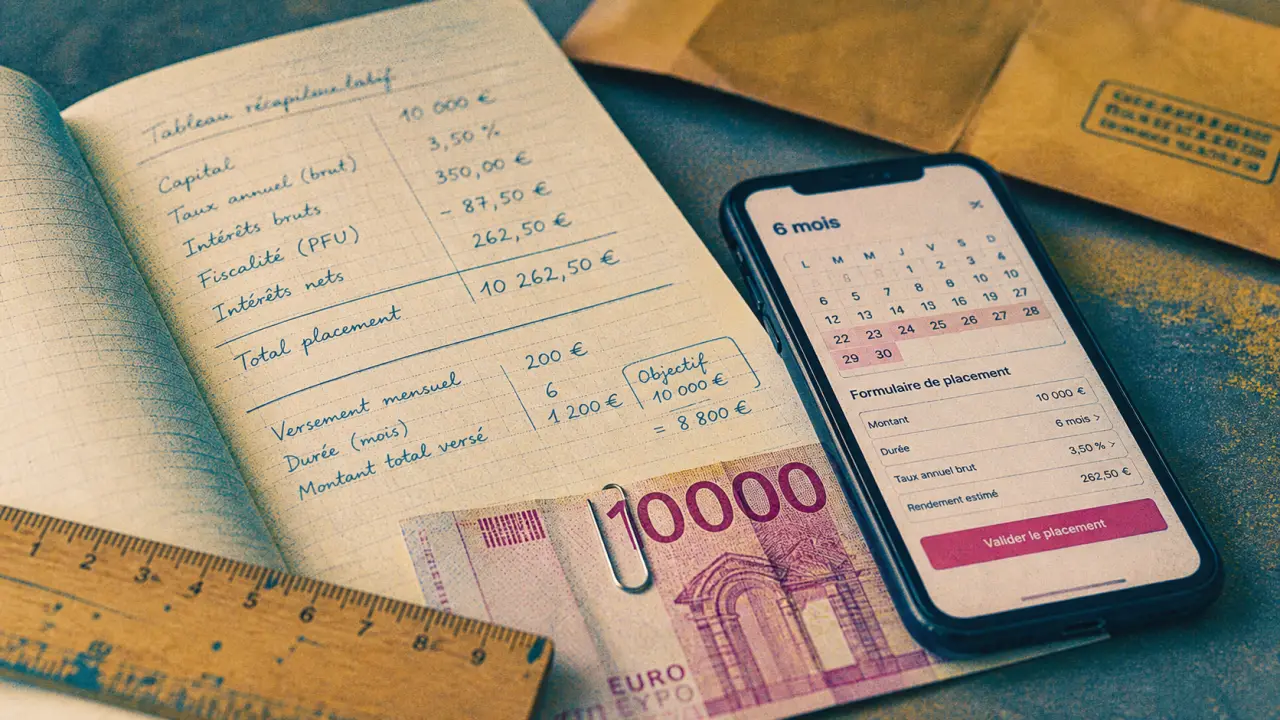
Calculation of interest
Note: This tool provides a rough estimate. It does not take into account taxes (social levies, income taxes), management fees, or possible early exit penalties.
Three common uses
The first use is precautionary saving: a reserve for unforeseen events, which must remain accessible at any time. Regulated booklets are often preferred. The second is waiting for an identified project, such as a real estate contribution in 12 months: the futures account or some money funds may become relevant. The third is the temporarily dormant capital, for example after a sale or premium, which one wishes to pay before deciding on a longer allocation.
You should avoid reasoning only at the displayed rate. A product to 2,50 % blocked for one year can be less suitable than a less remunerative booklet if you need the funds in four months. In the short term, returns are always judged after liquidity, fees, taxes and exit risk.
The main solutions to compare
Short-term investments are distinguished by their level of security, availability and remuneration. The table below summarizes the most common options, without replacing reading the conditions specific to each institution.
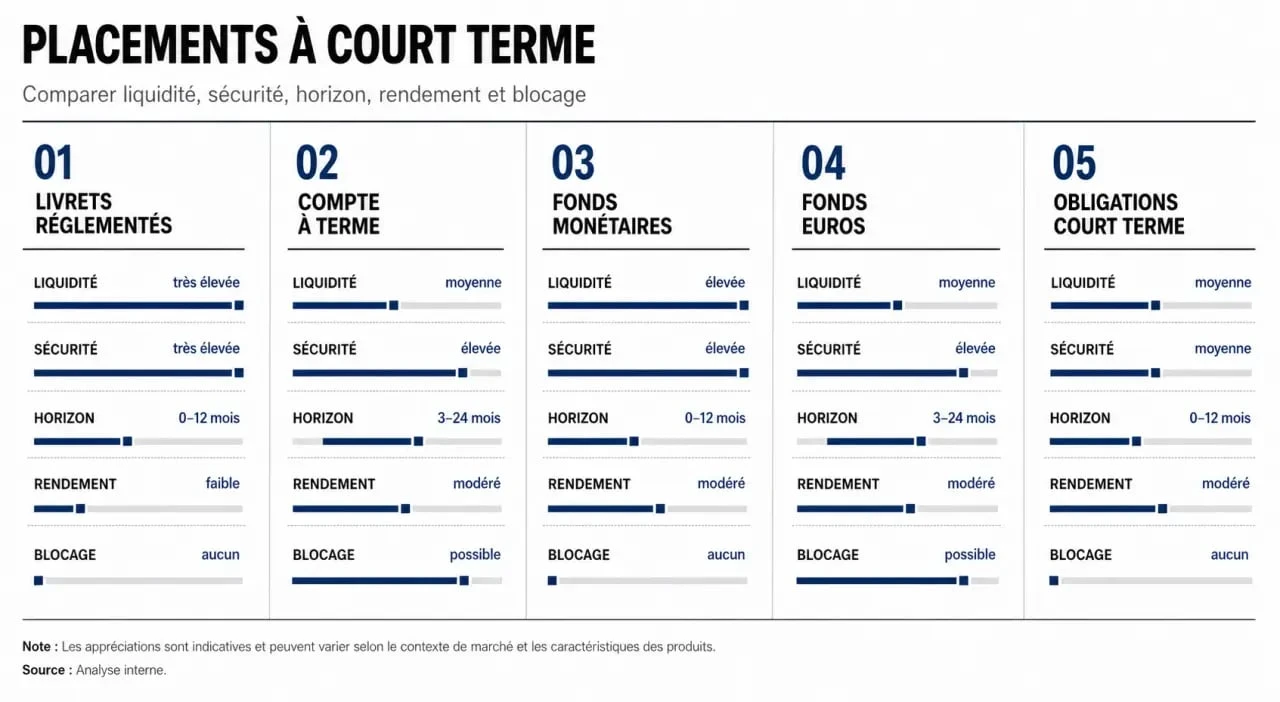
| Solution | Availability | Security | What need? |
|---|---|---|---|
| Regulated books | Very high | Guaranteed capital | Precautionary saving, rapid withdrawal |
| Bank books | High | Generally secure, according to bank | Benefit from a temporary promotional rate |
| Future account | Maturity or penalty | Capital generally guaranteed | 6 to 24 months |
| Monetary funds | High by medium | Low risk, not zero | Flexible alternative in a securities account or life insurance |
| Euro funds | Variable according to contract | Secured capital under contract conditions | Precautionary savings already housed in life insurance |
| Short-term bonds | Variable | Depends on the issuer and the market | Investor including rate and credit risk |
| Crowdfunding real estate | Low before maturity | Risk of possible loss | Performance Search with Risk Acceptance |
| Stablecoins | High in theory | Technology and counterpart risk | Warning profile, very framed use |
Booklets: single, liquid, but capped
Book A and LDDS are the best known reflexes. Booklet A has a ceiling of 22 950 €, while the LDDS is capped at 12 000 €. Their main advantage is the immediate availability of funds and favourable taxation for regulated booklets. SARA and the Young Book may also be of interest when eligible.
Unregulated bank books, sometimes called super livrets, can offer attractive promotional rates for a limited period of time. A concrete example: 2,25 % 6 months generates 114,50 € interest per 10,000 €. Some institutions also display promotional offers such as 4 % for 4 months, then a basic rate of 1%. The challenge is therefore to look at the actual duration of the enhanced rate and the applicable taxation.
Futures account: readable if money can be blocked
The futures account is suitable when you know your maturity. You deposit a sum for a fixed period, with a rate known in advance in most cases. For example, a futures account 2,50 % over 1 year can produce 500 € interest per 20,000 € placed. In return, an early exit may reduce remuneration or result in less favourable conditions.
This product is useful for a dated project: payment of a vehicle in a year, real estate contribution, company cash pending use. It is less suitable for pure security savings, as money is not always instantly available in good conditions.
Security, liquidity, taxation: the triangle not to be imbalanced
A short-term investment is based on a compromise. Seeking maximum return can lead to accepting low liquidity or risk of loss. Conversely, aiming for absolute security often limits pay. The best placement is therefore rarely the highest. He is the one who respects your time constraint.
Everything about the LLDS · Discover the features, operation and tax advantages of this defiant savings product that is available at any time.
Security is not limited to guaranteed capital
A product may seem prudent while at the same time misunderstood. Money funds are generally considered low-risk products, but they are not equivalent to a regulated booklet. Short-term bonds may vary depending on market rates and the quality of the issuer. Real estate crowdfunding can offer more ambitious remuneration, but money is often immobilized and the risk of delay or loss exists.
To arbitrate, imagine your money as a boat near the shore. On a calm sea, you can move a little to enjoy a better current. If there's a wave coming in, you have to be able to come back quickly. This is exactly the logic of the short term: the closer your project is, the closer your placement is to the shore. A higher rate does not always compensate for the discomfort of capital unavailable at the wrong time.
Taxation can change the real result
Two investments at the same gross rate do not necessarily give the same net gain. Regulated livrets benefit from a specific tax framework, while bank books, term accounts, bonds or funds held on certain media may be subject to taxation of capital income. Therefore, before you subscribe, you have to compare the expected net return, not just the commercial rate put forward.
Costs also play a role. Over a short horizon, too high entry, arbitration or management costs can absorb a significant portion of the interest. This is particularly important for life insurance, money funds accessible via investment envelopes or certain specialised platforms.
Choose according to your profile and project
The right method is based on your need, then select the product. A student, an active youth, a family, a pensioner or an entrepreneur do not have the same availability or risk constraints.
If you want to keep a reserve available
Prefer regulated booklets to their ceilings where possible. They are simple, legible and adapted to unforeseen circumstances. If the ceilings are reached, a bank booklet may supplement the reserve, provided that the rate after promotion and taxation are verified. The aim is not to maximize every euro, but to avoid having to sell a risky or blocked investment in an emergency.
If you have a specific maturity of 6, 12 or 24 months
The futures account becomes relevant if you can immobilize the money. You know the duration, you compare the rates, then you accept the blocking in exchange for visibility. For a less certain deadline, you can combine a book game and a part in the future, in order to keep a pocket immediately available.
If you accept a little more complexity
Money funds, short-term bonds or Treasury bills can complement a prudent strategy, especially for higher amounts or for investors already equipped with a securities account, a life insurance contract or a wealth support. On the other hand, real estate crowdfunding and stablecoins must remain limited and assumed pockets. They don't replace precautionary savings.
The right reflexes before placing your money
Before subscriptions, check four simple points: the date on which you will need the funds, the likely net return, the terms of withdrawal and the actual level of risk. This check avoids the most frequent disappointments, including very short promotional rates, exit penalties or products presented as prudent when they are not guaranteed.
- Keep a liquid pocket for unforeseen expenses, even if another product earns more.
- Compare the duration of the advertised rate : 4 promotional months are not worth a stable rate over 1 year.
- Calculate the net return After taxes and fees, especially excluding regulated booklets.
- Avoid blocking all capital if your project can progress or be postponed.
- Diversify media where the amount becomes significant or the maturity is uncertain.
For a capital of 10,000 € available in 6 months, a liquid booklet or a super temporary booklet may suffice. Per 20,000 € for purchase in 1 year, a futures account 2,50 % can offer interesting visibility, with the example of 500 € interest over the year. For a higher sum without an exact date, a distribution between booklet, futures account and monetary support can better balance availability and yield.
A successful short-term placement is not the one that impresses on paper. It is the one that allows you to recover your capital at the right time, in good conditions, with remuneration consistent with the accepted risk.