
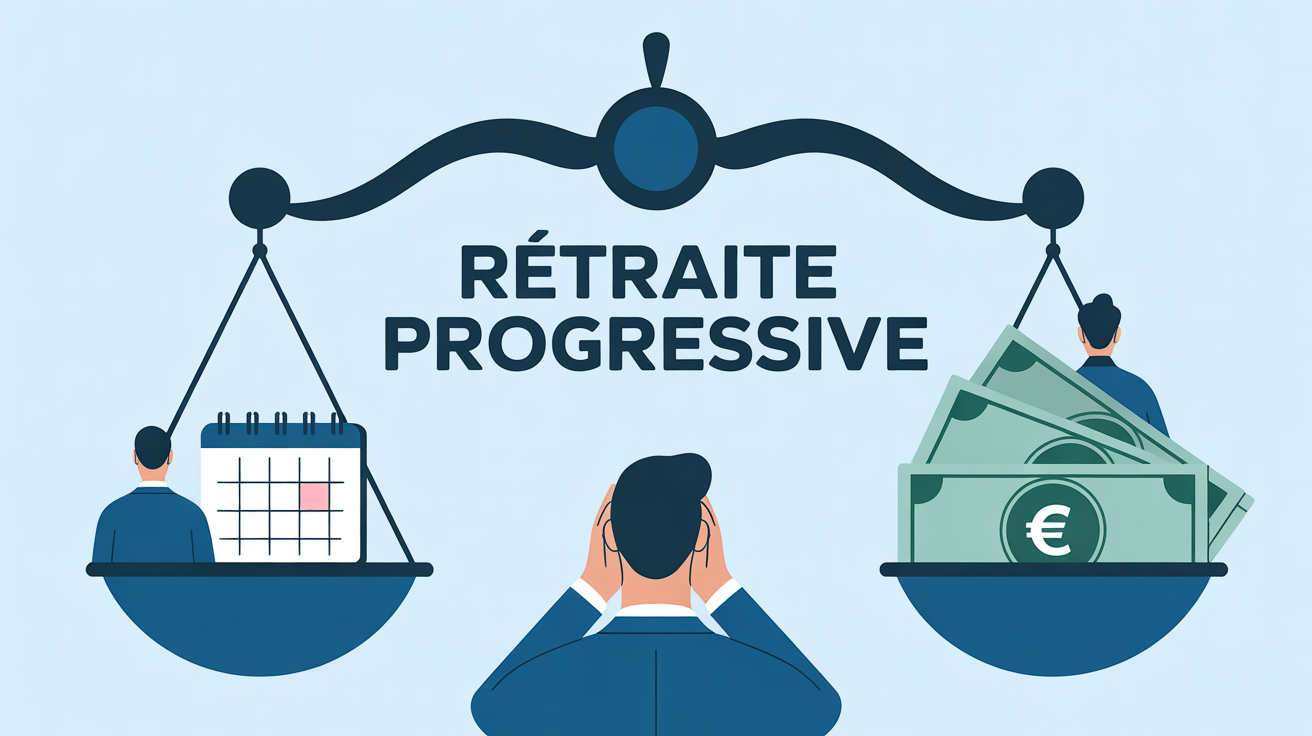

Forecast the real impacts of the progressive retirement remains a crucial step to protect your future rights and guarantee every euro of your income when it's time to slow down professionally. Behind the flexibility displayed, this device also contains subtle pitfalls, both on access conditions and on the pension or the validation of quarters. It is regularly recommended that each option, with supporting numbers, be examined to avoid any permanent loss at this key moment in your career.
Traps of progressive retirement: it is better to identify the tricks before taking the step
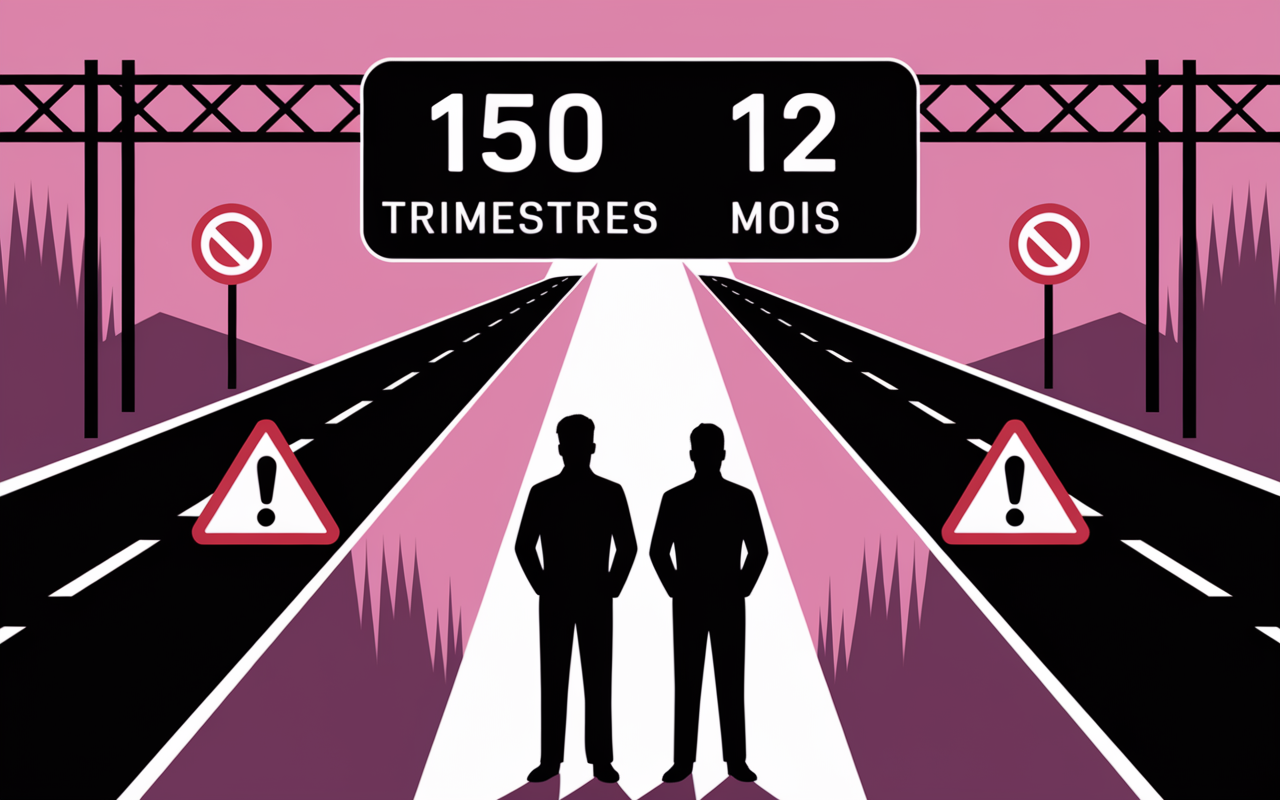
Progressive retirement attracts from its perspective – reducing the burden of work while granting entitlement to pension. Taking this turn without assessing the consequences sometimes means losing more than expected. Here's what we can remember from the main traps to know quickly so that your choice remains controlled.
Behind the apparent simplicity (a combination of part-time and part-time retirement), some pitfalls arise: pension locked up for a year or more, sometimes unsuspecting income cuts, validation of compromised quarters... Not to mention the impact on supplementary retirement, too often forgotten. Supporting figures: with partial pension of 1 500 € and 60% of earnings maintained, the decrease may exceed 300 € per month in relation to full time.
It is at this point that everything accelerates: spot, evaluate (thanks to the simulator), then eliminate the illusions of progressive retirement, long before beginning the steps. Key? A truly informed decision without bad financial surprises or loss of future rights.
What is progressive retirement?
To limit errors, it is better to first understand the operation of the device. Progressive retirement combines a supervised part-time (of 40% to 80% full time) and payment of a fraction of the pension. The main idea is to cushion the transition from employment to total retirement.
General principle and regulatory framework
In concrete terms, employees (or persons treated as self-employed under special conditions) spend part time and receive a pension fraction calculated on the basis of unworked time. From September 2025, the age of access rose to 60 years, for any category. It is also necessary to meet at least 150 quarters all schemes combined.
For example, working with 60% full-time will be affected 60% salary, supplemented by 40% pension. But this initial calculation masks some of the sometimes underestimated impacts at first reading...
Access conditions and mandatory thresholds
Choose between 50%, 60% or 70%? Attention, the work quota must always remain between 40% and 80% full time. Additional hours are limited to +10% on the contract chosen.
Another sometimes neglected point: gross annual wages must reach 1 803 € by quarter validated in 2026, i.e. 7 212 € to reassure the validation of 4 quarters. Falling below these thresholds endangers the future of acquired rights.
What are the major pitfalls of progressive retirement?
In fact, limiting income decline seems to be accessible, but some unexpected side effects may be irreversible. Let us look more closely at the main examples and concrete figures.
Pension locked 12 months (or more)
The part of retirement paid under progressive retirement remains frozen for at least 12 months. It cannot be adjusted even if the working time or salary changes. In other words, an error in the choice of quotity or a situation that changes blocks your rights down... It is better to calibrate each detail upstream.
Once the deadline has expired, it is possible to make a new application or to adjust administratively, provided that all the effects have been anticipated over the initial period (and sometimes overestimated according to specific agreement).
Real income decline and additional trap
The total collected (salary + retirement) is often less than full time, as the proportional calculation can be unfavourable and the taxes modified. In addition, the supplementary pension (AGIRC-ARRCOIn some cases, there is a haircut due to the coefficient of anticipation, which may fall to 0,819 (or -18%).
In practice, some real cases reveal a loss of 250 to 350 € monthly for a change to 60%, compared to a 100% hold. It's a shock for those who haven't done a pre-simulation! One advisor recently pointed out that several employees rediscover this point at the end of the process.
Insufficiently validated terms, threatened future rights
The acquisition of annual quarters requires a minimum wage (1 803 € Gross per quarter in 2026). Part-time work too low or poorly negotiated (e.g. 45% In some cases, full-time at the SMIC) results in the validation of only 2 or 3 quarters or less... The future pension will suffer from this.
Some professionals believe that this flaw "catchs" years later, and is only partially visible on conventional simulators.
Dependence on employer agreement (and administrative friction points)
The employer's agreement remains mandatory (with exceptions). It is common for some to refuse, delay, or impose a quota that is difficult to keep on a daily basis. Sometimes an application blocks administrative points or a change of direction is arduous. It is recommended to anticipate negotiation and secure a specific amendment!
Comparison of main risks
| Risk | Concrete effect | How can I avoid it? |
|---|---|---|
| Pension blocked | Fixed amount 12 months, no immediate correction possible | Precise simulation before, adjusted schedule |
| Additional right reduction | -18% possible on AGIRC-ARRCO | Overcoding, requiring simulation caisse |
| Unvalidated quarters | Future pension amputee | Ensure gross wage level (≥ 7,212 €/year) |
| Refusal of employer | Blocked/unoptimized approach | Pre-agreement written, prepare for negotiation |
How to check if the device is suitable for your situation?

Avoiding the traps of progressive retirement requires reflection and anticipation. Here is a concrete method to assess whether this choice remains relevant in your case, a few steps to follow.
Simulate... But intelligently : checklist
The simulation should include future pension (base + supplementary), retained gross and net income, quarterly validation and taxation. There are several tools: focus on those that allow "before/after" display according to different scenarios (50%, 60%, 70% Part-time work).
- Make sure the salary validates 4 quarters (7 212 € in 2026)
- Compare several quotities to identify the "point of change" between more free time and loss of pension
- Anticipate impact AGIRC-ARRCO : coefficient of anticipation and possible discount
- Calculate the real loss or monthly gain on 12 months
For example: a client thought she was losing "just 100 €" less per month, in reality the difference was close 400 € after verification. This suggests that thorough control is required...
When progressive retirement turns out to be a miscalculation
The device shall show its limits when:
- Part-time pay falls below the threshold to validate all quarters
- Supplementary pension decreases sharply (or the overcontribution option is inapplicable)
- The employer's agreement lacks flexibility for the quotency or hours
- The income gap flirts regularly with discomfort (below 2 000 € net monthly, excluding assets)
In this context, it is generally better to renegotiate a "classical" part-time or defer the application for progressive retirement. One counsel suggested that some officers prefer to wait for a higher level of fees.
Procedure and regulatory vigilance: marking the administrative path
The administrative route accounts for between 75 and 80% of success and avoided worries. Here is a summary to structure each step and limit incidents.
Critical steps: from demand to final liquidation
It all starts with a part-time changeover, validated by the employer. Then, the file must be sent to the pension fund before the selected date. If this is not respected, you may waste time in the current period. It is best to check that all supporting documents are complete (assessments, bulletins, HRD certificates, etc.).
The partial pension is usually paid under 3 to 4 months. The amount then remains frozen for 12 months. Leaving the device implies asking for "final disposal": be careful, this approach is not reversible, be sure of your deadline.
Administrative traps often underestimated
Errors in date, change or calculation are common. Too often, insured persons forget the effect of overcontribution, or wait too long to adjust parttime. In practice, the control of validated quarters is carried out after the fact that all anticipation remains the best option.
Good to know
I recommend that you always check with an expert the validity of the terms confirmed by the free simulators, especially in case of a complex career, to avoid bad surprises at the time of liquidation.
Some free simulators now include these checks, but only some retirement advisors guarantee the reliability of personalized calculation for a complex career. A trainer cited the case of an agent who discovered a lack of quarters only at the time of liquidation.
Advanced FAQ – Traps and Solutions on Progressive Retirement
Despite caution, several points remain unclear. Here are the common trap questions, with their synthetic answers...
Pension frozen for one year: Is it systematic?
Indeed, it remains locked every calendar year, and can only be modified with a new full application. It is recommended to opt for the ideal quota from the first file.
How much activity does it take to validate its quarters?
In 2026, any quarter requires at least 1 803 € Gross salary. To validate the entire year, we must reach 7 212 €: be careful not to go below this threshold with too little part time!
Can the employer refuse?
Yes, unless an agreement imposes such a retirement arrangement. It is often recommended that your arguments or plan B be carefully prepared. Refusal or administrative silence varies by sector of activity.
Can we get out of the device at any time?
Yes, it's possible. We must then "liquidate definitively" our rights: this choice does not allow us to go back.
Loss of additional rights: Is it automatic?
Except in advance (and validated by the employer's agreement), the calculation AGIRC-ARRCO loses until 18% points. This is also why it is necessary to consider the activation of overcontribution, while accepting a reduction in net income over the period concerned.
Why perform a custom simulation?
A complete simulation, which takes into account base, complementary, wages, quota variation and projection over several years, helps to protect against bad surprises. This calculation can take about 30 to 45 minutes with an expert, but one professional estimates that it potentially protects several thousand euro of loss over the long term.
- Recommended Tools: official Cnav/Agirc-Arrco simulator, PDF checklist to download, meeting with a retired expert (count between 90 € and 150 € for a full audit).
To continue, it is best to download the checklist of the essential steps, then launch a specific simulation before any administrative process. It is rarely obvious to anticipate everything without being accompanied, especially in complex careers.