
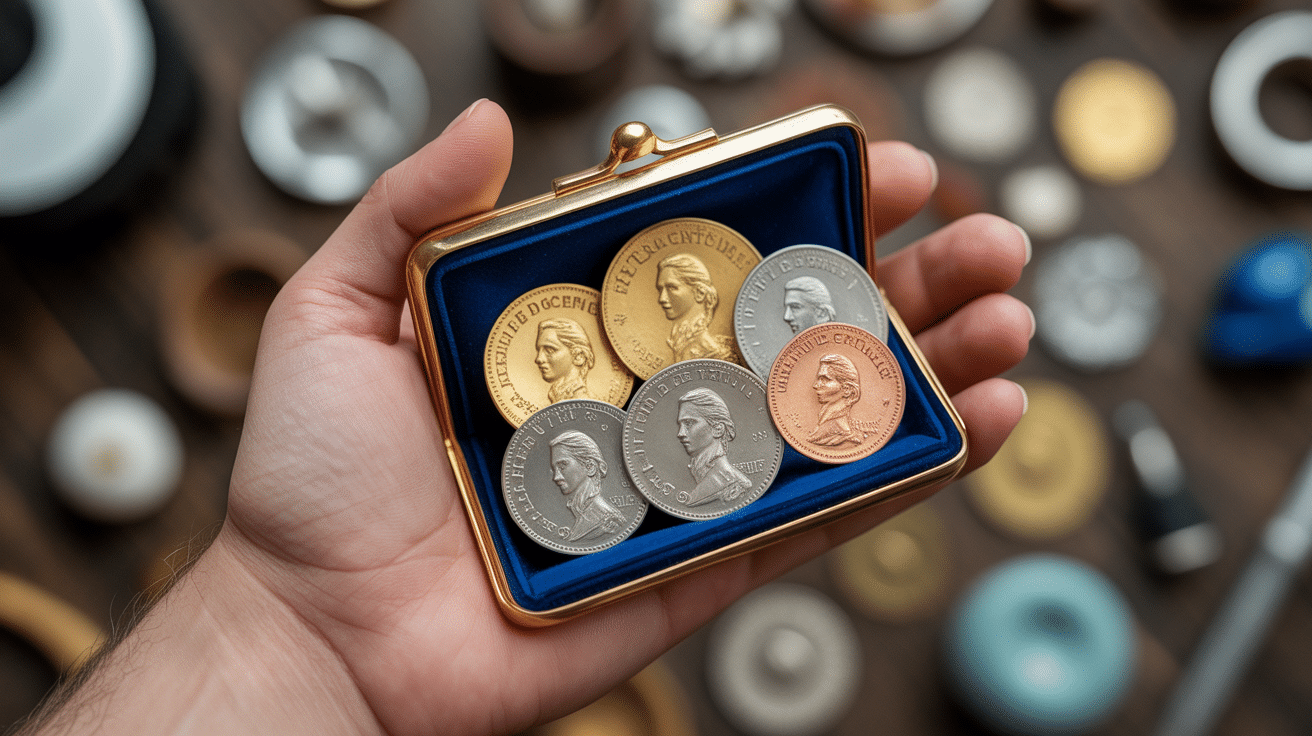

Untrace a 50 cent coin rare Sometimes it causes its lot of unexpected questions, and it happens that chance reserves real astonishments, especially those that it wishes to set aside a small family heritage or to guarantee its savings... My role, as an advisor, is to illuminate without jargon, pointing out immediately the fundamentals to remember: how to identify rarity and evaluate such a piece, so that everyone – simple curious or beginner collector – can flaunt the hidden values that often flow before our eyes.
With this user-friendly approach, we propose concrete benchmarks to understand what, in practice, makes the price of a modest piece and decide how to sort, independent expertise or even transmission.
Summary of key points
- ✅ Identifying the rarity of a 50 cent coin is based on several criteria, not just seniority.
- ✅ Some years and manufacturing errors significantly increase the value of the parts.
- ✅ The state of conservation and the historical context strongly influence the actual rating.
Rare 50 cent coin: how to identify those that are really more expensive?
This question goes through the minds of many: who would think that the modest piece of 50 cents, apparently annoyed, could hide a beautiful surplus-value? In some cases, the circulation or output of French coins (in franc or euro) has a value that goes well beyond the sum shown (from 20 to 500). € depending on the situation: year, errors, conservation...). Essentially, it is to identify some simple benchmarks, accessible to all, regardless of experience. Here is what one can remember to recognize and estimate these potentially unusual pieces.
What is a rare 50 cent coin?
In numismatics, one must distinguish well: an old room does not necessarily rhyme with rarity. What matters is, above all, the initial quantity produced, whether or not there are errors, and sometimes specific circumstances that limited distribution. It is regularly observed that a combination of factors, not just age, transforms a common currency into an object sought by wise collectors.
Speaking example: the 50 cents 1975 French, never put into circulation, arouses both covetousness and it reaches odds between 70 and 120 € even in correct condition (professional collectors often evoke this phenomenon during conventions). We see it: sometimes it is the detail that makes the piece exceptional.
Rare or simple seniority? Small comparison table
To better understand the nuance, here is a table that compares two currencies readily confused:
| Exhibit | Quantity struck | Rare (cote 2025) |
|---|---|---|
| 50 cts franc 1975 | 1200 (private trials!) | Very rare (70 to 120 €) |
| 50 cts franc 1981 | 120 million | Current (less than 2 €) |
| 50 cts euro France 2002 | 670 million | Very common (face value) |
Last point to note: it is not seniority (or the changeover to the euro) that creates rarity. It is this confusion that makes it sometimes thought wrong that certain currencies have no real particular interest.
Criteria for recognizing a 50-cent rare
Identify a rare piece Looks like a secret hunt on a treasure map. The criteria are multiple. Yet some are decisive. It is better to spot them before betting on an unlikely fortune.
1. Year of strike (the vintage)
The vintage often offers the first track. Some dates only experienced a few hundred or thousands of emissions, while others exceeded hundreds of millions. A specialist in numismatics told me that it is common to ignore this detail, while it changes everything.
- Milles in franc 1975, 1980 and 1991 are among the most monitored, especially in the case of rapid tests or withdrawals.
- Euro versions : The years 1999-2000 in condition BE/BU, or some DOM-TOM strikes, keep the odds at many enthusiasts.
Some collectors say that they found in their wallet a simple 2002 coin, which was actually worth more, thanks to a mistake that was not noticed. Like, nothing is played in advance.
2. Manufacturing errors
For some, these errors quickly become addictive: to spot an anomaly, it may be to see the value climb unexpectedly! Some net errors (stripped strike, unusual metal, inverted face...) exceed the 200 € on the market, especially if the object intrigues at first sight.
- Lettering absent, inversion of patterns, or visible lining on one side.
- Non-compliant metal (piece struck on a foreign or atypical flan).
Often, a magnifying glass is enough. Have you ever crossed a strange color or a number that seems to be split? It seems that these anecdotes regularly feed the specialized forums.
3. Storage status
This criterion is constantly encountered in an estimate: a rare piece in superb condition (SUP or FDC) often multiplys its rating by ten. Attention, copies « plastic » (BE/BU) hardly ever pass in the pocket of the general public.
- Condition TB: clear marks of wear, erased reliefs
- SUP condition: slight imperfections, legible elements
- SPL: almost new appearance, minimal handling
- FDC: Strictly no trace or scratch
Sometimes a piece of modest value becomes more meaningful in a succession inventory, especially thanks to its impeccable preservation.
4. Historical context or strike « confidential »
There are sometimes unexpected stories behind the rarity of a coin – lack of distribution to the public, melting old stocks at the manufacturer or free-euro transition limiting circulation. Some experts recall that the 50 cents 1975 became emblematic for these reasons, even though it has never been born in a supermarket box.
Under the anecdotal aspect, the history around the piece can add in some cases to its side and to the interest of collectors.
Specially wanted years and models
Keep a close eye on 50 cents of knocks issued on special dates or opportunities, especially if the manufacturing technique comes out of the ordinary. Several years crystallize most of the numismatic value, and it is not uncommon for a happy chance to give rise to a nice discovery.
The rarest 50 cent coins in franc
For some vintages, we can bend if we believe the rankings made by the reference sites Lefranc.net and CGB.fr :
| Year | Particularity | Estimate (SUP to FDC) |
|---|---|---|
| 1975 | Not issued (rare tests) | 70 to 120 € |
| 1980 | Vintage distributed in box only | 30-60 € |
| 1991 | Relatively low draw (limited retail sale) | 20 to 45 € |
An episode often returns: a person discovered a 50 cents 1980 at the bottom of a pocket vacuum in an old Renault, part sold more than 50 € Hey! It is sometimes like family stories that one finds the most unexpected values.
Rare or atypical euro coins of 50 cents
On the euro side, the state of preservation (BU, BE), an anomaly or a special edition make all the difference:
- Series 1999/2000 in BE or BU : estimate of 35-80 €
- DOM-TOM or Commemorative Strikes: Market Rarity Value
- Manifest error on a euro: amount up to 200 € if the anomaly is remarkable
Another point to be made is that the vast majority of the 50 euro cents (French, German, Spanish, etc.) are of no value – except for very targeted exceptions among experts.
Value estimation and expert advice
Evaluate the « True » price of a rare piece, it is always a story of data crossing: vintage, state, position on the current quotation... It should be added that a few tricks avoid many disappointments, when you put your parts on sale or when you receive a first evaluation.
How much is my 50 cent coin worth?
The values vary widely, ranging from 1 € symbolic to more than 120 € for some remarkable years, not to mention confidential parts in SUP quality. Some sales are done at the brocante, others on specialized catalogue – diversity is real!
Overall observed market trend (2025):
| Exhibit | State TB | SUP State | FDC State |
|---|---|---|---|
| 1975 FRF | 40 € | 90 € | 120 € |
| 1980 FRF | 18 € | 48 € | 60 € |
| 50 cts euro error | 50–90 € | 120–200 € | Up to 250 € |
He sometimes hesitates in the face of a price gap between the Internet and a professional: in this case, it is better to ask a recognized independent expert to decide, rather than to conclude too quickly.
For numismatic enthusiasts, discovering a piece of 50 rare cents can also inspire the desire to explore treasures like this one. rare 2 euro coin: top 15 currencies to watch in 2026.
For numismatic enthusiasts, understand how investing in antique coins can complete your research on rare pieces and enhance your collection.
Have your room tested safely
It is regularly recommended to give priority to accredited professionals, established sales houses or certified specialized sites (CGB, BDOR, Monnaie de Paris...). Some even offer a free remote estimate, including on photo or public awareness days.
- Do not leave your room to anyone, and avoid shipping by post without any concrete warranty.
- It is best not to wash a room that one wishes to estimate, at the risk of reducing its rating.
An experienced numismate recently cited the reliability of the 2025 odds catalogues (Lefranc.net, Gadoury...) for an objective first idea, even for an amateur.
FAQ: Common questions about rare 50 cent coins
Do you have any more questions? No wonder, then the most direct answers are summarized here:
What is the rarest 50 cent coin in France?
It is undoubtedly the 50 cents franc 1975, issued only as a trial and never spent in the usual trade.
How do I know my 50 cent coin is rare?
First question to ask: Year (franc: 1975, 1980, 1991). Next, a careful eye on any anomalies, or a remarkable quality of preservation. In case of doubt, it is worth comparing online, or requesting the opinion of a recognized specialist.
Can a room of 50 cents in bad condition be rare?
Yes, that remains possible! If the vintage is very confidential or the error is visible, wear does not completely cancel the value – even if it drops the final rating. It is not uncommon for the discovery of this kind of piece to take place at the time when it is least expected.
Where to have a coin tested for free?
Several numismates offer this service (CGB, BDOR, partner counters, some specialized trade shows). It should also be added that calling before or learning about local discovery days often avoids unnecessary travel.
What's the difference between a rare room and an old one?
There is regular confusion: an old coin has no guarantee of value, if it was issued by millions. The key element is limited production, non-distribution to the public, or the identified error.
Are 50 cent euro coins rarer than those in franc?
It can be assumed that most euro series remain common. However, some BU/BE boxes or anomalies easily exceed the majority of ordinary francs in rarity. Like that, vigilance is required regardless of the vintage!
Can we find rare coins in the current currency today?
It happens! Mainly for euros with exceptional errors, or when a legacy, a forgotten box, reappears at the bottom of a family attic.
Good to know
I recommend that you always authenticate your coin from several deemed sources before any sale or purchase.
I also advise you to store it without cleaning it, sheltered from moisture and shocks.
Don't be mistaken: a common room can hide a beautiful pactole. The secret is to keep a curious, sometimes cautious approach and rely on experts or guides updated fairly regularly. After all, no one really knows where the next shot of luck will be...