

Decoding the volatility and the prospects for Pi Network can impress both recent figures and technical complexity. However, we note that keeping control of his choices remains largely possible. I propose clear and pedagogical benchmarks, so that everyone can steer their Pis back and understand the stakes hidden behind each announcement, without yielding to fears or unrealistic promises.
Immediate price and news Pi Network
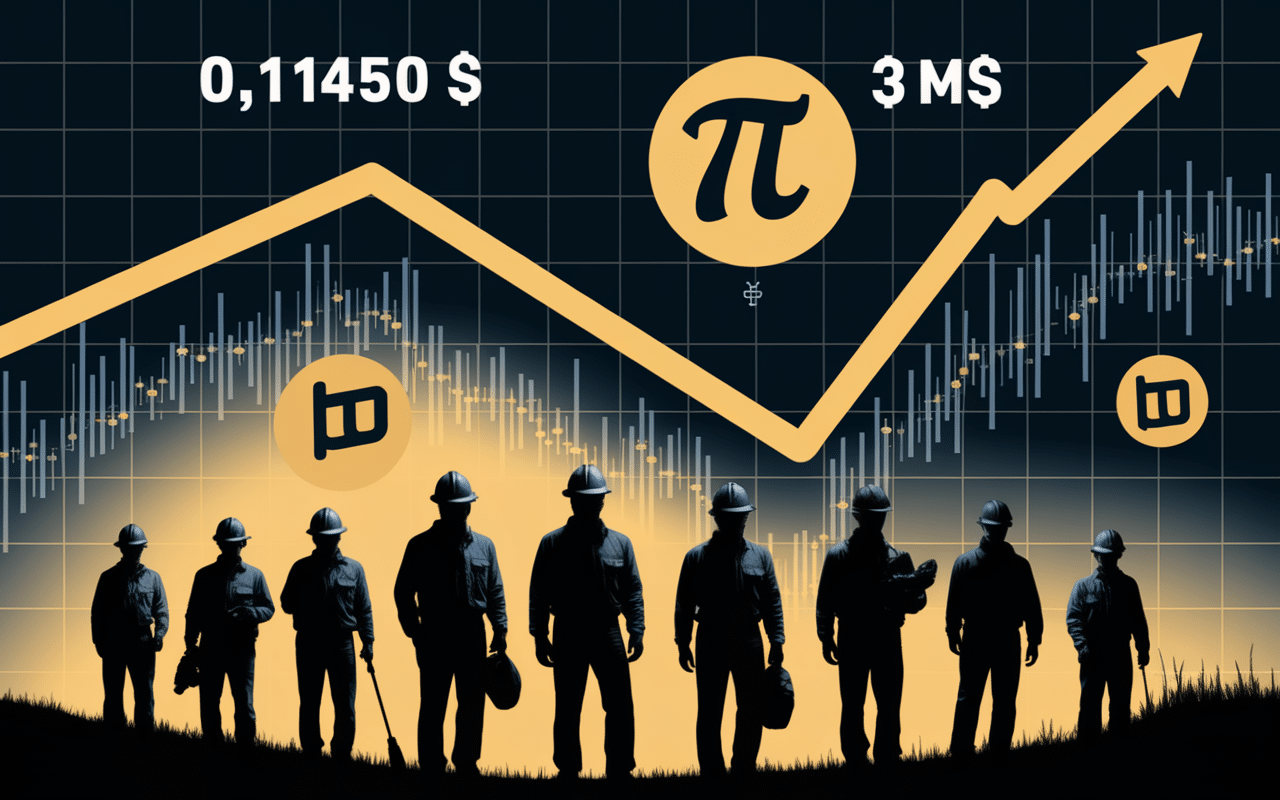
The number of the day hits strongly: on January 31, 2026, the IP ranked around 0,1450 $, very far from the summit of 2.98 $ in early 2025, which represents a decrease of more than 93 %. This stall shakes the community because more 133 million tokens have been unlocked in a few days, causing rarely observed sales pressure and increasing market instability.
The volume of transactions over 24 hours displays 28 M$ (four times more than the previous day, which was 7 M$), which suggests a "capitulation" phase, or many miners seek to sell urgently. This kind of situation, which is relatively common in the cryptoactive world, occurs whenever a large batch of newly accessible tokens submerges a still young market.
- Current price IP : 0.1450 $ on 31 January, the trend remains around 0,17 $ Week
- 7-day change : -11,1 %
- Market cap : 1.38 Md$ (under pressure)
- Volume 24h : 28 M$net increase
Behind this movement, many question: does the decline sign a scam or is it simply passing through a typical stage of maturity before adoption accelerates? This question feeds the discussions, both in specialised forums and in Telegram groups. Moreover, a blockchain project manager indicated that these stages of discouragement are frequent – but not necessarily definitive.
Why such volatility on IP? Quick decryption
The decisive element remains the wave of new tokens released each month: with 133 M in January, up to 1.3 billion could arrive in a year if the pace continues. This mass creates a pressure on sales: the more supply, the harder the price is to keep up, especially if real demand (uses or new entrants) does not grow at the same rate.
Many users express some frustration, as they accumulate Pi on their app for months to see that the value falls at the very moment it becomes exchangeable, at least partially. But this scenario is not exclusive to Pi Network: in other crypto projects, this risky phase also marks the emergence of the real distinctions between a solid community project and an ephemeral hype effect. Moreover, some members report that they are reluctant to activate their wallet, for fear that the value will melt when access is unlocked.
Technical Updates and Ecosystem Actu 2026

Despite the bleak atmosphere on the prize, the Pi Network team is openly aiming for a new course. The PA App Studio, a young platform, encourages developers and creators to make concrete applications to use Pi directly within the ecosystem.
L payments, mini-games and in-app purchases in Pi, without needing to go through a conversion on an official exchange. The approach, which is still discreet, is based on various events reserved for creators in January-February: the aim is to highlight daily uses rather than speculation. Moreover, some blockchain payment professionals believe that the multiplication of practical cases can trigger public interest faster than a mechanical price increase.
There is already a small transition: several miners test the exchange of Pi for good gifts, advertising or microservices between members. For example, via a "marketplace" driver app, Léa has been able to buy a personalized hat from an independent designer: payment in Pi n This kind of experience remains marginal, but illustrates the strategy: bet on utility, even let liquidity come later... or never, as some skeptics fear.
Roadmap: between ecosystem call and mainnet waiting
Difficult to provide a perfectly reliable date for the open mainnet. At the opening of 2026, the official communication insists on the evolution of apps more than on the arrival on major trades. Developers are encouraged to build in-app solutions: shops, games, practical services, in order to give the Pi the status of "useful token".
According to the roadmap shared by the team, migration to a complete mainnet will only come if the ecosystem demonstrates real use, replacing simple passive mining. Many members are waiting for a "scale-up" this year, but it is better to keep their heads cold: there is no guarantee of a quick launch, and it is regularly observed that patience remains the master word in the cryptosphere.
Major risks and prudence 2026
The question constantly comes back: "What if all this was just a bubble?" It is better to keep in mind several warning signals: prolonged testnet, no clear regulation, massive release and no registration on major trades such as Binance or Coinbase.
Comparing with Bitcoin or Ethereum, the latter enjoyed much greater technical transparency from the beginning, liquidity on many exchanges and clear team identification. For Pi Network, everything still goes through the official application and some marginal platforms, which makes the whole much more sensitive to hazards. Some experts point out that the slightest episode of FUD (fear, uncertainty, doubt) or a misunderstood unlock is enough to lower the price of 10 % in a few hours, as observed in January.
Volatility, liquidity, and FUD: understanding before acting
A tip mentioned in crypto training: never take a "real-time" course or an announcement of profitability for yourself. Think about the liquidity : if buying or selling large volumes of IP immediately lowers the price, the market remains unstable. There is no evidence that it is a scam, or evidence of a successful project: it is just a common risk, especially during the extended launch phase. Is it really reasonable to go strong when all protections don't exist?
- No regulated listing : no official listing on major trades
- Mass release : until 1.3 billion tokens could be accessible in 2026
- Uncertain regulation – legal status of imprecise token, attention to KYC and personal data management
- Strong Community Dependence : value depends mainly on the commitment of members, not institutional adoption
Finally, it is often recommended to commit only sums actually accepted as blocked or volatile... even if this sometimes requires another one or two years to see if the bet is paid.
Practical guide: What to do with Pis?
After months of mining, your Pis are available, but the choice is: sell, use or wait for an unexpected embellishment? This is most often reflected in the questions asked throughout the community in 2026.
FAQ – Use, Migration and Prospects
Q1 - Are my Pis worth anything today?
In theory yes: about 0.16 $/Pi According to the platforms, while knowing that liquidity remains very low and that costs sometimes discourage some exchanges.
To better understand the dynamics of projects like Pi Network, explore the complete guide on Tada Crypto: full guide, operation and outlook 2026.
To better understand the parallels between the volatility of the Pi Network and other cryptocurrency, discover our analysis on XRP news: what to know about technical and institutional signals.
To better understand the dynamics of the Pi Network, it may be useful to compare with established projects such as FTM crypto: uses, prospects and forecasts for informed investors.
Q2 - Can I cash them in my bank account?
At the moment, this is not possible directly: IP is not referenced on large trades. Some platforms offer peer-to-peer conversions, but it is better to be wary of scams and the lack of guarantees for the user.
Q3 - How do I migrate my Pi to the "myNet" or an app?
The pass must be done via the transfer option on the official application. This procedure now includes a simplified KYC for some countries and encourages the use of partner applications (marketplace, mini-games, Pi shops...)
Q4 – Do I have to sell or keep my Pi?
There is no universal response: some prefer to wait to bet on a future expansion, others sell a share in order to test the services or avoid losing everything in case of a sharp decline. Essential: decide according to your own risk tolerance, not ambient euphoria.
- Migration of Pis from the testnet to compatible apps: pay attention to official announcements
- Experience the purchase or reservation of services via a few partner apps: several members were able to test the purchase of vouchers or derivatives
- Keep up to date with the first semi-official listings throughout the year: some forums relay this information in near real time
One point that several trainers recall: it is better to follow concrete and pedagogical progress first rather than promises of rapid profits. When you read the feedback, it happens that a user simply rejoices at learning how to run an app blockchain, even if the financial gain remains aleatory.
Community voice: frustration, patience... and micro-hopes
The fatigue gradually gains the majority of specialized forums. Julien, a "historical" minor for three years, evokes his feeling: "I was expecting a small crypto bonus, but I can't spend anything anywhere... Still happy if it pays a coffee in 2026." On the other hand, Aïcha, a new recruit, sees above all the opportunity to acquire skills without great risk: "J
This dichotomy is omnipresent in the crypto ecosystem. Some members still dream of a "bull run" for Pi around 2027, provided that in-app usage actually progresses. But, last point to note, caution remains the best ally: "it's not always obvious," as some miners say on Telegram.
Useful information and resources to go further
Claim: This is informative content. It does not provide any investment advice. The value of IP remains speculative, its regulation is still absent and the risks are very real. It is generally recommended to focus on training and vigilance prior to any action, the most prudent being often to subscribe to a strong newsletter or to join a community to exchange safely.