
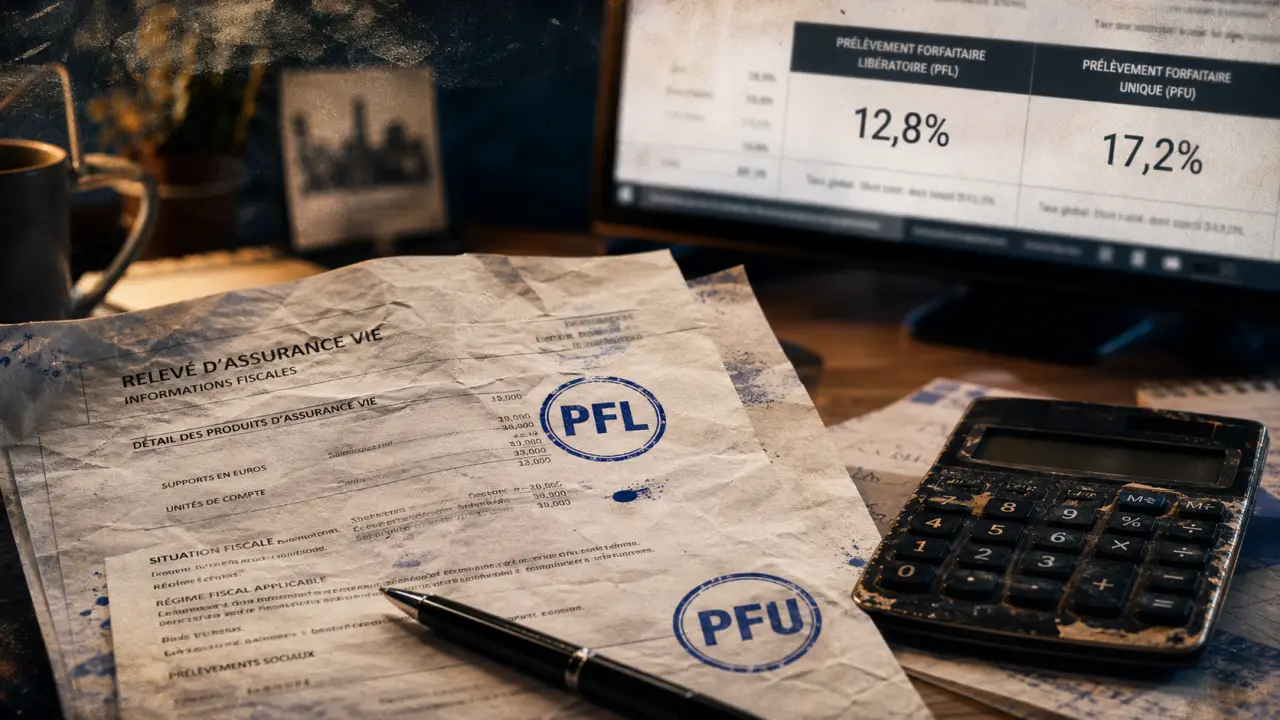

Between a flat-rate levy, income tax and a single flat-rate levy, investment taxes can quickly become difficult to read. The right reflex is to compare the displayed rate with your Marginal tax bracket, date of payment, age of contract and reductions available, especially in life insurance.
Understand the three diets before choosing
The lump sum levy: a tax levied at source
The lump sum exemption, often abbreviated PFL, made it possible to pay tax on certain investment income at the time of payment or redemption. It says « liberator » because once levied, the corresponding tax is no longer included in the progressive scale of income tax. In practice, the financial institution applies the prescribed rate and the taxpayer does not have to incorporate these gains into its progressive tax, even if the amounts generally have to be reported.
Understanding the taxation of life insurance withdrawals · Find out the tax rules applicable to your life insurance buybacks based on your outstanding amount and the length of your contract.
This mechanism remains especially useful to understand the taxation of life insurance, in particular for products linked to premiums paid before 26 September 2017. Historical PFL rates vary according to the length of the contract: 35% before 4 years, 15% between 4 and 8 years, then 7,5% After eight years. These tax rates add social contributions when they are due.
Income tax: earnings join your other income
With income tax, investment products are included in your taxable income and subject to the progressive schedule. The interest of this option therefore depends directly on your MIT, i.e. the part of your last taxable euro. For a low taxed taxpayer, this option can be more advantageous than a flat rate. For a home already in a high slice, it can instead increase the bill.
This option is not simply a rate. It can also change some of the household's tax balances, as income included in the scale increases taxable income. Therefore, the entire return must be reasoned, not just on the amount of the redemption or interest received.
The PPU: the flat tax that changed reflexes
Since 1 January 2018, the single flat-rate levy, or PFU, applies to many income from movable capital. It is often called flat tax. Its overall rate is 30%, composed of 12.8% of income tax and 17.2% of social levies. It should therefore not be confused with the historical PFL: the PFU has become the benchmark for many financial products, while the PFL remains mainly in situations related to historical payments, particularly in life insurance.
Life insurance: date of payments changes everything
Life insurance is the case where the comparison between the lump-sum levy and the income tax is most often repeated. Taxation depends on both the age of the contract, the date of premiums paid and the amount held. The same contract may therefore contain several tax layers.
| Situation | Scheme to be examined | Attention |
|---|---|---|
| Premiums paid before 26 September 2017 | PFL or income tax as appropriate | Rate of 35%, 15% or 7.5% depending on age of contract |
| Revenues collected from 2018 onwards | PFU or scale option | UFP of 12.8% tax + 17.2% social levies |
| Contract over 8 years | Potentially more favourable regime | Annual reduction of 4,600 € for one person alone, 9 200 € for a couple |
| High stocks | Rates to be verified according to payments | 150,000 threshold € to be taken into account for the reduced rate |
After 8 years, the annual reduction is often the decisive factor. It applies to taxable earnings, not to the total amount withdrawn. A partial redemption may therefore include a non-taxable share of capital and a share of proceeds covered in whole or in part by the reduction. Two withdrawals of the same amount may result in different taxes depending on the share of gains included in the redemption.
Imagine your contract as a file to look at from several angles. The posted rate only illuminates part of the decision. To see the whole, one must look at the seniority of the contract, the actual share of surplus value in the buy-back, the discount still available, the MIT and threshold 150 000 €. This reading avoids a frequent error: retaining the regime that appears to be the lowest on paper while a personal discount or low tax makes the other option more relevant.
Compare options according to your tax profile
Where the flat rate may be advantageous
A flat-rate levy is generally attractive when your marginal tax bracket is higher than the applicable flat-rate tax rate. For example, if a product can be taxed at 7,5% After 8 years under the LFP, the lump-sum option may be of interest to a taxpayer taxed in a higher instalment, especially after taking into account the annual life insurance allowance.
The 30% PPU must also be read in two parts: 12.8% tax and 17.2% social levies. The comparison with income tax focuses on the tax part. Social levies remain an important tax cost, but they do not disappear because you choose the progressive scale.
When income taxation deserves study
The option for income tax may be relevant for non-taxable or low-tax households. If your marginal tax rate is lower than the flat rate of tax, incorporating the earnings into the scale may reduce the rating. This logic is useful for both connected and non-attached students, early-career young people, some retirees, or households with declining incomes.
However, the option for the scale should be considered as a whole. It may cover all of the year's financial revenues, according to the applicable rules, and not just the investment you look at in isolation. Before checking a box or validating an option, it is prudent to simulate the effect on the entire report.
A simple example for reasoning
Suppose a life insurance buyback of more than 8 years with a share of taxable earnings of 3,000 € for one person alone. Annual reduction of 4 600 € can absorb these gains: income tax related to this redemption can then be zero, excluding social contributions due according to the applicable rules. In this case, the choice of the tax system must be analyzed from the actual taxable gain after the deduction, not from the total amount withdrawn.
On the other hand, if taxable earnings far exceed the discount and the household is in a high band, the flat-rate levy or the UFP can offer better visibility. It caps the tax portion at a known rate, which facilitates anticipation of the net amount collected.
Steps and traps to avoid
Choose at the right time
The plan is usually chosen at the time of redemption, payment of income or on the annual return, depending on the product concerned and the applicable regime. For life insurance, the insurer or bank often requests the tax option when applying for redemption. The scenarios must therefore be compared before signing, as the option can be difficult to correct once the treatment has been completed.
For income subject to the UTP, the option for the progressive scale is in principle reflected in the income tax return. The taxpayer can then waive the flat rate of 12.8% tax if the scale is more favourable. Pre-filled information must be verified, especially when several financial institutions have submitted single tax printed matter.
Do not confuse taxes and social levies
A common error is comparing a tax rate alone with an overall rate. The 30% PFU includes 17.2% of social contributions. The old LFP rates are income tax rates, to which social contributions can be added. To make a reliable decision, it is therefore necessary to compare net amounts after all the levies, not isolated percentages.
Check special cases
Certain parameters may change the analysis: tax residence, old contracts, payments before and after September 26, 2017, outstanding over 150 000 €, exceptional income or change of family status. Investments held abroad may also involve specific reporting obligations. In case of doubt, the official records and your personal space on impots.gouv.fr remain useful verification points.
The practical method of arbitrating without mistake
To choose between a lump sum levy, a tax on income or a PFU, leave your real situation instead of a general rule. The right choice is not the same for a non-taxable home, a couple with a contract of more than 8 years or a heavily taxed taxpayer making a substantial buyback.
- Identify the product concerned Life insurance, securities account, interest, dividends or other financial income.
- Find the date of payments before or after September 26, 2017 for life insurance.
- Calculate the share of earnings : tax does not always relate to the total amount withdrawn.
- Apply discounts : 4,600 € for one person alone and 9 200 € for a couple after 8 years in life insurance.
- Compare with your TMI : if your band is small, the scale may be interesting; If it is high, the lump sum can secure the cost.
- Simulate the entire report The option chosen may influence the overall taxable income.
In practice, a tax simulator or an estimate made with your advisor helps avoid shortcuts. The aim is not only to pay less on an investment, but to maintain the consistency of your annual taxation. The best arbitration is one that takes into account the rate, the withdrawal schedule, the discounts and your family situation at the time the income is collected.