


Choosing between a Housing Savings Plan (LSP) and a life insurance scheme is a combination of rigid security and heritage flexibility. While these two pillars of French savings share the objective of capital formation, their mechanics differ. The ELP offers a regulated framework with long-term visibility, ideal for a real estate project. Life insurance, however, acts as a Swiss knife capable of adapting to all stages of life. To decide, it is necessary to analyse the availability of funds, the real return and the impact of taxation.
Operation and features: two savings philosophies
The ELP is a contract product with a minimum duration of four years. Its operation requires an initial payment, followed by compulsory periodic payments of at least 540 € per year. Conversely, life insurance is a free capitalization contract. The saver pays sums on an ad hoc or regular basis, without a statutory minimum period obligation, although the tax advantage is optimal after eight years.
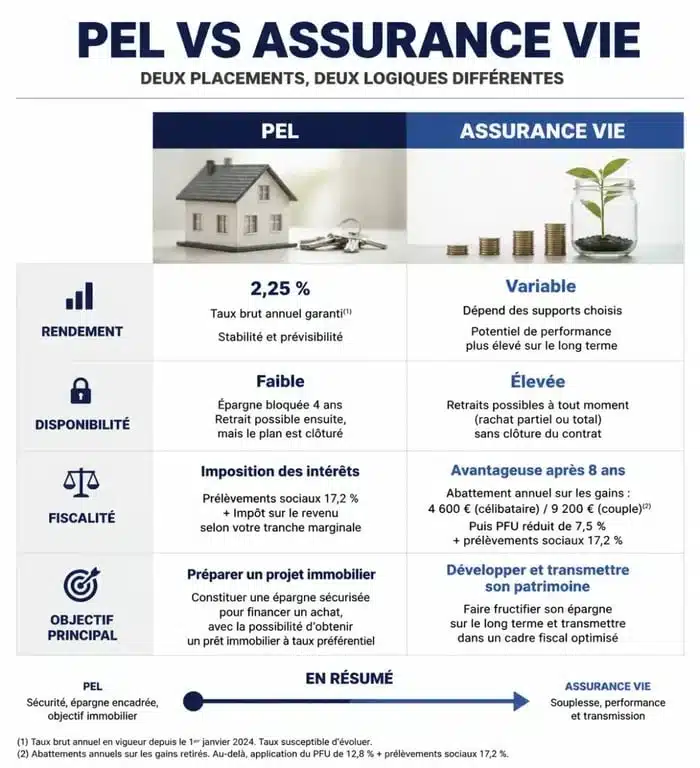
The ELP, the choice of real estate visibility
The ELP's main asset is its promise: an open rate of pay and a total guarantee of capital. In 2024, the gross rate was 2.25%. The ELP is also a loan right. After four years, it allows to obtain a real estate loan at a preferential rate known in advance. This security has a price: any withdrawal before four years carries penalties, and any withdrawal after that date causes the plan to close. It's an investment. blocked which requires strict discipline.
Life insurance, tailor-made diversification
Life insurance is distinguished by its multi-support structure. It allows to distribute its money between the Euro funds, secure, and the Units of account (shares, bonds, real estate via SCPI or ISR funds). Unlike the ELP, capital is not capped. Liquidity is higher: partial redemptions can be made at any time. It's the right tool to make a capital grow while keeping an exit door in case of unforeseen.
Detailed comparison: returns, taxes and risks
The displayed return is never the actual return. Taxation reduces earnings according to rules specific to each envelope.
| Reliability | Housing Savings Plan (LSP) | Life insurance |
|---|---|---|
| Performance | Opening fix (e.g. 2.25% gross) | Variable (euro funds + units of account) |
| Ceiling | 61 200 € | Unlimited |
| Availability | Blocked (closed if withdrawn) | Available at any time (repurchases) |
| Taxation | 30% from first year | 30% (after 8 years) |
| Risk | None (guaranteed capital) | None on euro funds / Real on UC |
The impact of taxation on net gain
Since 2018, the ELP's interest has been subject to the One-Specific Flat-rate Collection (SPF) of 30% from the first year. For an ELP of 2.25%, the net yield falls to about 1.57%. Life insurance works differently. If you withdraw money before eight years, the UFP applies. After eight years, you get an annual discount on interest of 4,600 € Single person (9 200 € for a couple). This tax optimisation allows large sums to be withdrawn without paying income tax, only social contributions of 17.2% outstanding.
The guarantee of capital: a criterion of reassurance
The ELP is guaranteed by the State, making it one of the safest investments. In life insurance, the guarantee covers only the part invested in euro funds. Units of account present a risk of capital loss. For a saver with a high risk aversion, the ELP or life insurance 100% euro funds are the only viable options, although the euro funds « pure » often require a minimum share of units of account.
For what profile and objectives choose one or the other?
The choice depends on your life plan and your investment horizon.
The real estate project: the historical advantage of the ELP
If your goal is to purchase your principal residence within 5 to 10 years, the ELP retains a strategic interest. It allows to freeze a borrowing rate. In a context of volatile credit rates, having an LEP open for a favorable period can save thousands of euros on a real estate loan. It is a security that life insurance cannot offer directly, although the accumulated capital can serve as a personal contribution.
Retirement preparation and transmission
To prepare its old days, life insurance upgrades the ELP. Its flexibility makes it possible to transform capital into a life annuity or to organize scheduled withdrawals. In addition, life insurance is a tool for transmission outstanding. Thanks to its specific taxation on succession (reduction of 152 500 € for payments made before the age of 70), it allows for the transfer of assets with reduced taxation. The ELP, on the other hand, enters fully into the classical estate and is subject to ordinary inheritance rights.
Synthesis: Can we combine both?
It is not necessary to choose a camp exclusively. The combination of ELP and life insurance is often the most resilient strategy for compartmentalizing savings.
Use the ELP to secure the money dedicated to a future real estate purchase in order to enjoy a guaranteed rate and a credit lever. Focus the surplus on life insurance to benefit from financial market diversification and tax optimization after eight years. Finally, keep in mind that life insurance allows you to pee in your capital without breaking your plan, unlike the ELP, which is much more rigid.
If you are looking for a secure savings for a specific real estate project, the ELP remains a safe value. If you're looking for performance, flexibility and wealth transfer, life insurance is the best support. In all cases, monitor the evolution of key rates that influence the remuneration of these two products.