
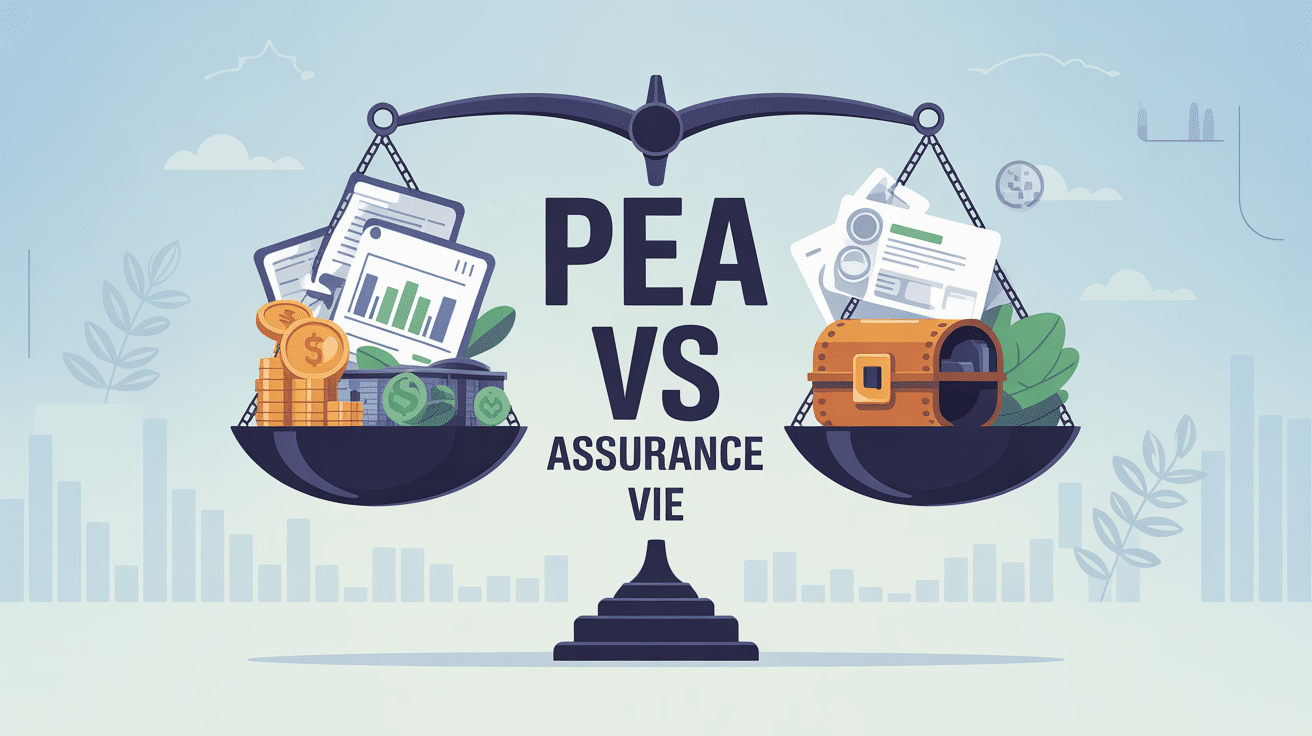

Choosing between a PEA and life insurance is a common dilemma for French savers. These two tax envelopes offer distinct benefits depending on your heritage goals, investment horizon and personal circumstances. Understanding their specificities will allow you to optimize your savings strategy and benefit from the best available tax advantages.
PEA vs life insurance: the main differences
PEA and life insurance have fundamentally different characteristics that guide their use according to your heritage needs.
| Criteria | PEA | Life insurance |
|---|---|---|
| Payment ceiling | 150 000 € | No ceiling |
| Investment support | European actions only | Euro funds + units of account |
| Optimal taxation | After 5 years | After 8 years |
| Transmission | Not transmissible | Without inheritance rights |
| Flexibility of withdrawals | Closing before 5 years | Free partial retirements |
This fundamental differentiation directly influences the optimal use of each envelope. The PEA is intended for investors seeking exposure to European markets with a long-term horizon, while life insurance offers superior versatility for complex heritage strategies.
Tax benefits: PEA or life insurance by duration

Taxation is one of the key criteria in the choice between PEA and life insurance. Each envelope presents its own tax rules that vary according to the length of detention.
Taxation of the PEA
The EAP benefits from particularly attractive progressive taxation. Before 5 years, capital gains are subject to the flat tax of 30% (17.2% of social contributions + 12.8% of income tax). After 5 years of detention, the income tax exemption applies, leaving only social levies of 17.2%.
Taxation of life insurance
Life insurance offers advantageous taxation after 8 years with annual discounts of 4 600 € for one person alone and 9 200 € for a couple. Beyond these thresholds, the tax rate is 7.5% for payments made before 70 years, supplemented by social contributions of 17.2%.
Comparative example
Example of a 10,000 gain € After 8 years of detention. With a PEA, you will pay 1,720 € social contributions. With life insurance, if you have not used your annual allowance, this gain will be completely exempt. If the reduction is exceeded, you will pay 7.5% of tax plus 17.2% of social contributions on the excess portion.
How to choose between PEA and life insurance
The choice between these two envelopes depends on your investor profile and your specific heritage objectives.
Choose the PEA if you are:
- An investor convinced of the potential of European equities
- Free to freeze your funds for at least 5 years
- Holder of a capital less than 150 000 €
- In search of simple and predictable taxation
Prefer life insurance if you wish:
- Diversifying your investments internationally
- Benefit from a capital guarantee with the euro fund
- Preparing for the transmission of your heritage
- Maintain managerial flexibility with partial withdrawals
Use by profile
A 30-year-old investor will generally focus on the PEA to build a long-term equity portfolio. A person close to retirement will opt for life insurance to secure part of his savings while preparing for transmission. Life insurance is a must for heritage transmission thanks to its inheritance benefits.
To maximize your returns while enjoying advantageous taxation, discover the unknown benefits of the PEA for your savings.
To understand everything about this savings option, discover Life insurance explained to invalids: operation and benefits in 2025.
To better guide your choice between PEA and life insurance, discover this comparing the best life insurance contracts in 2026.
Can we combine PEA and life insurance?
Holding a PEA and life insurance is not only possible but often recommended to optimize your property allowance. This complements the specific benefits of each envelope.
Optimal distribution strategy
A balanced approach is to use the PEA for your exposure to European equities and life insurance to diversify to international markets and secure part of your savings from the euro fund. This strategy offers you the best of both worlds: potential growth and capital security.
For a young investor, the distribution could be 70% PEA and 30% life insurance. With age, this proportion can gradually reverse to focus on safety and transmission. The order of opening depends on your situation: start with the EAP if you are aiming for performance shares, or life insurance if flexibility prevails.
Optimize your savings strategy
The choice between PEA and life insurance should not be exclusive. These envelopes complement each other perfectly in a comprehensive heritage strategy. Analyze your goals, investment horizon and family situation to determine optimal distribution. Don't hesitate to consult a wealth management advisor to refine your strategy according to your personal situation.