
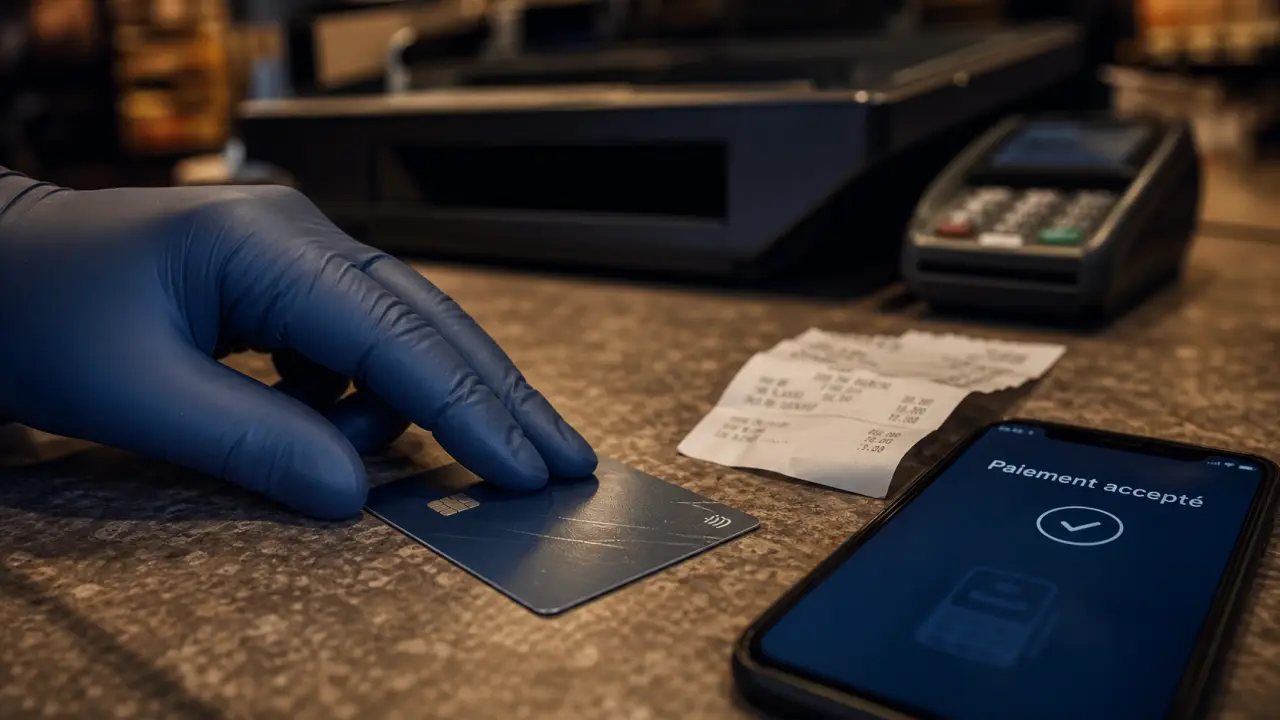

A card payment accepted in store or online may not appear immediately on your account. In most cases, the transaction is neither a cancellation nor an asset of the merchant: the transaction is simply awaiting transmission, processing or updating by the bank. The main point is not to consider this money available until the situation is clarified.
Why a validated payment can remain invisible in the account
When paying by credit card, two times are often confused: authorization and effective debit. When the terminal displays « Payment accepted », the bank generally validated that the card could be used and that the transaction could pass. But this does not always mean that the amount is already on your statement. Agreement and flow rate do not necessarily fall at the same time.
How long do you keep your administrative records? · Consult the official guide for the legal retention periods of your personal documents and avoid litigation.
Bank authorization is not always debit
Banking authorisation is a control step. It shall in particular verify the validity of the card, the ceilings, the apparent availability of funds or the security rules. The transaction must then be transmitted in a batch of payments, often via the trader's telecollection. Until such time as this transmission has been finalized, the payment may not appear, or appear briefly before disappearing. The visible status in the banking application therefore does not always reflect the actual state of the transaction.
This is what some call a « phantom flow » : you know that you paid, the merchant got an agreement, but your banking application does not yet show anything definitive. This lag is common with some e-payment terminals, e-shopping, service stations, hotels or transactions done just before a weekend. In these cases, the update may depend on both the merchant and your bank.
The role of the trader and telecollection
The merchant does not always transmit every payment instantly to the bank. Transactions can be temporarily stored on the electronic payment terminal, then sent at the end of the day, the next day or after a technical incident. If the telecollection is not triggered or fails, the flow may be delayed. The transmission time therefore plays a direct role in posting the payment.
There may also be a gap between the information received by your bank and the display in your customer space. Some banks update card transactions in real time, others with a delay. An operation can therefore be technically ongoing without still being visible in the list of movements. The same payment can thus appear later in future transactions or in final debits.
The usual delays before the operation appears
A card payment that does not appear should first be placed in its normal calendar. Most often, the update takes place under 48h to 72h. This period may vary depending on the type of purchase, the time of the transaction, the bank, the card network and the merchant's practices. A Friday night payment can therefore remain invisible longer than a purchase made at the beginning of the week.
| Situation | Time limit often observed | Point of vigilance |
|---|---|---|
| Purchase in stores on weekdays | 24h to 72h | Waiting for the merchant's telecollection |
| Payment on Friday evening or before holiday | Up to several working days | Weekend can shift the display |
| Online shopping | 48h at 72h, sometimes more | The flow can go on shipping |
| Payment abroad | A few working days | Conversion, international network and foreign bank can slow down |
| Hotel, rental, fuel | Variable | Pre-authorisation possible before final flow |
When the delay becomes abnormal
If the operation still does not appear after 72 hours, you should not panic, but it becomes useful to check. Start by looking at whether the payment appears in future transactions, pending authorizations or a separate section of your bank application. Some interfaces do not place card payments in the same location according to their status. This check avoids the false belief that the payment has disappeared.
After a few working days, contact the merchant first if you need to know if the transaction has been captured. For an online purchase, also check confirmation email, order status and shipping date. The flow can sometimes be triggered later than the initial validation. If the order has been prepared or shipped, the delay of display is nothing unusual.
The real risk: believe that money is still available
The main danger of an undisclosed payment is not technical but budgetary. If you spend the amount as if it were still yours, debit can fall later and cause insufficient balance, overdraft, or even agios depending on your banking situation. Risk often comes from too optimistic a reading of the displayed balance.
A good way to manage this type of shift is to keep a personal gauge of your actual balance. Your app displays an amount, but your available budget should include the transactions you have done that are not yet visible. For example, if your account says 620 € and you paid 160 € which no longer appear, your balance of decision is not 620 €but 460 €. This logic avoids piloting your account from an incomplete display, as one would avoid driving with a fuel gauge that reacts late.
Double flow, temporary disappearance and late flow
A payment that disappears from the statement may then reappear as a normal debit. In most cases, money ends up being debited sooner or later. A figure of 99,9 % is even advanced in some feedback experiences. It is therefore prudent to keep the sum aside until clarification.
Double debit is rarer, but possible in case of processing error, repeated attempt or bug between the merchant, the payment provider and the bank. If two identical flows appear, do not just wait indefinitely: gather the proofs and report the anomaly quickly. The earlier the application is documented, the simpler the processing is.
Confounding purchases
Some payments more easily create misunderstandings. Hotels and renters sometimes use pre-authorisations, which block a sum without matching the final debit. Service stations can also generate more authorization than the amount actually consumed. On the Internet, a merchant can validate the card at the time of ordering, and then debit on shipment. In these cases, the absence of immediate debit does not mean that the operation is cancelled.
There are also experienced cases where a monthly credit or recurring payment has not been debited for a long period, sometimes up to 1 year. This type of situation remains special, but it recalls a simple rule: the absence of bank writing does not automatically mean that the debt has disappeared. The amount may reappear later without this being an error.
What to do if card payment does not appear
The correct response depends on the delay. In the first 24 hours to 72 hours, the main objective is to monitor without acting too fast. After this time, you must document the situation and contact the right person. The essential is to move forward with dated elements, not with an impression.
- Note date, amount and merchant as soon as you see no flow.
- Keep the check-in ticket, confirmation email or invoiceespecially for an important purchase.
- Check pending transactions in the banking application, not only the main statement.
- Do not spend the amount until the status is clear.
- Enable banking notifications to spot the flow as soon as it appears.
- Contact the merchant if the order is related to a delivery, reservation or deferred service.
- Contact your bank if the operation appears inconsistent, doubled or absent for several working days.
Bank or merchant: who calls first?
If you are looking to know if the payment has been captured, the merchant is often the best placed, as he can check his terminal, payment provider or order history. If you want to understand why the transaction does not appear in your customer space, your bank is the logical interlocutor. The two answers are not the same, so it is better to choose the right contact from the start.
If payment is refused, refusal codes can also help to understand the origin of the problem. Codes 01, 05 or 14 are commonly associated with card refusals or discrepancies according to payment systems. But in the specific case of an accepted and then invisible payment, it is not necessarily a refusal: it is often a delay in processing.
Rights, remedies and time limit for payment to return
A trader can claim a payment later if the transaction has been completed. The legal period for claiming payment may be up to 13 months. This means that a very late flow is not necessarily illegitimate, even if it can be surprising and difficult to manage if you have not anticipated. It is therefore best to keep track of the payment and not to rely too quickly on its absence.
On the other hand, you also have duties in case of manifest error: double debit, incorrect amount, transaction that you do not make, payment cancelled but deducted, or no promised refund. In this case, the main thing is to react with dated evidence. Tickets, statements, e-mails and screenshots facilitate verification.
- Compare the amount charged with the ticket, invoice or order confirmation.
- Ask the merchant for a written explanation if the debit is late or different.
- Report the anomaly to your bank from the customer area or from an advisor.
- Keep exchanges, screenshots and supporting documents until resolved.
The right reflex, finally, is simple: to consider the payment as due as soon as it has been accepted, even if it does not appear yet. This avoids discovery, bad surprises and hasty protests. If the delay exceeds several working days or if the amount is reappeared twice, then go from simple supervision to a formal procedure with the trader and your bank.