
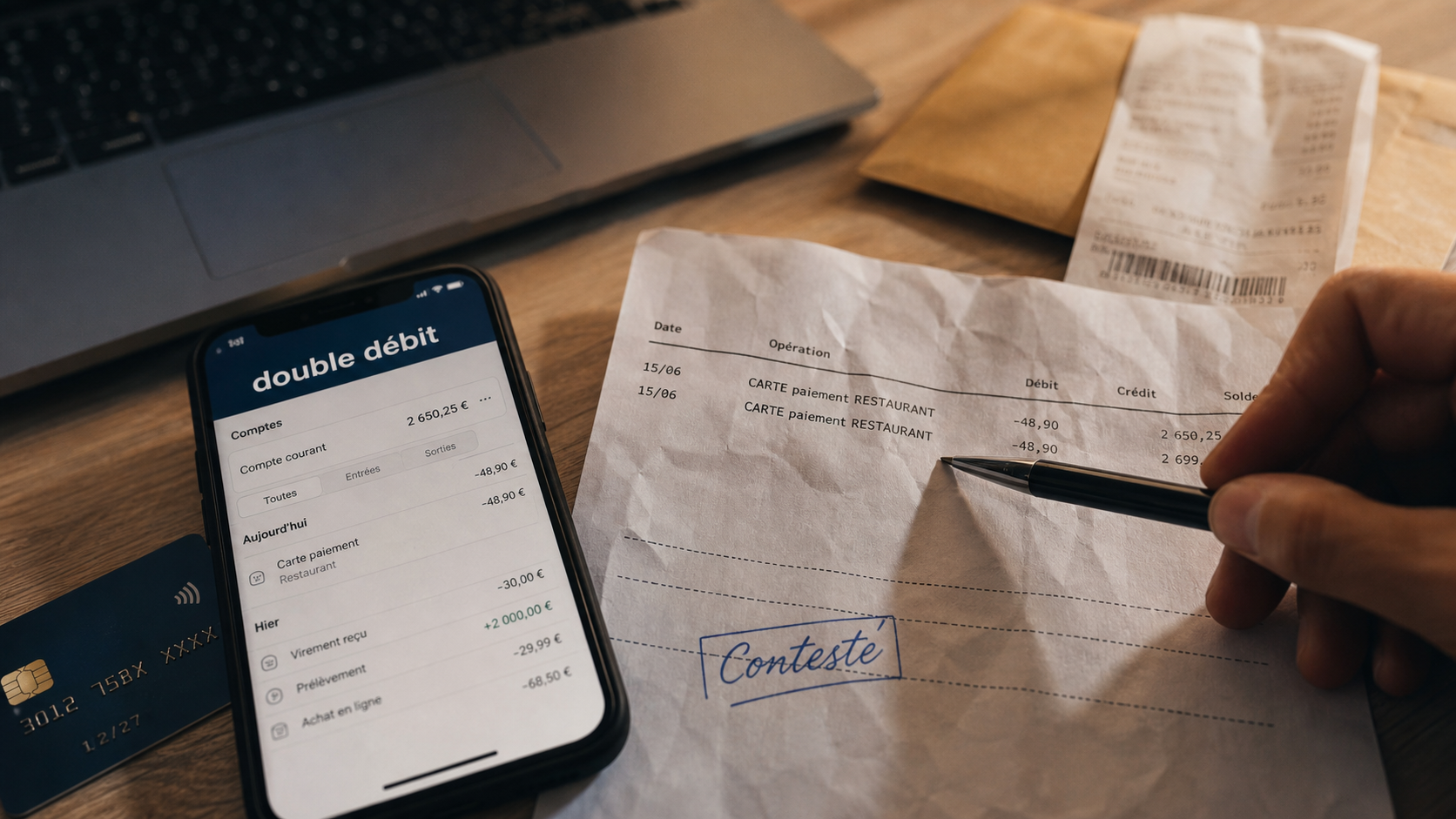

You consult your bank statement and the surprise is immediate: a purchase, yet unique, appears twice. This double levy, although stressful, is a common situation which benefits from a protective legal framework. Whether it is a simple technical error of the trader or a malfunction of the terminal, your right to reimbursement is defined by the Monetary and financial code.
Understanding dual sampling: causes and reality
A double debit occurs when a transaction is recorded twice by mistake. This happens when a payment is made in-store, if an electronic payment terminal (TPE) bug causes double validation, or when an online purchase is made, if the trader's server processes the request twice. It is essential to distinguish this error from a fraudulent purchase.
Test your knowledge of the challenge procedure
Unlike a fraud where your card is used by a third party without your knowledge, the double levy results from a technical incident. Your liability is not incurred and you do not have to fear consequences on your bank profile. The speed of action remains your best ally to regularize the situation.
Your rights and legal time limits to act
European and French legislation protects the cardholder. In the event of a malfunction, you have solid guarantees. The legal time limit for contesting an unauthorized or poorly executed transaction is 13 months for transactions within the European Economic Area (EEA). Outside EEA, this period is reduced to 70 days, although it may vary depending on the contractual conditions of your bank.
Once the dispute has been formally filed, your bank is required to repay the amount unduly deducted. If the transaction is recognized as a technical error, the bank cannot charge you any fees for processing this claim. The institution must justify each step of processing your file.
The step-by-step procedure to challenge the flow
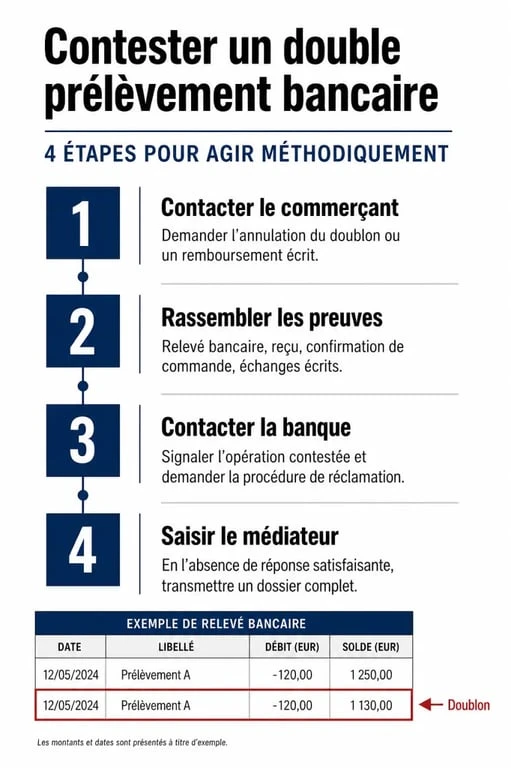
To obtain the refund, the rigor is necessary. The procedure for formalizing your application is as follows:
Official model for challenging a banking transaction · Use this form to report an error or contest unjustified charges on your statement of account with your bank.
Contact the merchant first. Before alerting your bank, try to contact the seller's customer service. A simple proof of double debit often allows immediate reimbursement by the merchant, thus avoiding a longer banking procedure.
Then gather your evidence. Mix your statement of account, cash ticket or order confirmation, and any evidence that the good or service was only purchased once.
Finally report the anomaly to your bank. If the dealer does not respond or refuses to collaborate, connect to your secure customer space. Use the built-in email to open a formal complaint. Make it clear that this is an operation misexecuted and not fraud.
There is sometimes a slight mismatch between the physical transaction and its actual accounting. This creates a delay in the management of your accounts, where debit seems to float between a provisional authorisation and a definitive levy. Understanding this mechanism does not confuse a simple line of « fund reservation » waiting with a real double levy, thus avoiding unnecessary steps with your advisor.
What if the bank refuses the refund?
If your bank rejects the challenge, it must state its reasons in writing. This refusal is not an end in itself. If you think you're right, you can climb the situation:
Send registered mail with acknowledgement to your bank's claim department. This is a mandatory step before any external action. If no solution is found within two months, you can enter the Banking Ombudsman your institution. Its contact details are available on your account statement or on your bank's website. As a last resort, you can contact the Prudential Control and Resolution Authority (ACPR) if you consider that your bank's practices do not comply with regulatory obligations.
Key differences: opposition, challenge and revocation
The terms are often confused, but each corresponds to a specific legal situation:
| Action | Situation | Objective |
|---|---|---|
| Opposition | Loss, theft or fraudulent use of the card. | Permanently block the map. |
| Dispute | Amount error, double debit, service not received. | Reimbursing a transaction. |
| Revocation | Recurring SEPA sampling you no longer want. | Stop future sampling. |
In the face of double sampling, remain calm and methodical. The law is on your side, provided you properly document your request and respect the official communication channels of your bank.