
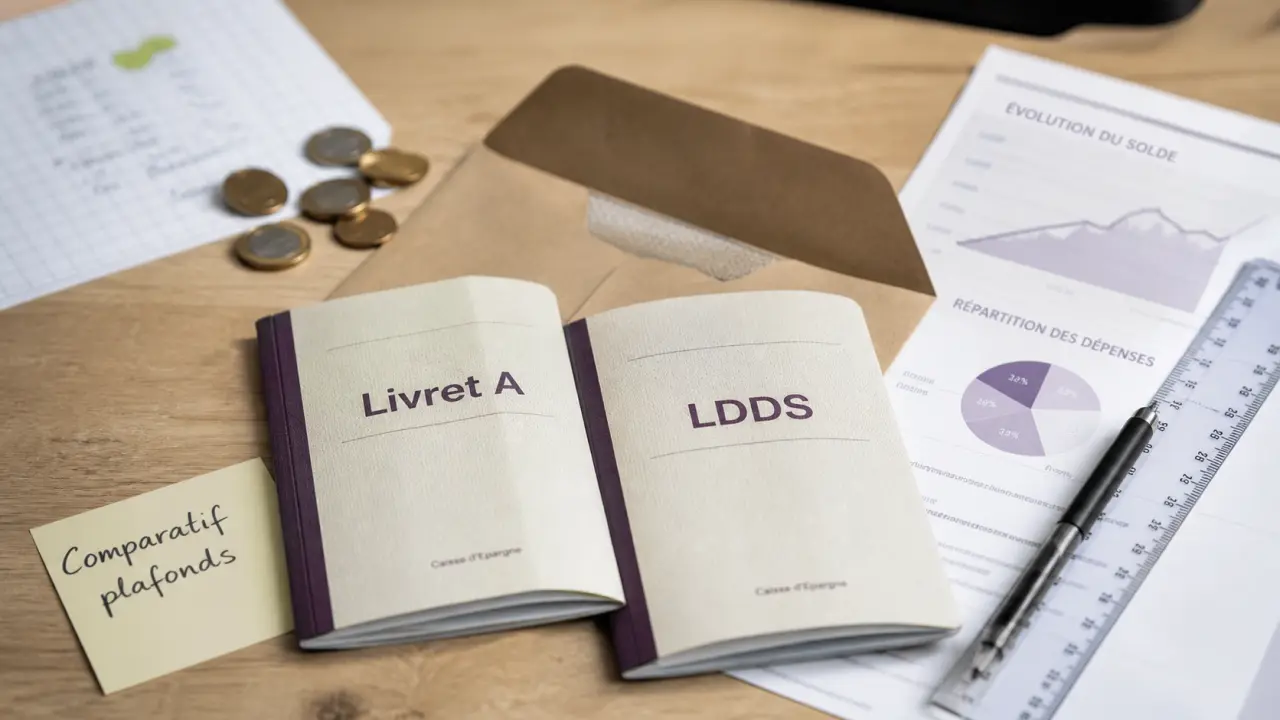

Between Book A and LDDS, the right choice depends mainly on your real need: keeping a reserve available, placing a larger amount, separating your projects or giving a solidarity dimension to your savings. Both booklets are regulated, challenged, liquid and secure, but their ceilings, access conditions and usage are not confused.
Two booklets close but not interchangeable
Booklet A and LDDS, for Sustainable and Solidary Development Booklet, belong to the same family: that of regulated savings products. Their rate is set by the State, their interest is exempt from income tax and social contributions, and the money remains available at any time, without withdrawal costs.
This proximity explains why many savers directly compare them. Yet they do not respond exactly to the same need. The Book A is the most common medium: more than four in five French people own one. It is often used as the first savings pocket, opened from childhood or used to maintain a security reserve.
The LDDS is more targeted. It follows the logic of security and liquidity of Book A, with a focus on sustainable and solidarity-based development. Its ceiling is lower, but it is useful to organize your savings when Book A is already well filled, or to isolate a sum for specific projects.
What really matters: availability
On these two booklets, money is not blocked. You can withdraw in case of unforeseen expenses and then reconstitute your savings. This makes them suitable for precautionary savings, usually estimated at 3 to 6 months of income depending on the stability of your situation, your expenses and your level of personal risk.
Ceilings, rates, taxes: the useful comparison
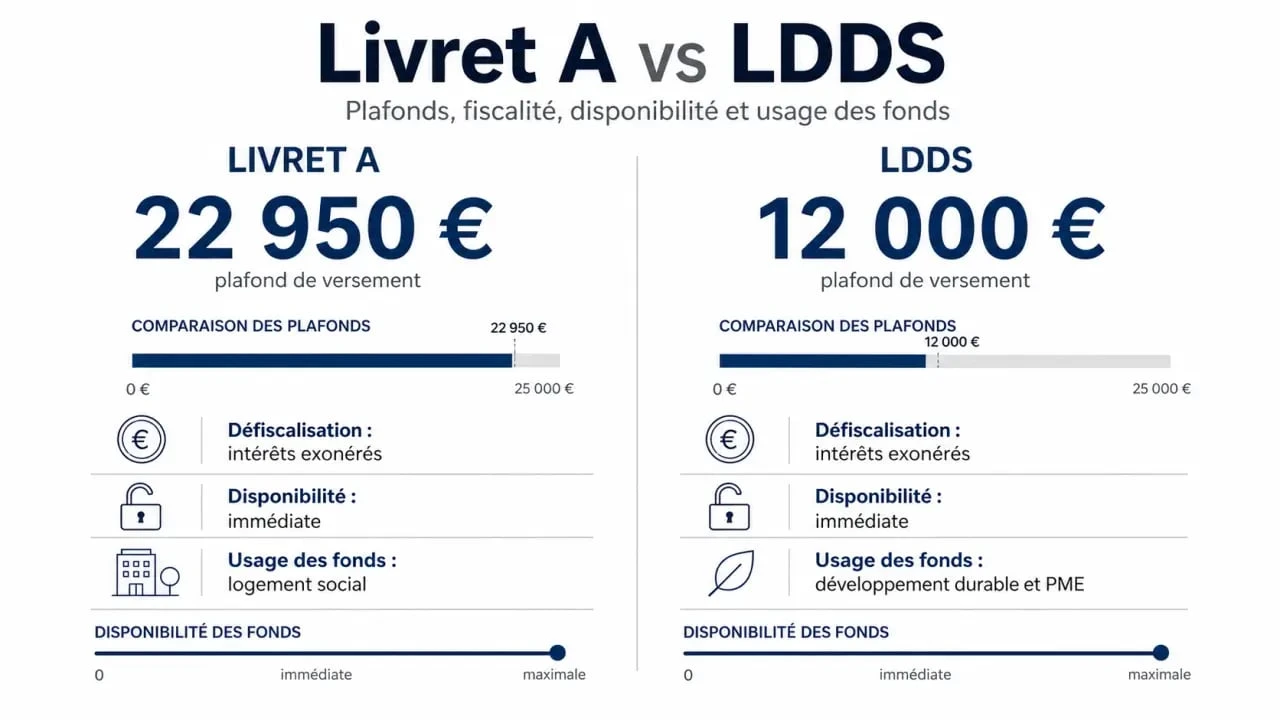
The most visible difference is in the deposit ceilings: 22 950 € for Book A, against 12 000 € for LDDS. Interest can then exceed these limits, but you can no longer add payments once the limit has been reached.
Evolution of Book A and SARA rates as of August 1, 2026 · Discover the new rates of pay for Book A and SARA effective August 1, 2026.
| Criteria | Book A | LDDS |
|---|---|---|
| Deposit ceiling | 22 950 € | 12 000 € |
| Rates: | State-regulated, revised rates | Generally aligned with Booklet A |
| Taxation | Interest not taxable | Interest not taxable |
| Calculation of interest | Fifteen, 1st and 16 of each month | Fifteen, 1st and 16 of each month |
| Availability | Possible withdrawals at any time | Possible withdrawals at any time |
| Use of funds | Social housing | Sustainable development and solidarity initiatives |
The rate of Book A was 3.0% in February 2023, while the LDDS also displayed 3% in 2023. These rates are regulated and can be revised twice a year, on 1 February and 1 August. Before opening or feeding a booklet, it is therefore prudent to check the current rate with your bank or an official service.
The calculation by fifteen also deserves your attention. A payment begins to generate interest from the 1st or the 16th following, depending on the filing date. Conversely, a withdrawal ceased to produce interest on the previous 15 years. In practice, it is best to drop off just before the 1st or the 16th, and remove immediately after, when possible. This detail does not change the nature of the product, but it avoids losing a few days interest on large amounts.
Which booklet to choose according to your situation?
You start your savings: priority at Book A
If you don't have any precautionary savings yet, Book A is often the first reflex. Its ceiling of 22,950 € leaves more room for gradually accumulating a reserve. It is simple, well known, accessible and adapted to unforeseen expenses: car repair, health care, equipment replacement, period of income decline.
It is also relevant for parents or grandparents who want to set aside a child's name, subject to the conditions applicable to minors. Its very generalistic character makes it an easy support to understand and follow over time. When you start saving, this readability counts as much as the rate.
Your Book A is already full: add the LDDS
If your Booklet A approaches its ceiling or if you want to better divide your savings, the LDDS becomes interesting. Its 12,000 € ceiling offer a second defiscalised pocket, always available, with close operation.
It can be used to distinguish between two objectives: Booklet A for Home Safety, LDDS for work, a major purchase, a mobility project or a reserve for less urgent expenses. This separation avoids mixing all your savings into a single balance. You keep a clearer view of what is used to deal with the unexpected and what is already reserved for specific use.
You want to make sense of your savings: LDDS advantage
The LDDS is distinguished by the allocation of part of the funds to objectives related to sustainable development and the solidarity economy. For a saver who wants to maintain maximum security while combining his money with a more committed purpose, this is a real argument.
A simple organization helps to decide: one emergency pocket, another for an identified project, and possibly longer support for performance. The idea is not to disperse everything, but to give each sum a clear role. In this way, the LDDS complements Booklet A well, as it adds a dedicated pocket without complicating management.
Benefits and limitations to be known before opening
The main advantage of the two booklets is their rare combination: Security, availability and advantageous taxation. Interest is net of taxes and social contributions, which simplifies comparison with other investments. The funds are guaranteed by the State, with a repayment period of 7 working days in the event of bank bankruptcy.
Another highlight is simplicity. You can open a booklet in a bank, manage it online in most institutions, schedule payments or withdraw on a timely basis. There are no entry, management or exit fees. For a precautionary saving, this sobriety is often more useful than a more technical product.
The limit, on the other hand, is clear: these booklets are not designed to look for strong long-term performance. Their rate protects part of your savings, but it may become insufficient if inflation is high or your investment horizon exceeds several years. Keeping all your savings on Livret A and LDDS can therefore be reassuring, but not always optimal.
Book A : savings base with a higher ceiling; LDDS : useful complement to separate projects and integrate a solidarity dimension; common weak point : limited return compared to longer or more risky investments; common strong point : money available quickly, without interest taxes.
What if the ceilings are reached?
Once the 22 950 € Book A and the 12 000 € continued to stack free cash is not necessarily the best strategy. The first step is to check that your precautionary savings are sufficient, but not excessive. For many households, 3 to 6 months of income already cover most of the current emergencies.
Beyond that, the choice depends on your profile. If you are eligible for SARA, the Popular Savings Book can be a path to study, as it also belongs to the regulated savings family, with income-related conditions. If your project is in the medium or long term, you can consider other solutions, possibly accepting a risk share or a lower availability.
The right method is to reason by horizon. The money required in the coming months remains on Book A or LDDS. Savings for a purchase in two or three years may be placed on prudent media. The amounts you do not need for several years can be directed towards more diversified investments, depending on your risk tolerance. This cutting avoids confusing safety, project and performance in a single envelope.
In short, Booklet A often comes first to build a solid foundation. The LDDS then comes as a challenge-based, liquid and useful complement to organize your goals. The real good choice is therefore not always one against the other: it is often the order in which you use them that makes the difference.