


Find best senior placement It involves balancing security, access to your funds and optimisation of transmission, while personalizing choices according to age, wealth level and life plan. Life insurance, secure booklets or SCPIs combine according to your risk sensitivity and the desired objective, whether to preserve your capital, generate a supplementary income or prepare a personalized succession. In a time of ever-changing regulation and taxation, tailor-made adjustment remains essential to secure your assets and prepare your future in peace.
What's the best placement for a senior? Clear response according to your priorities
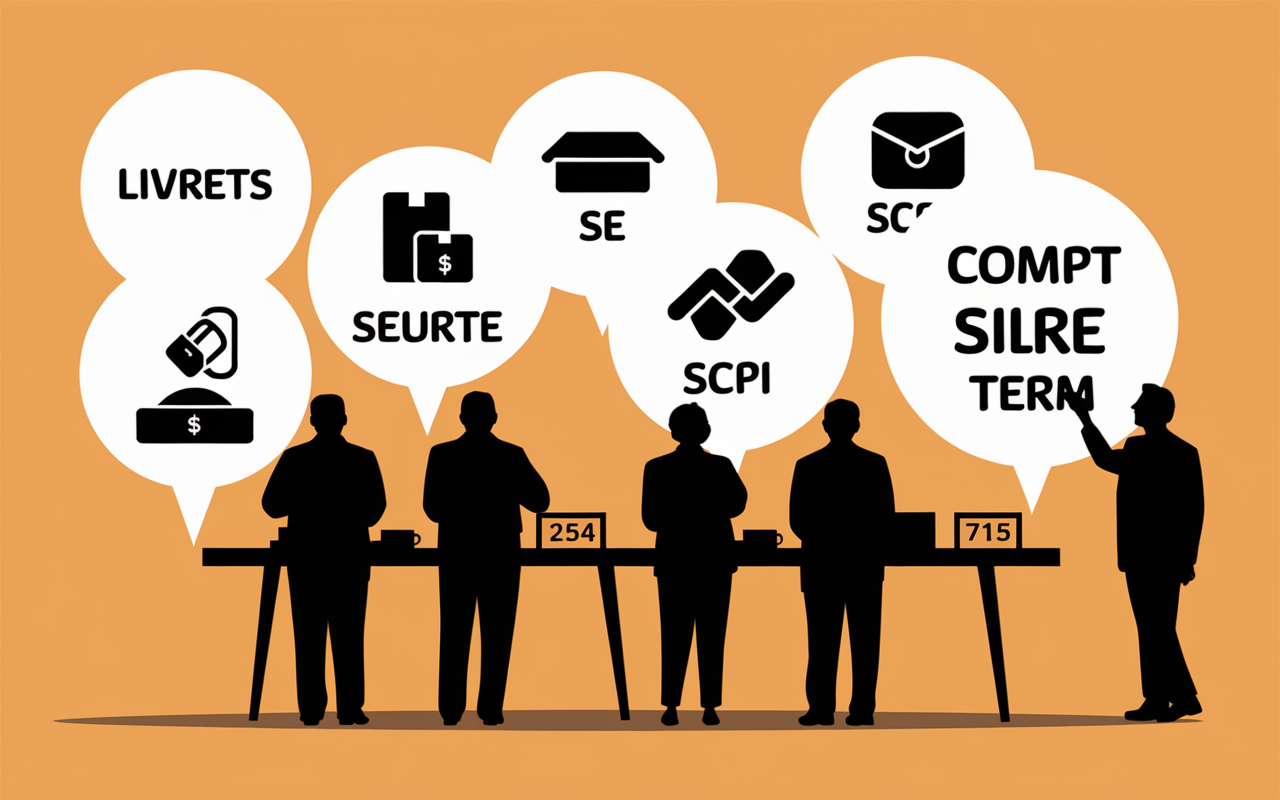
Between the guarantee of your capital, the concern for additional income or the willingness to transmit in good conditions, there is no universal "best senior investment": it adapts to your profile and your expectations. Keep in mind the essentials – From 60 to 70 years of age, the preferred solutions are life insurance (euro funds and/or units of account according to your temperament), the regulated booklet (for precautionary savings), SCPI (potential source of income), and the futures account (security and fixed rates). Their assembly, modified according to your situation, allows you to better understand the great heritage issues at this age.
For example: to give priority to safety, Book A (rate 1.5% in 2026, ceiling 22 950) €) or Euro funds life insurance (about 2 to 2.5% depending on the contract) remains reassuring. If your priority is income, SCPI between 4 and 6 % per year (gross return 2026), with liquidity and risk to be taken into account. For transmission, life insurance retains a certain advantage before 70 years with its 152,500 tax reduction € per beneficiary; After 70 years, the solution must be adapted, but remains effective.
To sum up: you don't manage your money the same way at 60, 70 or 80. The important thing is to focus on safety for precautionary savings, mix life insurance and/or SCPI according to your risk appetite, and ask for support (free heritage audit often proposed) to refine your strategy especially in terms of transmission or when special needs arise.
An encrypted overview and practical examples will help you better position yourself later. Is there any hesitation? Feel free to use a simulator or contact a specialist (tools and contacts available below).
What criteria for the placement of a senior?
Over the ages – 60, 70 or 80 – your priorities change: ensuring the security of your assets, finding an additional source of income or arranging the transmission to your loved ones. Taking the time to question upstream proves regularly useful.
Security, yield, liquidity, taxation, transmission: the five decisive pillars
What links an A booklet to life insurance? These two supports reassure, but their functioning differs fundamentally. Most prudent seniors first prefer security – protected capital, no risk of loss, almost immediate availability. Other criteria come into play very quickly to guide your investments over time.
Some markers to keep in mind:
- Security of capital : essential at the beginning (euro funds, booklets, futures accounts)
- Performance : vital in the face of inflation, but vigilance over unperceptible risks (e.g. life insurance units of account, SCPI, bonds)
- Liquidity : access to variable capital according to choice (real estate paper, lifesaver: take care of resale times)
- Taxation : allowances, life insurance exemptions (up to 152 500 € per beneficiary), easier heritage transmission
- Simplicity and management Possible delegation (euro funds, management mandate) or autonomous (direct rental property)
In each phase, ask yourself the question: « What would be the most anxious for me? Too little yield or fear of losing what I built? ».
Comparison of major senior investments

Before analyzing the various options with details, here is an encrypted panorama to help you think. This table brings together the benefits, risks, liquidity and taxation of the main investments favoured by seniors in 2026.
| Placement | Security | Annual yield | Liquidity | Taxation | Transmission |
|---|---|---|---|---|---|
| Booklet A / SARA | Guaranteed capital | 1,5 % / 2,7 % | Total, immediate | Tax exempt and PS | No specific advantage |
| Life insurance (euro funds) | Guaranteed capital | 2 – 2,5 % | 7-10 days | Prev. flat-rate allowance after 8 years | 152 500 € discount/benefit. before 70 years |
| SCPI | Unsecured | 4 – 6 % | Variable liquidity (4-6 months) | Real estate taxation | Possible, but taxed |
| Future account | Guaranteed capital | 2,05 – 3,10 % | Blocking (6 to 60 months) | IR, PS interest | 100 000 € Security deposit |
| PER | Depends on supports | Variable | Indispo pension/rent | Challenges at entry | Transmissible, possible reduction |
| Viager | Specific | Decgressive rent with age | Low | Partially imposed | Depends on contract |
Field tip: Mixing Euro funds (for security) and a little SCPI (for income-seeking) within life insurance is a method of diversification often cited in professional interviews.
Focus on Life Insurance: The Heritage Envelope Senior Queen
Life insurance retains its reputation as a versatile tool for the heritage management of seniors: flexible, reassuring (euro funds), tax adapted... including the age of 70, despite several popular ideas.
Life insurance: why is it (again) the best ally of seniors?
This placement is distinguished by its flexibility. In euro funds, your savings remain protected, accessible in about ten days, with interest around 2 to 2.5% in 2026. Anecdote: a couple of young retirees invests 50,000 € from Euro funds: each year, it generates between 1,200 and 1,300 € net tax, while retaining the possibility of withdrawing capital without excessive penalty. Taxation becomes softer after eight years, thanks to the annual reduction (4 600 € for one person alone, 9 200 € for a couple).
Major asset for the senior: transmission. For all payments made before 70 years, each beneficiary may receive up to 152 500 € free of inheritance rights. After 70 years, the reduction is limited to 30,500 €, but life insurance remains effective in structuring complex transmissions, protecting a spouse or transferring to distant family members.
Some heritage trainers report that units of account present more risks – free to each of them. The arbitration is always carried out in connection with an expert (a suitable caution is necessary).
What about life insurance after 70 years?
Contrary to what we sometimes hear, opening a contract after 70 years is not necessarily counterproductive. Subsequent payments allow for freedom of transmission and often remain more manageable than a simple security account or booklet.
Example: Senior Drops 40,000 € 72 years old. At death, the overall reduction of 30 500 € applies (for all beneficiaries). Beyond this, taxation remains competitive (20 % up to 700,000) € transmitted).
Parenthese: Many seniors discover that it is possible to turn saving into a life-saving annuity even in the late days, and thus ensure a lifetime income supplement (an option that is little used, but very relevant for people without heirs or seeking income security).
SCPI and real estate paper: a revenue lever for seniors... to be adjusted according to its profile
Many seniors want regular income without coping with tenant stress. The SCPI ("paper stone") meet this need, provided that it understands its workings: attractive yield, prudent risk balance and liquidity to be monitored closely.
SCPI: additional revenue source up to 6% per year attention to liquidity
The SCPIs offer average yield from 4 to 6 %/year (source ASPIM 2026), well above the booklets and close to the best periods in the real estate market. An investment can start from a few thousand euro, without direct property management. One professional quotes: out of 100,000 € a senior can get up to 500 € net each month, paid as a salary, without concern for unpaid or work... a formula appreciated by many.
On the other hand, it is a long-term strategy: the resale of shares can last several weeks (sometimes a few months in a crowded market) and there is no guaranteed capital in case of a real estate decline. Entry fees are to be examined (8-12 per cent of the amount invested). Nuance: Taxation follows that of conventional real estate, except when SCPI is housed in life insurance.
Real estate in dismemberment and life: two-way heritage strategies
To transfer at a lower tax cost, dismemberment (nue-property/usufruct) allows you to offer a property (or shares of SCPI) while optimizing the future estate. The lifesaver provides an income supplement ("rent") while allowing to stay at home. For information purposes, an apartment estimated at 200,000 €, a senior can get a bouquet of 50,000 € and a monthly pension of 1,250 € For life.
These are powerful options, to be preferred among well-advised people. It is sometimes difficult to navigate alone in these strategies without the help of an expert, according to a manager who has met during training.
Choose by age and goals: practical arbitration 60, 70, 80
It would be unrealistic to invest his money in the same way at 63, 74, or 81 years. Each age group raises new heritage priorities.
60-70 years: secure, prepare transmission and diversify without stress
It is often during this period that the compromise is decided: should we keep euro funds, or should we inject a bit of dynamism? Many seniors retain a proportion of their assets in "liquid" (books and life insurance), invest in transmitting (life insurance before age 70), and sometimes add a share of SCPI to counter monetary erosion.
Mini-cases: Alain, 65, deposits 40,000 € Euro funds (2.4%/year), 15 000 € on SCPI (objective 6%), the balance on Booklet A (for flexibility). Its additional annual income approaches 2,000 €while preserving availability.
After 70 years: tax focus, regular income and adapted transmission
Life insurance payments then change logic (debt on transmission– 30 500 € All beneficiaries). To organize the succession, it is better to anticipate early. Simplified management, access to capital, and sometimes exiting into an annuity (to ensure end-of-life income or avoid inactive funds) are preferred.
Illustration: Mariette, 73 years old, to organize 60,000 € : it maintains 20,000 € from Euro funds, 30 000 € in SCPI (in old life insurance), 10,000 € on SARA. It gets nearly 2,200 € In addition, it has funds, if necessary, and orchestrates transmission via the beneficiary clause.
After 80 years: simplification and risk management, priority to availability
From the age of 80, the choice often turns to liquidity, minimal administrative management, and (sometimes) anticipation of accompaniment needs (dependence, home help...). Booklets, euro funds or lifetime pensions are then preferred. Simple transmission solutions (donations, life insurance clauses...) are also useful.
This question is sometimes asked during consultations: "Do I have to close my SCPI at this age?" This is not systematic: it may be wise to conduct an audit to calm down and simplify management.
Practical cases and numerical examples for seniors
To better visualize, here are examples of common, illustrative arbitrations.
Combining availability and income: concrete example of distribution
Let's take Mireille, 68, who has about 100,000 € savings to be managed:
- Booklet A: 15,000 € (rapidly accessible, 1.5 %/year)
- Life insurance fund euro : 50 000 € (2.5 %/year, protected capital, facilitated transmission)
- SCPI in life insurance: 30,000 € (5 %/year, additional income, availability without taxation after eight years of contract)
- Term account: 5,000 € (3 %/year, blocked 3 years, mobilizable for specific project)
Mireille thus gets more than 2,800 € annual interest and yields, keeps a significant portion of its funds in reserve, and secures transmission for its two children (using the specific life insurance discounts).
Optimizing transmission after 70 years: the right manual
A common mistake is to believe that life insurance becomes "useless" after 70 years. However, if the reduction per beneficiary increases to 30,500 €, it is still possible, by skillfully drafting the beneficiary clause, to optimise the share of each child or grandchild, while taking advantage of the flexibility of buybacks and taxation that is softer than a so-called "classic" transmission. An advisor may also recommend a donation (100 000 €/ child over 15 years) to complete the device.
A misunderstood, but effective idea: offering each grandchild 31,865 € without rights, and pass on the rest via life insurance, even beyond 70 years. Many households do not know that this possibility exists.
Asset risk management, taxation and transmission: points of vigilance
Many seniors fear the "bad surprise" of investment or taxation on a legacy. Some ways to limit risks:
Securing capital: essential safeguards
Make sure you never go beyond deposit guarantee (100 000 € by person and institution) on your accounts. Also beware of attractive offers at above average rates (a SCPI of more than 7% per year... The risk of loss of capital is real outside the regulated framework).
For life insurance, prefer ORIAS-labelled companies, recognized for their strength. It is recommended that a free heritage audit be systematically requested prior to any major decision.
Transmission and discounts: anticipate to (many) less pay
Life insurance allowance (before age 70: 152 500 € per beneficiary; after 70 years: 30,500 € All beneficiaries) forms the keystone of the senior heritage. Many families benefit from a considerable amount of exemption, provided they act at the right time.
Giving in one's life (donations, coordinated life insurance, tailor-made beneficiary clause) also promotes a soothing transmission. A point sometimes overlooked: the drafting of the beneficiary clause is as strategic as the choice of placement itself!
FAQ – Your key questions about the best senior placement
You may recognize yourself in these common situations:
What is the safest placement for a senior?
Peace is offered by the euro funds (life insurance), booklets, futures accounts with reference institutions (see FGDR guarantees). The stock exchange and units of account should be excluded if you do not have a high risk tolerance.
Does life insurance remain useful after 70 or 80 years?
Yes, mainly to organize the division between heirs, the protection of the spouse, and the ease of withdrawals. Even after 70 years, the estate benefit decreases, but the flexibility of the contract remains.
SCPI or direct real estate for a retirement income supplement?
The SCPIs allow easy management, reduced access thresholds (some EUR thousands) and regular efficiency (4-6 % per year). Only reserve: liquidity. Live real estate is more demanding, but with high symbolic value.
How to manage a large, risk-free sum?
It is better to divide between livrets (under the regulated ceilings), euro funds, and several life insurances. We recommend never placing everything in one medium – caution remains your ally!
What if I have very specific needs, or if I want to validate my strategy?
Most recognized experts offer free property audits and without commitment, available online or by telephone (see contact/expert box below). A precious reflex to every challenge of your allowance.
To deepen or confirm your ideas: Simulate your heritage project or request an interview with an advisor to obtain a suitable diagnosis (button or guide to download in the dedicated section).
Key Resources, Simulators and Social Evidence
Need to go further or secure a decision? Here are some useful resources to consolidate your strategy:
- Simulator to maximize succession (life insurance discount, donations, multi-beneficiary transmission)
- Comparator of senior investments (euro funds, SCPI, booklet...)
- Free heritage audit (ability to make an appointment)
- PDF guide to download (« Retirement money: security, income, transmission »)
- Certified testimonials (Google Note 5/5 of 53 opinions, Auguste Heritage – see box)
- Simple lexicon of technical terms (dismemberment, usufruct, units of account, inheritance allowance...)
- Official sources : Banque de France, ASPIM, Service-public.fr
Tip that we often meet: perform a simulation every year, if only to check if your heritage allowance remains in line with your age, your goals... and your desires.