
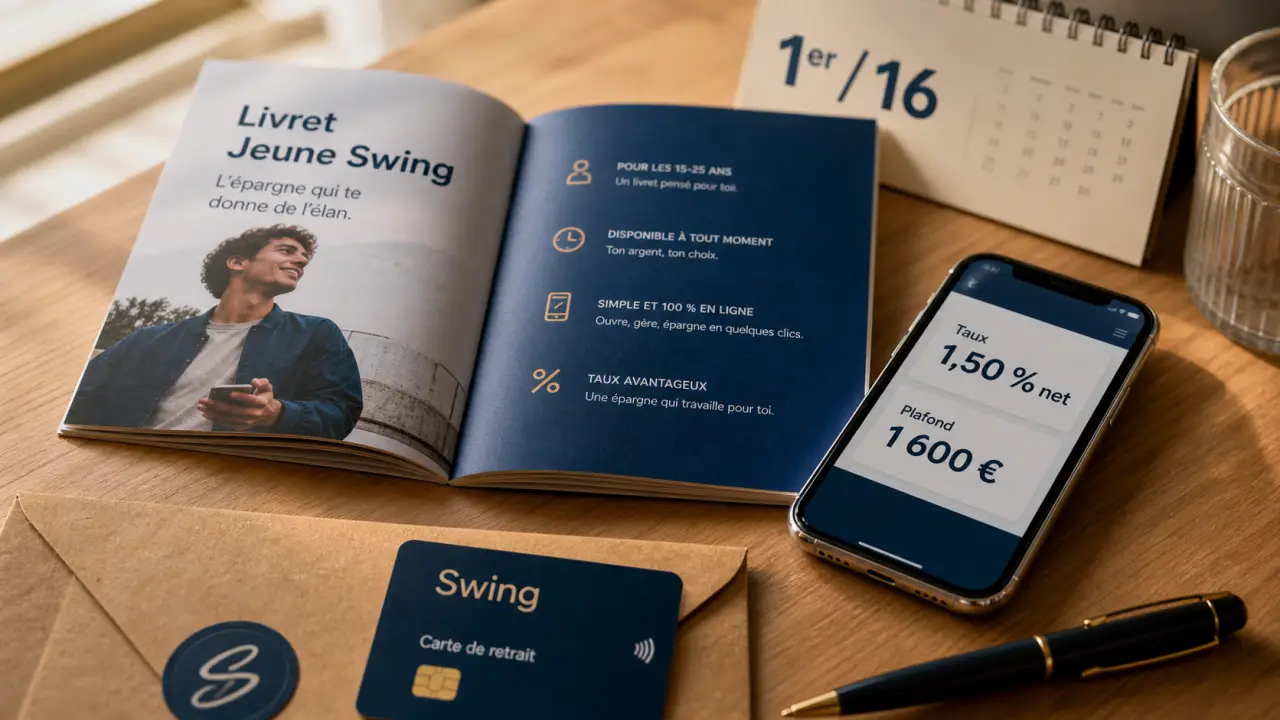

The Young Swing Booklet The Bank Postale posted a rate of 1.50 % net as at 22 February 2026, with a ceiling of 1 600 € excluding interest. It is a regulated investment for 12-25 year olds, without interest tax or social contributions, thought to learn to save while keeping his money available.
Young Swing Book rate and what it really brings back
At La Banque Postale, the rate of the Young Swing Book is fixed by the bank in accordance with the general rule of the Young Book: its remuneration must remain higher than or equal to that of Book A. The rate announced is NetThis means that interest is not reduced by income tax or social contributions.
Interest calculator
Note: This is an indicative estimate based on simple interest, assuming constant capital. This calculation does not take into account the actual calculation method per fortnight. Reminder: The remittance limit applies to deposits, capitalized interest can carry the balance above this limit.
| Element | Young Swing Booklet |
|---|---|
| Current rate | 1.50% net as at 22 February 2026 |
| Payment ceiling | 1 600 € excluding capitalised interest |
| Minimum payment | 10 € |
| Taxation | Interest exempt from tax and social contributions |
| Availability | Possible withdrawals at any time, subject to conditions |
A simple example of annual earnings
If the booklet remains completed at its ceiling of 1 600 € for an entire year at 1,50 %, the theoretical gain is 24 € Net over the year. The amount remains modest, but it has two clear advantages: it is secure and it is not taxed. Interest is then added to the capital, even if the ceiling of 1 600 € is already reached because this ceiling concerns payments and not capitalized interest.
A history that shows that the rate can move
The Young Swing Book rate is not fixed. In particular, 3.0% in 2023and 2.40% in 2025, of 1.70 % in 2025, before reaching 1.50% in 2026. This development reminds us that a Young Book must be followed in time. It may remain interesting for its taxation and flexibility, but its remuneration depends on rate decisions and the general context of regulated savings.
Who can open this booklet and under what conditions?
The Young Swing Booklet is intended for young people from 12 to 25 years resident in France. A person may hold only one Young Book, all establishments combined. Before the opening, the bank therefore checks the eligibility of the holder and the absence of another similar booklet.
Everything about the Young Booklet: how it works and benefits · Discover the opening conditions, the ceiling and the remuneration rules of this challenging savings account reserved for 12-25 year olds.
Minor, student, young active: practical rules
For a minor, opening usually requires the intervention of a legal representative, with an appropriate authorization. The booklet can then be used to set aside money received on an anniversary, a family worker, a part of a summer job or a first apprenticeship pay. For a young adult, management is more autonomous, but the product retains the same logic: available savings, limited ceiling and net remuneration.
Payments, withdrawals and Swing Card
The minimum payment is 10 €, which makes the booklet accessible even with small amounts. Funds remain available, unlike some blocked investments. The Bank Postale also associates a Swing withdrawal card free, with possible withdrawals up to 300 € by 7 days period. This card can help to gain autonomy, provided you keep a simple rule: this booklet is used to save, not become a daily expense account.
Calculation of interest: the 15 rule to be known
The interests of the Young Swing Book are calculated according to the rule of 151st and 16th of each month. In concrete terms, a payment begins to generate interest from the next 15 years. Conversely, a withdrawal ceases to produce interest from the current or previous fortnight depending on its date of execution. It is a technical detail, but it can change the actual yield if it is often made movements.
The right reflex to pour and remove
To optimize without complicating life, it is better to deposit money just before the beginning of about fifteen, for example before the 1st or before the 16th, and avoid withdrawing just after these dates if it is not necessary. The idea is simple: do not lose a few days of interest for a movement that could wait.
When payments and withdrawals succeed too quickly, the money passes through the booklet without staying there long enough to produce its full effect. Conversely, deposits placed at the right time allow capital to work longer. For a young person, this is often the most useful lesson of the Young Book: performance counts, but the regularity of saving also counts.
Using a calculator to estimate earnings
Bank Postale proposes calculator Young Booklet to simulate interest according to the amount placed. For a quick estimate, use the following formula: capital invested for one year x annual rate. It gives a correct approximation if the amount remains stable throughout the year. On the other hand, if payments are progressive, the real gain will be lower than if the ceiling were reached from the outset.
Young Booklet, Booklet A, LDDS: which one to prefer?
The Young Swing Booklet is not intended to replace all other booklets. Its ceiling of 1 600 € is deliberately low, which makes it rather a First savings pocket. Once this ceiling is reached, it becomes relevant to direct new payments to another available medium, such as Book A or LDDS depending on the situation.
| Product | Public | Ceiling | Main use |
|---|---|---|---|
| Young Swing Booklet | 12-25 years | 1 600 € | First available savings and challenges |
| Book A | All public | 22 950 € | Wider precautionary saving |
| LDDS | Eligible persons | 12 000 € | Additional savings available |
Book A had a rate of 3% in 2023, with a much higher ceiling than the Young Book. The LDDS, for its part, also offers a higher investment capacity, with a ceiling of 12,000 €. The correct order therefore depends on the rate of time and amount to place. As long as the Young Booklet offers attractive remuneration and the holder is eligible, it is often logical to fill it out as a priority and then complete it with a Booklet A.
Closing at 25 years, taxation and points to be checked before opening
The Young Book cannot be kept indefinitely. Closing is mandatory at 31 December of the year of the 25th anniversary. At this time, the future of the balance must be anticipated. In particular, it may be transferred to a Book A if the holder owns one or wishes to open one, or to another account depending on the organization chosen with the bank.
Very favourable taxation
The interests of the Young Swing Booklet are exempt from income tax and Social contributions. This is one of its main assets, especially for simple and market-free savings. As the posted rate is net, it is easier to compare performance with other solutions: 24 € annual interest out of 1,600 € 1.50% corresponds well to 24 € In the case of non-receipt rates or movements in the course of the year.
The checklist before deciding
- Verify that the holder is between 12 and 25 years of age and resides taxably in France.
- Ensure that no other Young Book is already open elsewhere.
- Provide a first payment of at least 10 €.
- Compare the rate of the Young Swing Booklet with that of the other booklets available.
- Take into account the ceiling of 1,600 € and provide a complementary solution if savings exceed this amount.
- Anticipate the closing of the year of the 25th anniversary on 31 December.
To open a Young Swing Booklet, the easiest way is to get closer to La Banque Postale, online or with an advisor, with the proofs requested according to the age of the holder. For a young person who begins to manage his money, this booklet remains a clear entry point: a known rate, advantageous taxation, immediate availability and simple enough rules to learn the right savings reflexes.