
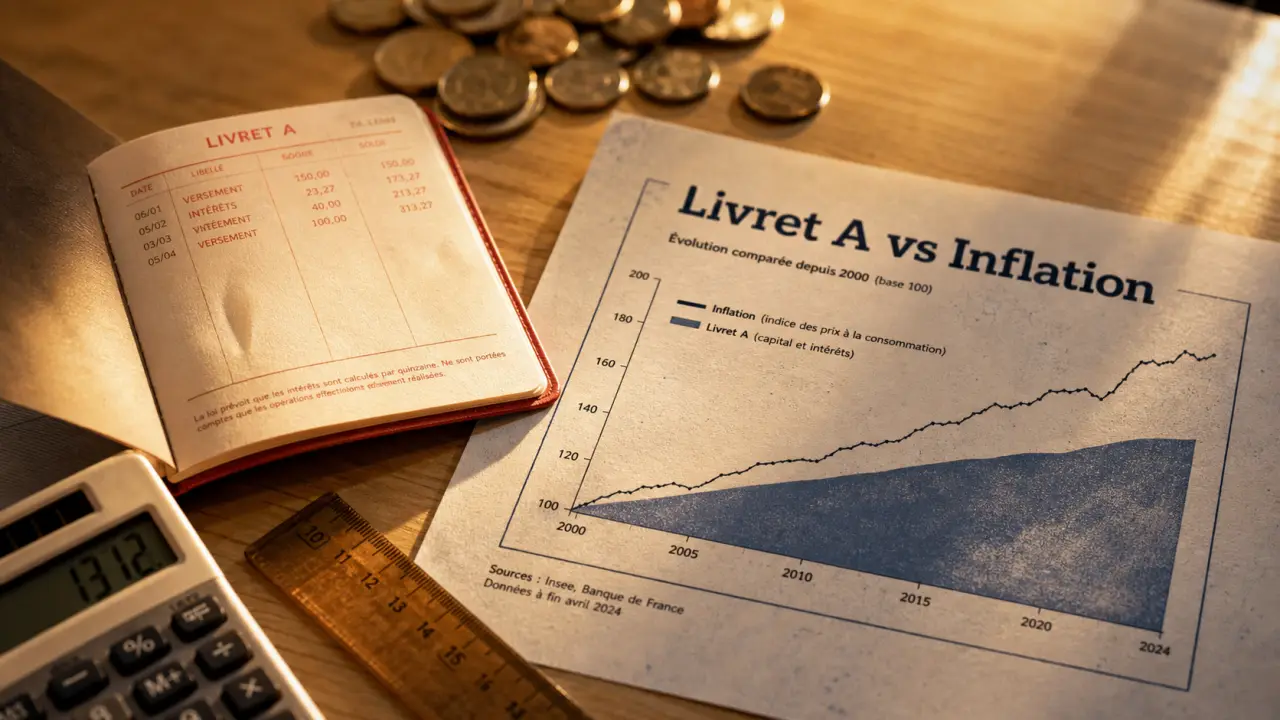

Book A protects savings against inflation only when its rate remains above the rise in prices. Otherwise, money remains available and secure, but purchasing power declines. The correct reading is therefore to compare the posted rate, net of taxes, with inflation over the same period.
With a Book A rate fixed at 1.7% on 1 August 2025 and 1.5% on 1 February 2026, the question is not whether this placement is "good" or "bad", but what it should be used for: precautionary savings, reserve available or performance tool. It's not the same use.
The real subject: the real return, not the posted rate
The rate of Book A is often presented as a simple figure. But what matters to save money is the actual return, i.e. the book rate minus inflation. If Book A earns 1.5% and prices increase by 0.8%, the real yield remains positive. If inflation rises to 4.9%, as in 2023, a less remunerative Booklet is not enough to compensate for the loss of purchasing power.
Calculator : Booklet A vs Inflation
Book A
Final capital: 0 €
Actual purchasing power: 0 €
Actual Performance: 0 %
SARA
Final capital: 0 €
Actual purchasing power: 0 €
Actual Performance: 0 %
Why a net tax rate is not always enough
Book A has a strong advantage: its interest is net of taxes and social levies. A rate of 1.5% on a Book A is therefore not directly comparable to a taxed investment of 1.5% gross. This tax advantage improves its competitiveness, especially in the face of futures accounts or bank statements subject to the single flat-rate levy.
But the absence of tax does not create a return. It only avoids losing a part of it. When inflation exceeds the rate served, saving increases in euros, but it makes it possible to buy fewer goods and services than before. It is this difference, sometimes invisible on the bank statement, which explains the feeling of loss despite interest payments.
A simple example to measure the effect of inflation
Imagine 10,000 euros placed for a year. At a rate of 1.5%, interest reaches 150 euros. While inflation is 0.8% at the same time, real gain remains positive: capital is growing faster than prices. Conversely, with an inflation rate of 4.9%, the EUR 150 interest rate does not offset the general price increase. Capital remains apparently intact, but its use value decreases.
What the recent rates of the A Book against inflation say
The relationship between inflation and Book A evolves in cycles. When prices accelerate sharply, the rate of Book A can take time to adjust. When inflation slows down, its rate also declines, but it may remain temporarily above observed inflation.
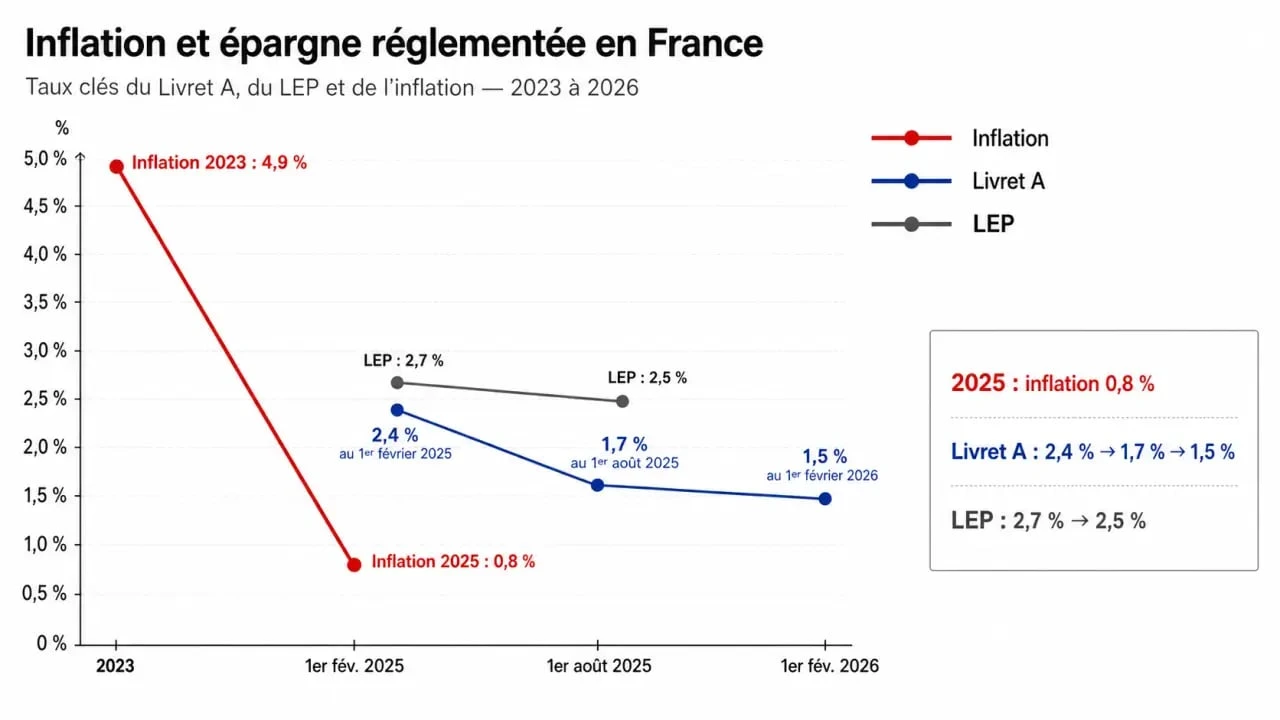
| Period or indicator | Number to be retained | Reading for savers |
|---|---|---|
| Inflation 2023 | 4,9 % | A high level that has weighed heavily on the real return on secure investments. |
| Rate of Book A on February 1, 2025 | 2,4 % | Remuneration is still high compared to more recent rates. |
| Average rate of Book A in 2025 | 2,17 % | An average annual return is higher than the rate in effect at the end of the period. |
| Inflation 2025 | 0,8 % | A net slowdown that returns a positive real return to Book A. |
| Rate of Book A on August 1, 2025 | 1,7 % | A declining rate, but still higher than indicated inflation. |
| Book A rate on 1 February 2026 | 1,5 % | Lower remuneration, to be monitored if inflation returns. |
This reading shows one important thing: Book A can become protective again when inflation slows down. Therefore, its efficiency should not be judged solely on its nominal rate, but on the difference between this rate and the rise in prices.
How the Book A rate is set
The rate of Book A is not freely decided by the banks. It is a regulated booklet, the rate of which is fixed semi-annually on the recommendation of the Banque de France and the decision of the public authorities. This mechanism explains why the rate may fall when inflation slows down, even if savers would prefer to keep higher returns.
Rate of Book A and SARA: Official Evolution as of August 1 · Discover the new rates of pay for Book A and SARA effective August 1, 2026.
A formula linked to inflation and interbank rates
The formula takes into account non-smoking inflation and interbank rates, including the level at which banks lend themselves to short-term money. The idea is to change Book A with the economic environment, on the one hand consumer prices and on the other monetary conditions.
However, this formula may be rounded or adjusted in exceptional circumstances. In other words, the final rate is not always a perfect mechanical application. It is also a balanced rate: it must pay personal savings, while remaining consistent with the financing of certain collective uses associated with regulated savings.
Why the fall in inflation often results in a fall in Book A
When inflation declines, the formula naturally pushes the rate of Book A down. This is sometimes misperceived, as savers immediately see the drop in pay. However, if prices rise much slower, the real yield can remain correct. A 1.5% rate in an inflation environment of 0.8% protects better than a higher rate in a period when prices rise very strongly.
Booklet A, SARA, LDDS: Which booklet resists inflation best?
Book A is not the only regulated savings product. In order to compare correctly, consideration must be given to performance, taxation, availability of funds and conditions of access. On this ground, the Popular Savings Book often emerges as the most protective alternative for eligible households.
| Placement | Main asset | Limit to know |
|---|---|---|
| Book A | Available, secure, net tax, very widely held with 57 million holders. | Yield sometimes lower than inflation in periods of sharp price increases. |
| SARA | Rate of 2.7 per cent on 1 August 2025 and 2.5 per cent on 1 February 2026. | Accessible under income conditions. |
| LDDS | Operation close to Book A, available funds and advantageous taxation. | Performance generally aligned with Booklet A. |
| Actions | Average yield often estimated around 4-5 % per year over long periods. | Unsecured capital and longer investment horizon required. |
SARA, the best shield for eligible savers
SARA offers a higher rate than Book A, with the same logic of security and tax exemption. At 2.7% on 1 August 2025 and 2.5% on 1 February 2026, he maintained a net advance on Book A. For an eligible home, it is generally rational to first complete SARA before strengthening Book A.
LDDS, useful but rarely more remunerative
The LDDS can complete Book A to keep a savings pocket available. On the other hand, it does not really change the situation against inflation if its rate is the same as that of Book A. Its interest is therefore more practical than strategic: to separate projects, organize a reserve or avoid letting too much money sleep on the current account.
What can we do about our savings in times of inflation?
The right answer is not to empty his Book A as soon as its rate drops. It's about giving him the right role. Book A is excellent for precautionary savings: unforeseen expenses, repair, health, transition between income, security reserve. It is less suitable to produce long-term savings.
Organize your money by horizons
A simple method is to reason by stratum. The first layer must remain immediately available: Reasonable current account and A Booklet for emergencies. The second may aim for better secure remuneration, with SARA if you are eligible. The third concerns the money you don't need for several years: life insurance, diversified supports or shares, depending on your risk profile. This layered reading avoids two common mistakes: looking for too much yield with security money, or letting a long savings simmer on a low-paying booklet.
Compare regularly, without multiplying arbitrations
It is useful to check twice a year the difference between the rate of Book A and inflation. If the actual performance remains positive, the booklet correctly plays its short-term protection role. If it becomes negative, it is necessary to look at the amounts concerned: a few months of expenditure can stay on Book A, while the surplus deserves to be oriented towards more suitable solutions.
Priority also depends on the situation of each individual. A young active person will often favour the creation of a safety mattress. A family will need a larger available pocket. A pensioner may seek a balance between liquidity, security and supplementary income. In any case, Book A remains a useful tool, but it should not be alone in the whole strategy of saving against inflation.