


The closing of the accounting year marks an intense period for business leaders and accountants. The tax base In this phase, its accuracy determines the amount of tax owed and the credibility of the company vis-à-vis the administration. Much more than a formality, it represents the official photograph of an entity's financial health over a given period.
What is the tax basket and what is it for?
The tax limit is a set of accounting and tax records that every business subject to a real tax system must produce at the end of its fiscal year. It is used as the basis for determining taxable profit, whether corporate tax (IS) or income tax (IR) for individual entrepreneurs.
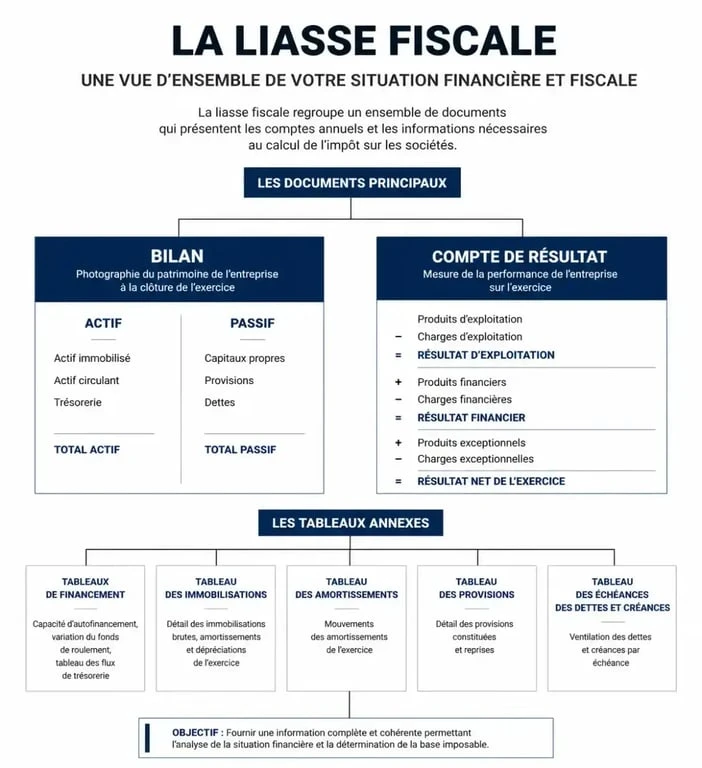
This file is a transparency tool. It allows the Directorate-General for Public Finance (DGFiP) to verify the consistency between the accounting results displayed by the company and the tax rules in force. Certain recorded income or expenses are subject to tax reprocesses, such as reinstatements or deductions, to the end result of the tax base.
A multi-recipient document
If the tax administration is the first recipient, it is not the only one to consult this file. Once filed with the Commercial Court Registry for commercial companies, the bundle becomes public. Banks analyse it when applying for financing, and trading partners, such as suppliers or credit insurers, use it to assess the solvency the company. It's the mirror of your management.
Who is required to deposit?
The obligation to produce a tax bracket depends on your tax system and your turnover. Unlike micro-entrepreneurs who benefit from simplified accounting obligations, the majority of professional structures are concerned.
The normal real speed applies to companies with turnover exceeding certain thresholds, set at approximately 840 000 € for sales activities and 247,000 € for services. The bundle is exhaustive. The simplified real regime (RSI) is intended for TPEs and SMEs located below these thresholds, allowing for a lighter set, with fewer tables attached. Finally, the non-commercial profit professions (NCBs) file a specific declaration, Form 2035, which acts as a tax bracket.
As soon as you leave the micro-enterprise framework to opt for a commitment or cash-to-real accounting, preparing this file becomes an annual requirement.
Detailed composition of the bundle: forms and tables
The structure of the tax bracket is codified by Cerfa form numbers that vary according to your tax system. Understanding the articulation of these documents is necessary to avoid forgetfulness during transmission.
The core of the file: Balance sheet and Result Account
All sets begin with the balance sheet, which shows the assets and liabilities of the undertaking at the closing date, and profit and loss account, detailing the revenue and expenses for the financial year. In the normal real system, this information is divided into several tables, from the 2050 series to 2053, while the simplified system often brings them together on form 2033.
Side tables: surgical accuracy
The level of detail increases with the accompanying tables, which justify certain items of the balance sheet and the result. It contains the table of capital assets and depreciations to track the wear and tear of assets, the table of provisions to anticipate future expenses, the statement of overhead costs for companies at the IS, and the document determining the tax result.
In a complex structure, the bundle can count up to 18 tables. Each element is a working This is essential: incorrect data in the amortization table distorts the profit and loss account, the calculation of tax, and then the final balance sheet. This interdependence requires absolute rigour, as automatic administration control software instantly detects any break in consistency between tables.
Transmission methods and timing: do not miss the check
Paper transmission has become obsolete. The tax limit must be teletransmitted to the tax administration.
EDI vs EFI: Which method to choose?
There are two ways of dematerialized deposition. Fashion EFI (Exchange of Informatized Forms) consists of a direct entry of data on the professional space of the site impots.gouv.fr, suitable for very small enterprises with little data. Fashion EDI (Informatized Data Exchange) is based on sending a file generated by your accounting software via an approved partner, a solution preferred by companies accompanied by an accountant.
Deadlines and sanctions
For undertakings closing on 31 December, the deadline for filing is the second working day following 1 May. An additional period of 15 calendar days is usually granted for teleprocedures. In case of closure during the year, the deposit must be made within three months of the closing date.
Failure to comply with these deadlines exposes the company to an increase of 10 % in the fees due, up to 40 % in the event of a notice of formal notice without reply. Even in the absence of tax payable, a flat-rate fine may be applied for failure to produce documentary material.
Tax liasse vs Accounting liasse: a subtle distinction
These two terms are often confused. The Accounting requirements, or annual accounts, is intended for the Registry of the Commercial Court to meet advertising obligations. It includes the balance sheet, profit and loss account and the accounting annex.
The tax base is more complete. It incorporates the entire accounting framework and adds the specific tables required by the tax authorities to justify the tax base, such as capital gains, tax credits or carry-forward deficits. If the purpose of the accounting framework is to give a fair picture of the assets, the tax framework guarantees the strict application of the tax law. It is the technical extension of the accounting framework, adapted to the requirements of the General Tax Code.
To secure this process, the support of an accountant is the best guarantee. This professional validates the overall coherence and ensures that the tax options chosen are the most advantageous for the sustainability your activity.