


A cryptographic crash is a sharp and significant fall in the cryptocurrency market, often amplified by forced sales. It can start from an economic shock, a confidence crisis or an imbalance between buyers and sellers. To understand what is going on, we must distinguish the trigger of the decline, the mechanisms that accelerate and the risks specific to its portfolio. A dramatic fall does not prove that everything will disappear or that a rebound is imminent.
Qualify the decrease before seeking the cause
The word « crash » describes a violent rupture, but it does not correspond to a universal threshold specific to cryptocurrency. The speed, magnitude and extent of movement count together. A small liquid token that collapses does not alone lead to a crash of the entire market.
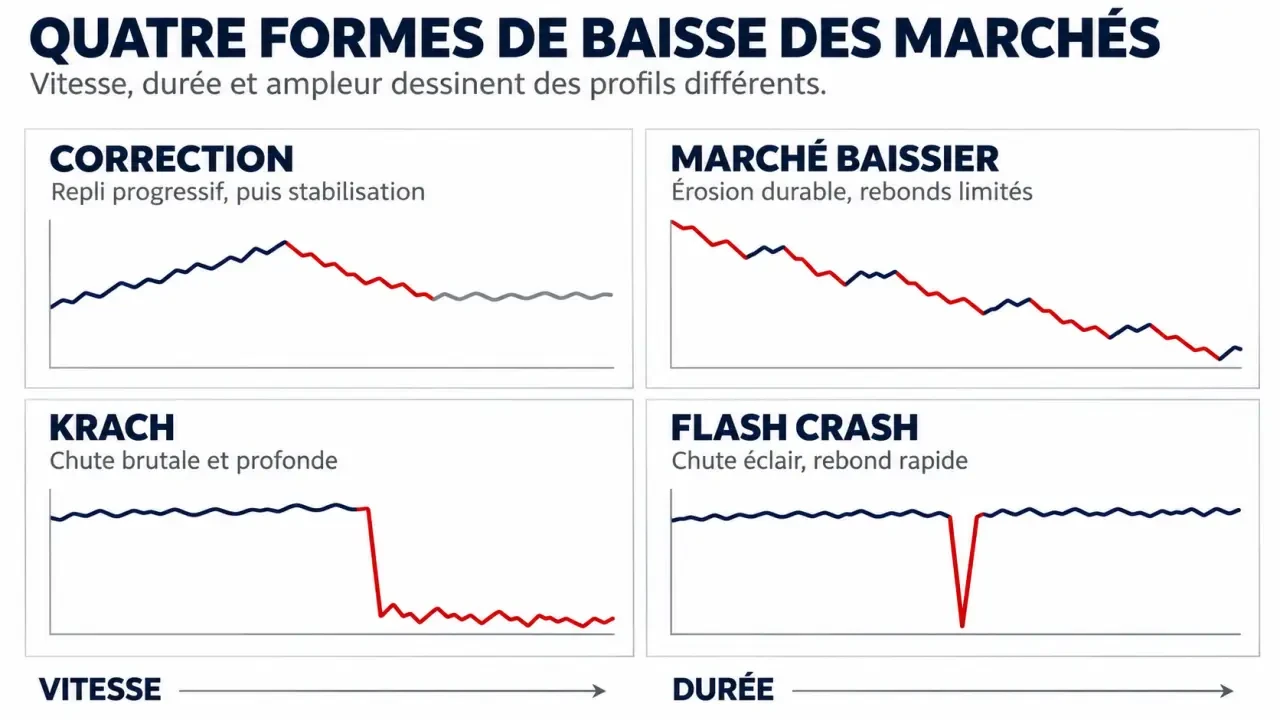
| Situation | What distinguishes her | Point of vigilance |
|---|---|---|
| Correction | Folded after an increase, more or less rapid | It can be limited or prolonged. |
| Lower market | Degraded trend that settles over time | Intermediate rebounds may mask its persistence. |
| Krach | Abrupt and deep decline, accompanied by strong tensions | Liquidity and forced sales can exacerbate the movement. |
| Flash crash | Extremely fast stall, sometimes followed by partial recovery | The price can vary greatly depending on the platforms. |
To measure the episode, always compare identical periods. A variation over a day is not equivalent to the drawdown, which measures the decline from a top. Also see if Bitcoin, Ethereum and the other cryptoactives are falling together: a generalised pressure does not tell the same story as an isolated incident.
From initial shock to liquidations: acceleration mechanics
Several factors can be combined
Higher rate expectations, energy pressures or persistent inflation can reduce appetite for risky assets. When bonds or remunerated liquidity become more attractive, some investors reduce their exposure to speculative investments. This mechanism can simultaneously affect actions and cryptocurrency.
Other triggers are specific to crypto: platform difficulties, security incidents, loss of confidence in a project or regulatory developments. Their effect depends on the liquidity available. If the order book contains few buyers, a large sale can cross several price levels, especially during some less active periods, including the weekend.
The lever turns a decline into forced sales
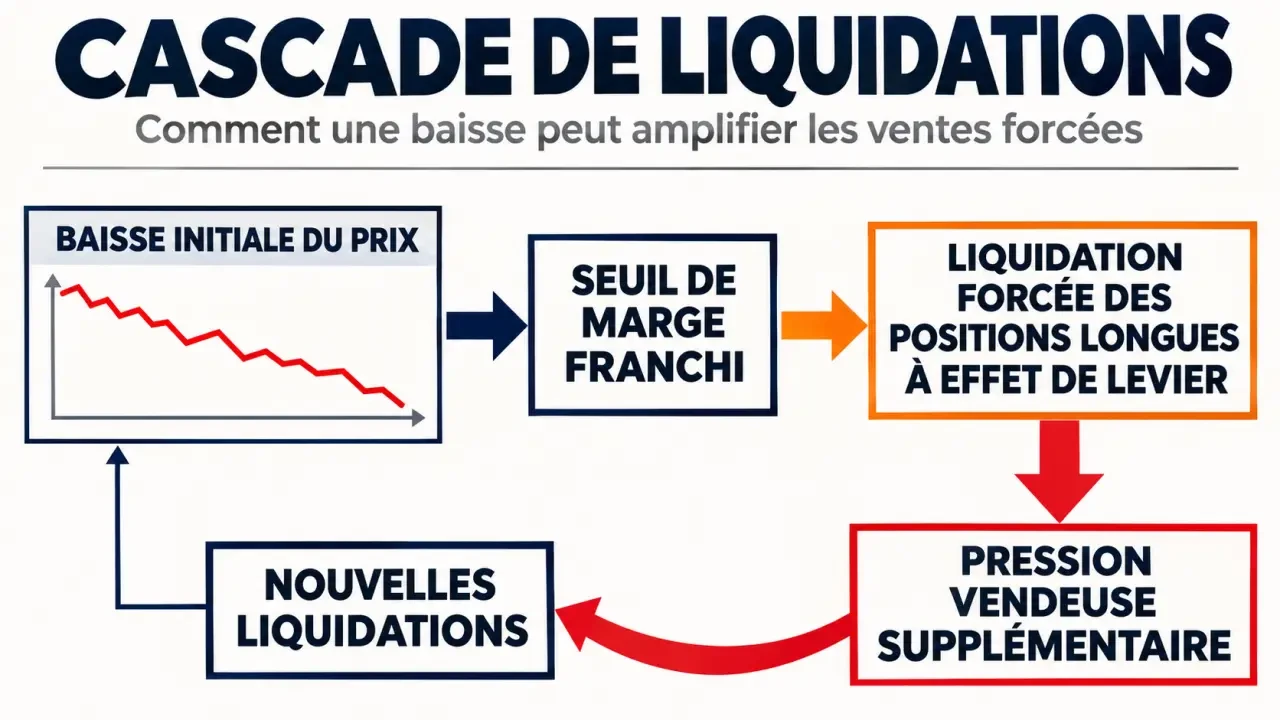
Leverage effect makes it possible to take a higher exposure than committed capital. So it amplifies potential gains, but also losses. When the guarantee lodged no longer meets the margin requirements, the platform can close the position: liquidation. It is not necessarily an investor who chooses to sell.
- The price is starting to fall.
- Leveraging long positions reach their liquidation threshold.
- Their forced closure accentuates the sales pressure.
- The new decline triggers further liquidations.
This cascade explains why the final amplitude may exceed that of the initial shock. BeInCrypto thus describes an episode where XRP recedes from 37 %with $500 million long positions liquidated in minutes. These figures illustrate a particular event, not a threshold defining all the crashes. Nor does a strong liquidation alone prove manipulation.
Read indicators without predicting rebound
A spectacular figure becomes useful only if one knows its perimeter. CoinGecko price data and Coinglass liquidation aggregations may illuminate an episode, but they do not describe exactly the same thing. The amounts liquidated relate to derivative positions: they do not represent all cash sales or an equivalent amount withdrawn from the market.
Official text adopted by the European Parliament in 2023 · Consult the official reference and full text of a European Parliament decision.
- Prices and volumes: Check the asset, platform, currency and comparison period.
- Liquidation: Distinguish long and short positions, as well as covered platforms.
- Market depth: examine the quantity of orders available near the current price.
- Bitcoin ETF flows: observe entries and outputs over several sessions rather than an isolated number.
- Economic environment: bring the movement of rates, stocks and important announcements closer together.
Technical supports are supervised areas, not guaranteed floors. Their breakage can lead to automatic orders and reinforce a decline, without explaining its origin. Similarly, a peak in liquidations indicates an intense debt reduction, but does not certify that sellers have completed. The observed fact, interpretation and prediction must be separated.
Bitcoin vs. actions and values refuges
Bitcoin does not behave systematically as a refuge. Noovo mentioned sometimes positive correlations with S&P 500 and Nasdaq-100 since 2020, referring to the CME Group. In some stress phases, investors sell several risky assets to get liquidity: Bitcoin can then decline with the shares.
This relationship varies from time to time. A positive correlation does not mean that actions cause the decline of Bitcoin, and a diverging session is not enough to demonstrate lasting independence. A coherent observation window should be examined rather than selecting a few days for a thesis.
The programmed rarity of Bitcoin also does not guarantee protection against inflation in the short term. The price also depends on demand, financial conditions and speculative positioning. Finally, holding several cryptocurrency does not ensure effective diversification: when they react to the same shock, their losses can accumulate.
In the face of the crash, decide according to its constraints rather than urgency
The first check concerns your actual exposure: cash or leveraged holding, money needed soon, portfolio concentration and platform risk. Without borrowing or margin mechanism, a fall in the price alone does not trigger automatic liquidation. However, it remains an economic loss, even before a sale.
A cash reserve can be used as a valve between the market and your daily budget. Its interest is not only to allow a future purchase: it avoids an unexpected invoice or expense requiring you to sell when the order book emptys. Separation of current needs from exposed capital thus reduces the risk of becoming a forced seller, even without leverage.
Selling reduces future exposure, but can crystallize a loss and cause a rebound to miss. Keep the possibility of recovery, without any guarantee that it will occur. Buying after a fall increases exposure to an asset that can still decrease; Splitting purchases distributes the risk of timing without removing the risk of loss.
Before making any decisions, describe your horizon, the additional loss that can be sustained and the reasons for leaving. A stablecoin is not an absence of risk either: its stability depends in particular on its mechanism and its transmitter. No previous method or performance guarantees to cross the next crash without loss. These benchmarks are part of general information, not a personalized financial advice.