
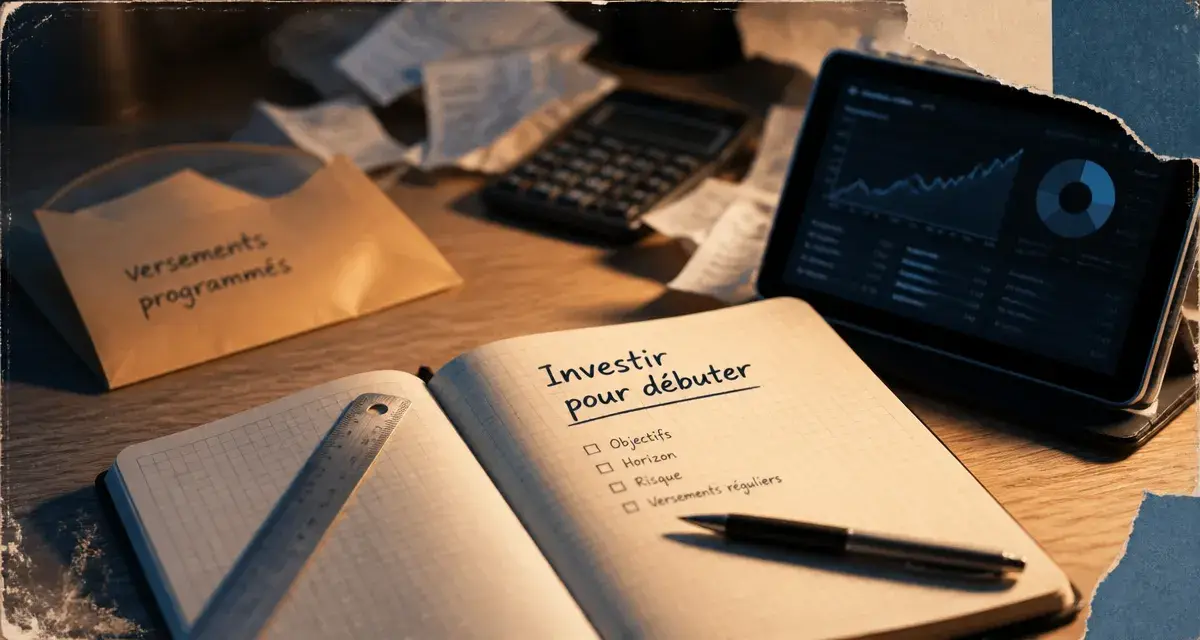

The idea of investing often seems to be reserved for a financial elite or experts in suit and tie. Yet reality is more accessible: 72% of French people today express a desire to increase their savings. Contrary to the ideas received, it is not necessary to have colossal capital to begin with. A few dozen euro are enough to open an account and take part in financial or real estate markets.
Understanding investment: much more than just saving
Before placing your first euro, it is necessary to distinguish savings, speculation and investment. Traditional savings, via a Book A, protects your capital but makes it less productive, making it vulnerable to inflation. Speculation, on the other hand, seeks rapid and risky gain over a short period, often at the expense of fundamental logic.
Investing is about putting your capital to work over the long term. This is to accept a share of volatility in return for a higher yield expectation. Since 1602, with the creation of the first stock-issuing company, this mechanism proves that patience is the main driver of wealth creation. Investment does not seek to predict the future, but to build a Financial base Resilient.
Overview of investments accessible to beginners
The choice of support depends on your time horizon and risk tolerance. Here are the most common options to start calmly:
Life Insurance is the Swiss knife of the French saver. It provides access to secure euro funds and more risky but potentially more profitable units of account. The EAP (Eparation Savings Plan) is ideal for investing in stock exchanges while benefiting from advantageous taxation after five years of holding. ETFs, or index funds, make it possible to invest in hundreds of companies in a single transaction, thus reducing the risks associated with the bankruptcy of a single company. Finally, SCPI, called paperstone, allow to invest in rental real estate without the constraints of owner management such as work or the search for tenants.
How to choose the right support?
In order not to get lost in the jungle of financial products, keep in mind this rule: the longer your horizon is, the more you can afford to invest in volatile media such as shares. If you need your money in less than three years, give priority to the safety of books or funds in euros.
Starting concretely: key steps
Start asking for the method. The first step is to define a budget that you can safely immobilize for your daily life. Once this amount has been defined, opening an account with an online bank or a specialised platform has become a dematerialised formality.
Once the account is open, do not look for the financial coup of the century. Set up Programmed payments. This strategy, called DCA (Dollar Cost Averaging), is to invest a fixed sum at regular intervals, regardless of market conditions. This smoothes your purchase price and reduces the emotional pressure associated with stock market fluctuations.
Managing your portfolio
In a complex financial system, some investors seek to adjust their strategies to suit each new economy. Instead of wanting to control everything manually, automate your transfers. This discipline acts as a valve of regulation, allowing the flow of savings to your investments without emotional intervention. This approach avoids errors related to fear or euphoria during periods of high volatility.
Frequent errors and risk management
The most common error in the beginner is the recency bias: wanting to invest massively because the market rises, or selling everything by panic as soon as it falls. The stock exchange has its cycles, and financial crises are part of its history.
To limit risks, the diversification remains your best ally. Never put all your eggs in the same basket. Divide your investments into different geographic areas, sectors of activity such as technology, health or energy, and types of assets such as shares, bonds and real estate. A diversified portfolio is statistically less exposed to shocks than a single-value portfolio.
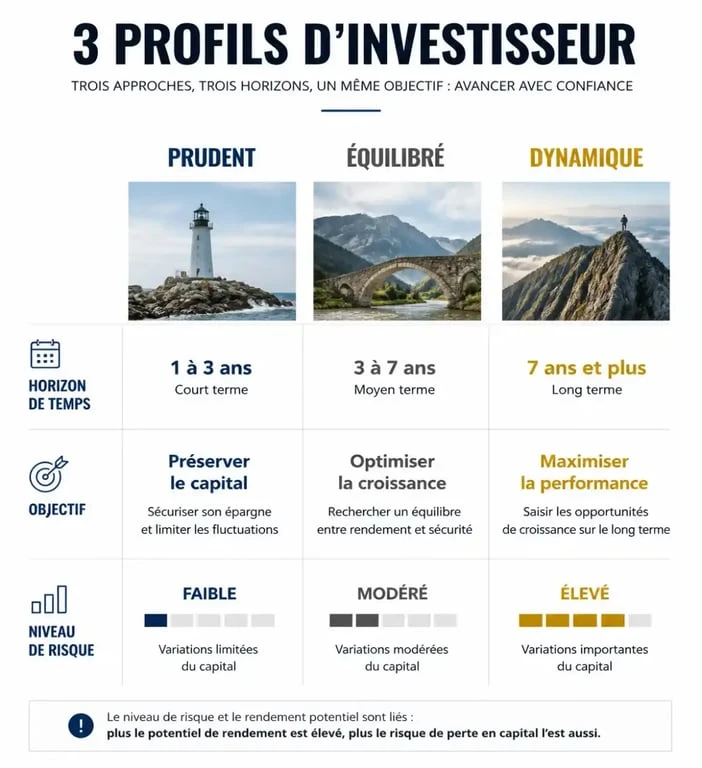
| Profile | Horizon | Objective | Risk |
|---|---|---|---|
| Prudent | Short term | Preserving capital | Low |
| Balanced | Medium term | Moderate growth | Moderate |
| Dynamics | Long term | Maximize gain | High |
Optimize your heritage over the long term
Optimization is a bottom management. Over the years, rebalance your wallet. If your shares have grown to the point of representing 90% of your savings, sell a portion of it to reinvest in more stable media, to return to the initial allocation corresponding to your risk profile.
Never forget the impact of the fees. Over 20 years, a 2% annual management fee can significantly reduce your final performance. Focus on low-cost media, such as ETFs, that replicate stock market indices without requiring costly active management. By remaining simple, regular and patient, you build a solid heritage, able to pass through the years with serenity.